FAA Finalizes Rules For Drones, UAS, And Model Aircraft

The FAA and DOT have finalized their rules for small Unmanned Aircraft Systems (UAS, or drones), and clarified rules for model aircraft. This is the end of a long process the FAA undertook last year that has included a registry system for model aircraft, and input from members of UAS and model aircraft industry including the Academy of Model Aeronautics and 3D Robotics.

Model Aircraft

Since the FAA began drafting the rules for unmanned aircraft systems, it has been necessary to point out the distinction between a UAS and a model aircraft. Thanks to the amazing advances in battery, brushless motor, and flight controller technology over the past decade, the line between a drone and a model aircraft has been fuzzed, and onboard video systems and FPV flying have only blurred the distinction.

The distinction between a UAS and model aircraft  is an important one. Thanks to the FAA Reauthorization Act of 2012, the FAA, “may not promulgate any rule or regulation regarding a model aircraft” under certain conditions. These conditions include aircraft flown strictly for hobby or recreational use, operated in accordance with a community-based set of safety guidelines (read: the safety guidelines set by the Academy of Model Aeronautics), weighs less than 55 pounds, gives way to manned aircraft, and notifies the operator of an airport when flown within five miles of a control tower.

Despite laws enacted by congress, the FAA saw it necessary to create rules and regulations for model aircraft weighing less than 55 pounds, and operated in accordance with a community-based set of safety guidelines. The FAA’s drone registration system doesn’t make sense, and there is at least one pending court case objecting to these rules.

The FAA’s final rules for UAS, drones, and model airplanes change nothing from the regulations made over the past year. If your drone weighs more than 250 grams, you must register it. For model aircraft, and unmanned aircraft systems conducting ‘hobbyist operations’, nothing has changed.

Unmanned Aerial Systems

The finalized rule introduced today concerns only unmanned aircraft systems weighing less than 55 pounds conducting non-hobbyist operations. The person flying the drone must be at least 16 years old and hold a remote pilot certificate with a small UAS rating. This remote pilot certificate may be obtained by passing an aeronautical knowledge test, or by holding a non-student Part 61 pilot certificate (the kind you would get if you’d like to fly a Cessna on the weekends)

What this means

Under the new regulations, nothing for model aircraft has changed. The guys flying foam board planes will still have to deal with a registration system of questionable legality.

For professional drone pilots – those taking aerial pictures, farmers, or pilots contracting their services out to real estate agents – the situation has vastly improved. A pilot’s license is no longer needed for these operations, and these aircraft may be operated in class G airspace without restriction. Drone use for commercial purposes is now possible without a pilot’s license. This is huge for many industries.

These rules do not cover autonomous flight. This is, by far, the greatest shortcoming of the new regulations. The most interesting applications of drones and unmanned aircraft is autonomous flight. With autonomous drones, farmers could monitor their fields. Amazon could deliver beer to your backyard. There are no regulations regarding autonomous flight from the FAA, and any business plans that hinge on pilot-less aircraft will be unrealized in the near term.

DJI Phantoms are now ‘drones’

This is a quick aside, but I must point out the FAA press release was written by someone with one of two possible attributes. Either the author of this press release paid zero attention to detail, or the FAA has a desire to call all unmanned aircraft systems ‘drones’.

The use of the word ‘drone’ in the model aircraft community has been contentious, with quadcopter enthusiasts making a plain distinction between a DJI Phantom and a Predator drone. Drones, some say, have the negative connotation of firing hellfire missiles into wedding parties and killing American citizens in foreign lands without due process, violating the 5th amendment. Others have classified ‘drones’ as having autonomous capability.

This linguistic puzzle has now been solved by the FAA. In several places in this press release, the FAA equates ‘unmanned aircraft systems’ with drones, and even invents the phrase, ‘unmanned aircraft drone’. Language is not defined by commenters on fringe tech blogs, it is defined by common parlance. Now the definition of ‘drone’ is settled: it is an unmanned, non-autonomous, remote-controlled flying machine not flown for hobby or recreational use.

[Clinton] Builds A Better Handgun

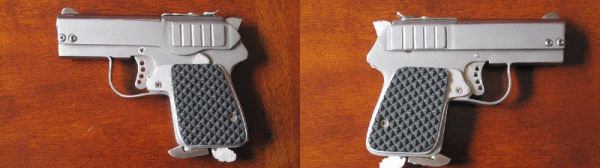
A few months ago, we caught wind of someone doing something remarkable. [Clinton Westwood] built a pistol from plans he found on the Internet. You can find plans to build anything on the web, from houses to four-stroke engines to perpetual motion machines. Most of the time these plans are incomplete and many of these devices have never been built at all. [Clinton]’s pistol was one of these never-built designs. After months of work, he’s ready to call this project done, and managed to build an awesome rig to rifle the barrel.

Before [Clinton] set out to build this gun from scratch, the only other example these plans could build a gun-shaped object were a few terrible pictures of what appears to be a gun that was thrown into a garbage disposal, then into a creek, then forgotten for several years. There is a distinct lack of workmanship in this one exemplar, but [Clinton]’s attempt at replication is far more professional.

Although this gun is designed to be built using simple tools, there is one aspect of amateur gunsmithing that requires some specialized equipment. The barrel must be rifled if you want any accuracy at all, and for this [Clinton] has come up with a very simple jig made out of a broken bicycle and some threaded rod.

If homebrew gunsmithery is your thing, but you’re looking for something with a little more punch than a .25 ACP, you can beat plowshares into an AK-47. All hail the shovel AK, defender of the motherland and digger of holes.

Network Security Theatre

Summer is nearly here, and with that comes the preparations for the largest gathering of security researchers on the planet. In early August, researchers, geeks, nerds, and other extremely cool people will descend upon the high desert of Las Vegas, Nevada to discuss the vulnerabilities of software, the exploits of hardware, and the questionable activities of government entities. This is Black Hat and DEF CON, when taken together it’s the largest security conference on the planet.

These conferences serve a very important purpose. Unlike academia, security professionals don’t make a name for themselves by publishing in journals. The pecking order of the security world is determined at these talks. The best talks, and the best media coverage command higher consultancy fees. It’s an economy, and of course there will always be people ready to game the system.

Like academia, these talks are peer-reviewed. Press releases given before the talks are not, and between the knowledge of security researchers and the tech press is network security theatre. In this network security theatre, you don’t really need an interesting exploit, technique, or device, you just need to convince the right people you have one.

Continue reading “Network Security Theatre”

Hackaday Prize Entry: A Very Small Password Keeper

One of the more popular security builds in recent memory is USB password vaults. These small thumb drive-sized devices hold all the passwords you have to deal with, and are locked behind a authentication code on the drive itself. For their Hackaday Prize entry, [Miguel] and [Noel] asked how inexpensively one of these devices could be made. The answer, coming in the form of their Memtype project, is very inexpensively.

The Memtype project is based on the cheapest and most simplistic USB implementation on the planet. It’s built around an ATtiny85 and V-USB‘s software only implementation of a USB keyboard, requiring only a few resistors and diode in addition to the ‘tiny85 itself.

The device can only be unlocked with a four-digit pin, input through the clever use of a small SMD joystick. After inputting the correct code, the Memtype grants the user access to all the stored passwords. As far as security goes, [Miguel] and [Noel] have implemented NOEKEON in assembly, however it should be noted that all security is weaker than a pipe wrench. For managing the passwords, [Miguel] and [Noel] built a small, simple GUI app to set the PIN and write credentials to the device.

[Miguel] and [Noel] already have a demo video up for the Memtype, you can check that out below.

Continue reading “Hackaday Prize Entry: A Very Small Password Keeper”

Hackaday Links: June 19, 2016

Wait a minute. We’re almost through June and we haven’t seen anyone’s ‘DIY air conditioning’ setup. Oh the shame! How could we ever argue about thermodynamics otherwise? Here’s some copper tubing wrapped around a fan. Does it make sense? Assuming you’re making the ice (or cold whatever) in a room separated from the crappy air con, and you don’t have to pay for electricity (or ice), and you don’t mind hauling buckets of ice every few hours, yes. It’ll work. Now we can argue if you should put salt in the ice water…

I know I mentioned this in last week’s links post, but [Arsenijs]’s Raspberry Pi project is growing by leaps and bounds. He already has more than 33 followers to this project (awesome!) and 3.3k views on his project page. Not only is it climbing in popularity, but this is also a great use for the Raspberry Pi. You don’t see projects like this come around very often.

The Goliath is a quadcopter powered by a lawnmower engine. It was an entry in the first Hackaday Prize, but the project literally never got off the ground. There’s now a Mk. II version in the works. Goliath is getting a new frame made out of aluminum tube and rivets. There’s going to be ducts on the props, and this version might actually fly.

You did know Hackaday has it’s own Hackaspace, right? Technically it’s the Supplyframe Design Lab, but there are still a few skull ‘n wrenches hidden in the rafters. The Design Lab is hosting an open house this week on June 23rd, and the design lab residencies will begin July 1st. If you have an idea for something you’d like to build, here’s the residency application.

The LimeSDR is a powerful next generation software defined radio that’s currently on CrowdSupply The crowdfunding campaign ends in just a few days. It’s a very impressive tool, able to send and receive anything from 100 kHz to 3.8 GHz.

Last week one of our writers posted a review on the Monoprice MP Select Mini 3D printer. This printer is becoming stupidly popular, and Monoprice has depleted their inventory twice since then. I’ve been watching the product page for this printer for a while now, and here’s what happens: 1) Printer is out of stock, with an ETA of about a month in the future. 2) Printer is still out of stock, ETA is a few days away. 3) Monoprice has this printer in stock. This cycle seems to repeat every week or so.

Arduino Raycasting. When you think of raycasting, you probably think about Wolfenstein 3D, or other barely 3D games. You don’t need a powerful CPU like a 386 for raycasting – you can do it on an Arduino. The display is a 32×16 matrix of LEDs, control is through a Wii Nunchuck, and yes, head-bobbing is implemented. Here’s a video.

Recreating Chiptunes In Verilog

The semester is wrapping up at Cornell, and that means it’s time for the final projects from [Bruce Land]’s lab. Every year we see some very cool projects, and this year is no exception. For their project, [Andre] and [Scott] implemented the audio processing unit (APU) of the Nintendo Entertainment System (NES). This is the classic chiptune sound that regaled a generation with 8-bit sounds that aren’t really eight bits, with the help of a 6502 CPU that isn’t really a 6502 CPU.

Unlike the contemporaneous MOS 6581 SID, which is basically an analog synthesizer on a chip, the APU in the NES is extraordinarily spartan. There are two pulse wave channels, a triangle wave channel, a random noise channel, and the very rarely used delta modulation channel (DMC) used to play very low quality audio samples. This is a re-implementation of the NES APU for a university lab; it is very understandable that [Andre] and [Scott] didn’t implement the rarely used DMC.

Everything about the circuitry of the NES is well documented, so [Andre] and [Scott] had a great wiki for their research. At the highest level, the APU runs on a 894kHz clock and controls three channels through dedicated registers. These outputs are fed through a mixer, which the guys scaled and combined into a 16-bit output played through a Wolfson WM8731 audio codec.

After implementing the NES APU, [Andre] and [Scott] added an SD card reader that can read the Nintendo Sound Format – the standard distribution format for NES chiptunes – and emulated a 6502 to control the registers. The result is a relatively simple device that plays NES chiptunes with amazing accuracy. The sound files on the project report sound like the real thing, but this is entirely emulated on modern hardware.

Hackaday Prize Entry: Microscopy With Blu-ray

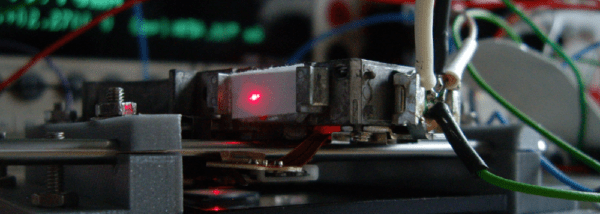
Confocal microscopy is an imaging technique that provides higher resolution micrographs than that of traditional optical microscopy. Confocal microscopes attain this higher resolution from an image sensor behind a pinhole. By eliminating out of focus light, and by scanning the specimen back and forth under the microscope, a very high resolution image may be produced. This technique has applications ranging from life sciences to semiconductor work. For this year’s Hackaday Prize, [andreas.betz] is building a confocal microscope using little more than a Blu-ray drive read head.

[andreas]’ build uses a standard Playstation 3 Blu-ray drive mechanism. The read head for this mechanism is well documented, but [andreas] still has to drive the laser and the voice coils for this machine to do anything. With the Blu-ray drive working, only the optics remained.

Just this last week, [andreas] imaged the die of a transistor with a resolution of about 680nm. An inductor was also imaged, showing a track separation of about 10um. This is approaching the limits of optical microscopy, and the apparatus is simple enough for anyone to replicate.

As a feat of technical ingenuity, this is a great project. It’s one of the best we’ve seen for the Citizen Science portion of the Hackaday Prize, and can’t wait to see what other images [andreas] can make with this machine.

The HackadayPrize2016 is Sponsored by: