Hackaday Links Column Banner

Hackaday Links: February 8, 2015

[CNLohr] is famous for his extremely strange projects, including something that does something with Minecraft that even he can’t describe. Over the years, he’s built up a vast collection of projects that have been both incredible fails and successes. Here’s a video tour of all those projects.

For this week’s edition “Kickstarter is going insane”, you only need to look at the title of the campaign: Tesla Coils for North Korea.

Last week, a few slow scan TV signals were received from the International Space Station. Here’s the reddit thread.

The worst thing about using an Arduino in a semi-professional environment is the IDE. Here’s cuwire, a better IDE.

Wanna see something insane? How about an SSH library written in x64 assembly?

Radio Shack is in its death throes, and since you haven’t gone in the last few years, you might as well head out one last time and pick up some items on clearance. Here’s the list of store closings (PDF) and all 1,784 stores slated to be closed plotted on Google Maps.

Photonic Reset Of The Raspberry Pi 2

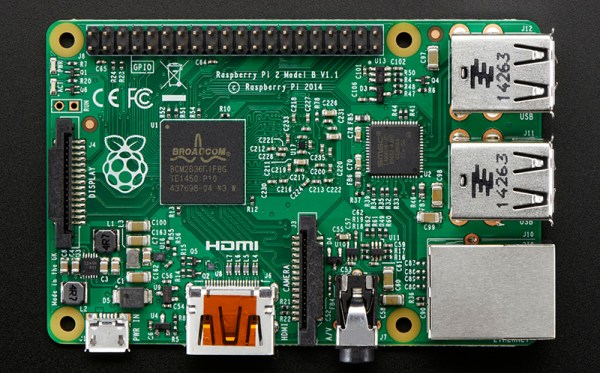
For the past month, the Raspberry Pi 2 has only been available to the Raspi Foundation, and for about 2 weeks, select members of the media who have worn the Raspi 2 on a necklace like [Flavor Flav] wears a clock. That’s not many people with real, working hardware and when a product is released, the great unwashed masses will find some really, really weird bugs. The first one to crop up is a light-sensitive reset of the Raspberry Pi 2.

[PeterO] on the Raspberry Pi forums took a few pictures – with flash – of a running Raspberry Pi 2. It took a little bit of deduction to realize that a camera flash will either reset or turn the Raspi 2 off. Yes, this is weird, and experiments are ongoing.

A short video from [Mike Redrobe] confirms the finding and a reddit thread offers an explanation. U16, a small chip located in the power supply part of the Raspi 2, is sensitive to light. Putting enough photons will cause the Pi to shut down or restart.

There’s still some research to be done, however, I can confirm a cheap green laser pointer will reset a Raspberry Pi 2 when the beam is directed at the U16 chip. This is the chip that is responsible, and this is not an EMP issue. This is a photon/light issue with the U16 chip. The solution to this bug is to either keep it in a case, or put a tiny amount of electrical tape over the chip.

Thanks [Arko] for staying up until an ungodly hour and sending this to me.

Unbricking A Counterfeit FTDI Chip

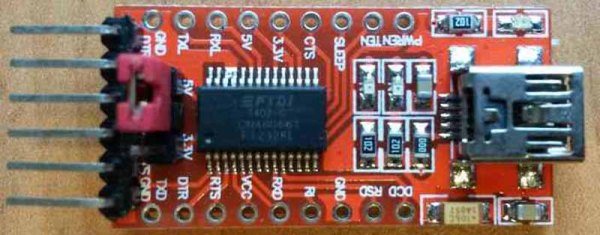
If you haven’t been paying attention, FTDI, makers of one of the most popular USB to UART chips out there, really screwed up last October. They released a driver to Microsoft that would brick unauthorized clones of their chip by setting the USB PID pair to zero. This renders the chip unusable by any computer. That Windows driver has been fixed by now, but there’s probably still a good number of bricked FTDI chips out there. [Tony G] figured out how to fix it, and it only requires a few lines in the console of a proper OS.

The bricking Windows driver worked by setting the USB PID on fake chips to 0000. Luckily, there are ways to reprogram these chips. [Mark Lord] released a set of tools that will reset the USB PID. This unbricks the chip, fixing whatever device it’s attached to. It’s also a great reminder to either update or roll back your Windows drivers.

Teardown: The Android-powered IPhone Case

Cellphones! Cellphone cases! Now that Radio Shack is kaput we need to pick up the slack!

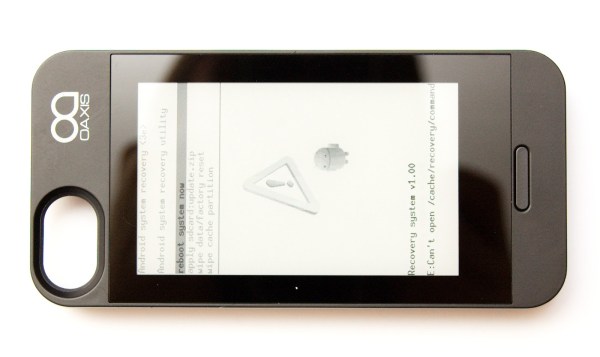
A company named Oaxis has been making cell phone cases for a while now, and they’ve recently rolled out something rather interesting – a cell phone case with an e-ink screen. It’s an interesting idea and [Anton] did a teardown on two new releases. The first one just sends an image to an e-ink screen, and on paper, that’s all the second one does as well. There’s something special hidden under the hood, though: a low-end Android system. What an age to live in.

Something interesting happened when [Anton] was futzing with the battery for the e-ink iPhone case. Somehow, the device booted into recovery mode. Android recovery mode. Yes, iPhone cases now run Android.

Inside the e-ink iPhone case, [Anton] found a board with a Rockchip RK2818 SoC. This is the same chip that can be found in cheap Android cell phones. There’s only one button on the cell phone case, and connectivity is only provided by Bluetooth LE, but the possibilities for modding a cell phone case are extremely interesting.

A Raspberry Pi SID Player

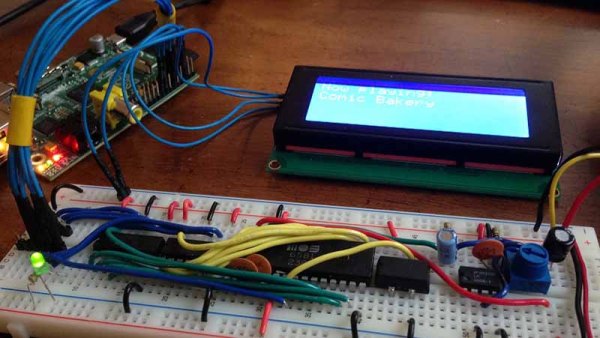
Of all the vintage chiptune machines out there, the Commodore 64 is the most famous. Even 30 years later, there are still massive gatherings dedicated to eeking out the last cycle of processing power and graphics capability from the CPU and the infamous synth-on-a-chip, the SID. [Bob] wanted to build a SID jukebox. A C64 is capable of the job, but if you want to have every SID composition on an SD card and connect that to a network, a Raspberry Pi is the way to go.

The SID chip, in its 6581 or 8580 versions, is controlled directly by poking registers on the chip through the address and data busses. This means a lot of pins, too many for the original Raspi expansion header. That’s not a problem that can’t be solved with a few shift registers, though. The rest of the circuit is an LM386 audio amplifier, an LCD that displays the current song, and a can crystal oscillator for the SID.

Right now everything is wired up on a breadboard, but making this a Raspberry Pi hat would be a rather simple proposition. It’s only a matter of finding a SID with working filters, and if you can manage that, it’s a pretty easy build to replicate. Video below.

Continue reading “A Raspberry Pi SID Player”

Benchmarking The Raspberry Pi 2

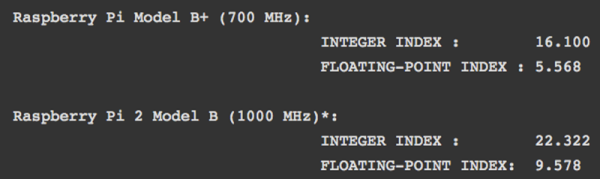
The Raspberry Pi has only been available for a few days, but already those boards are heading through the post office and onto workbenches around the world. From the initial impressions, we already know this quad-core ARMv7 system boots in about half the time, but other than that, there aren’t many real benchmarks that compare the new Raspberry Pi 2 to the older Raspi 1 or other similar tiny Linux dev boards. This is the post that fixes that.

A word of warning, though: these are benchmarks, and benchmarks aren’t real-world use cases. However, we can glean a little bit of information about the true performance of the Raspberry Pi 2 with a few simple tools.

For these tests, I’ve used Roy Longbottom’s Raspberry Pi benchmarking tools, nbench, and a few custom tools to determine how fast both hardware versions of the Raspberry are in real-world use cases.

Continue reading “Benchmarking The Raspberry Pi 2”

I’ve Come To Bury Radio Shack, Not Praise It.

This is a post that has been a long time coming. Today, Radio Shack, the store that has been everything from an excellent introduction to electronics and computers to a store that sells cell phones, cell phone accessories, and cell phone plans has declared bankruptcy.

To anyone, this should not be news. For the last decade, the public perception of Radio Shack was one of a shell of its former self. In 2007, The Onion famously published Even CEO Can’t Figure Out How RadioShack Still In Business, an article that like most of The Onion’s work, is a sand dune of grains of truth.

In recent years, Radio Shack has made attempts to appeal to the demographic that holds the ‘shack in such high regard. Just four short years ago, Radio Shack made an appeal to this community and asked for suggestions for what people would actually buy at Radio Shack. The answers ranged from Arduinos and larger component selections to Parallax Propellers. Even with this renewed focus on DIY, repair, electronic tinkering, and even in-house cellphone repair shops in some select locations, this was not enough.

This was a make or break year for Radio Shack. Last fall, Standard General, a hedge fund with an amazing name, attempted to refinance Radio Shack’s debt with specific revenue benchmarks set for the holiday season. These benchmarks were not met, and now Radio Shack has filed for bankruptcy protection after reaching a deal to sell nearly 2,500 stores. Radio Shack now has about 5,000 stores in the U.S.. Half of them will close, and as many as 1,700 will be operated by Sprint. The future of Radio Shack was a cell phone store, it seems.

Right now, there are rumors of Radio Shack employees ‘released from service’, with mass closings of stores very, very soon.

There has always been a love-hate relationship with Radio Shack with the DIY and tinkerer community. It was everything from many programmer’s first introduction to computers, the only place in town you could buy [Forrest Mims]’ excellent books, to a horrible place to work, and an odd store where you need a phone number to buy batteries.

This is not a eulogy; Radio Shack isn’t quite dead just yet, and eulogies are reserved for the loved ones in our lives. Radio Shack is neither. We all have a rich history with Radio Shack, and next time you’re buying some resistors on Mouser or Digikey, just remember we’re living in a different world now.