VCF East: Old Computers, New Games

While the vintage computer festival in Wall, NJ had just about every vintage app you could imagine – multiple varities of *NIXes, pre-Zork Dungeon, BASIC interpreters of all capabilities, and just about every game ever released for 8-bit Commodore systems – there was, perhaps unsurprisingly, a distinct lack of modern programs written for these retro systems. Yes, despite there being people still curled up to keyboards and writing games for vintage systems, modern software was a strange oddity last weekend.

There were two wonderful exceptions, however. The first was Fahrfall, a game for the TRS-80 Color Computer. We’ve seen Fahrfall before when [John Linville] wrote it for the 2012 RetroChallenge Winter Warmup. The game itself is a re-imagining of Downfall for the Atari Jaguar, with the graphics scaled down immensely. The basic idea of the game is to jump down, ledge to ledge, on a vertically scrolling screen. Hit the walls or the bottom, and you’re dead. It’s a great game that probably would have sold well had it been a contemporary release.

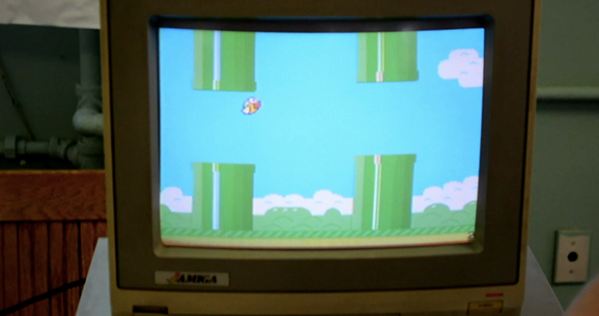
Next up is a rather impressive port of Flappy Bird for the TI-99. The video does not do this game justice, although part of that might just be the awesome Amiga monitor used for the display. This game was brought in by [Jeff Salzman] of Vintage Volts who isn’t the author of the game. Honestly, the video doesn’t do the graphics any justice. It really is a great looking port that’s just as addictive as the Android/iDevice original.
Continue reading “VCF East: Old Computers, New Games”

The Raspberry Pi Compute Module

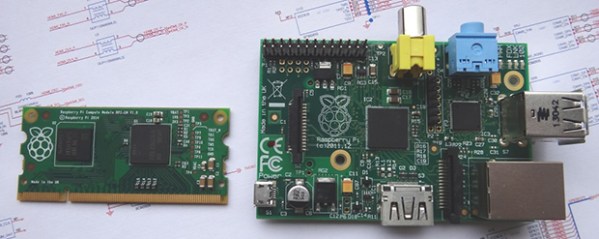
Raspberry Pi cluster computers are old hat by now, and much to our dismay, we’ve even seen Raspberry Pis crop up as the brains of a few ill-conceived Kickstarter projects. The Pi was never meant for these applications, with the very strange port layout and a bunch of headers most people don’t need. The Raspberry Pi foundation has a solution for the odd layout of the normal, consumer Pi:  The Raspberry Pi compute module, a Raspi and 4GB flash drive, sans connectors, on an industry standard DDR2 SODIMM module.

This isn’t something you can plug into your laptop (yet; that’s just a BIOS hack away, right?), but the new format does allow for some very interesting projects. All the normal Raspi I/O – CSI and DSI ports, USB, HDMI, JTAG – and a whole bunch more GPIO ports – are broken out onto an I/O board for development. The idea is that anyone can develop a product for the Raspberry Pi, create a custom board with a SODIMM connector, and use the compute module as the brains of their project.

The compute module should cost about $30/piece in quantity 100, available in June. No word yet on how much the I/O board will cost, but we expect a few open source expansion boards to crop up shortly so anyone can create a very cool cluster computer based on the compute module.


VCF East: [Vince Briel] Of Briel Computers

Replica1

Judging from the consignment area of the Vintage Computer Festival this weekend, there is still a booming market for vintage computers and other ephemera from the dawn of the era of the home computer. Even more interesting are reimaginings of vintage computers using modern parts, as shown by [Vince Briel] and his amazing retrocomputer kits.

[Vince] was at VCF East this weekend showing off a few of his wares. By far the most impressive (read: the most blinkey lights) is his Altair 8800 kit that emulates the genesis of the microcomputer revolution, the Altair. There’s no vintage hardware inside, everything is emulated on an ATmega microcontroller. Still, it’s accurate enough for the discerning retrocomputer aficionado, and has VGA output, a keyboard port, and an SD card slot.

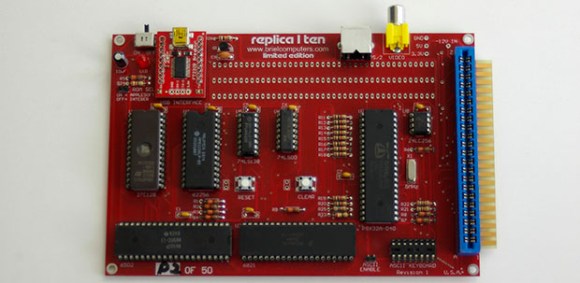
The Replica I is an extremely cut down version of the original Apple, using the original 6502 CPU and 6821 PIA. Everything else on the board is decidedly modern, with a serial to USB controller for input and a Parallax Propeller doing the video. Even with these modern chips, an expansion slot is still there, allowing a serial card or compact flash drive to be connected to the computer.

Video below, with [Vince] showing off all his wares, including his very cool Kim-1 replica.

Continue reading “VCF East: [Vince Briel] Of Briel Computers”

VCF East: PetPix, Streaming Images To A Commodore PET

PETaday

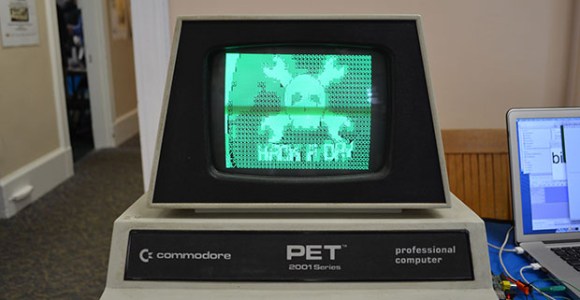
Thought the Vintage Computer Festival would just be really old computers with hundreds of people pecking 10 PRINT “HELLO” 20 GOTO 10? Yeah, there’s plenty of that, but also some very cool applications of new hardware. [Michael Hill] created PetPix, a video player for the Commodore PET and of course the C64.

PetPix takes any video file – or streaming video off a camera – and converts 8×8 pixel sections of each frame to PETSCII. All the processing is done on a Raspberry Pi and then sent over to the PET for surprisingly fluid video.

There is, of course, a video of PetPix available below. There are also a few more videos from [Michael] going over how PetPix works.

Continue reading “VCF East: PetPix, Streaming Images To A Commodore PET”

VCF East: The Swyft Card

Ninety five percent of the population will say Apple computers is the brainchild of [Steve Jobs]. The other five percent will be right, but what nearly no one knows is that the Macintosh project was originally conceived by [Jef Raskin]. He holds the honor of turning the Mac into an, ‘information appliance’ and being one of the first people to seriously consider how millions of people would interact with computers.

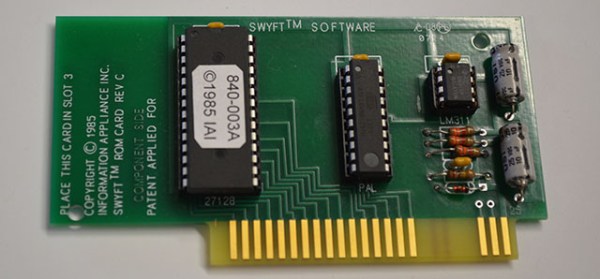
The Mac wasn’t [Jef]’s first project at Apple, though. Before the Mac project he was working on something called Swyft – an easy to use command line system that was first implemented as a firmware card for the Apple IIe. [Mike Willegal] was kind enough to bring one of these Swyft cards to the Vintage Computer Fest this weekend, and did a demo of it for us.

The basic idea behind the Swyft card was to have an integrated word processor, calculator, and access to Applesoft Basic. Holding down a ‘leap’ key – in the case of the Apple IIe add-on, the open apple key – allowed the user to search for text and perform operations on any result. It’s odd, but it just makes sense in some strange way.

[Mike] is doing a build class at the VCF today where anyone attending can build their own Swyft card. He also has instructions for building your own, should you want to experiment with one of the ‘could have beens’ of user interface design.

Continue reading “VCF East: The Swyft Card”

We’re At The Vintage Computer Festival This Weekend!

VCF

This weekend takes some of the Hackaday crew to the Vintage Computer Festival East in Wall, New Jersey. There’s going to be lots of cool stuff, some dork walking around handing out Hackaday t-shirts and stickers, and more awesome retro computation devices than you can shake several sticks of RAM at.

On the agenda for Friday are a host of talks that include bootstrapping CP/M, assembly programming, disk imaging, and a talk from our very own [Bil Herd] on how to not kill yourself with a CRT monitor.

Saturday is when things really heat up with exhibits including a PDP-8, a 1960s UNIVAC, Chromeco Dazzlers, VAXxen, and a whole slew of computers that weigh less than several hundred pounds. There’s even a real Apple I. Seriously. There are also workshops that include some really obscure work from the late, great [Jef Raskin], and more talks, including [Dave Haynie]’s recollections of Commodore’s circling the drain.

The VCF is hosted at InfoAge, an exceptionally cool vintage technology treasure trove that’s more than worth the visit, even if there weren’t a vintage computer festival going on this weekend. We caught up with the InfoAge guys a while back, and needless to say, if you come, you’ll have fun.

If you see somebody walking around with a Hackaday t-shirt on, be sure to tell them you’re a fan. If they don’t know what you’re talking about, ask them who they got the shirt from. Regular updates to follow, including a video of someone loading the Hackaday Retro site with an Intel 4004 microprocessor. I didn’t think that was possible either.

Oh, watch our Twitter or something. That’s a thing now.

Fixing Misaligned PVC With Kerf Bends

misalignment-coupler

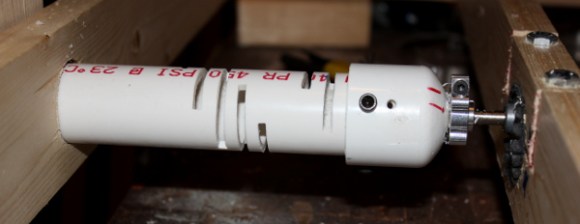
Our old pal [Jeremy Cook] is doing his own remix of [Theo Jansen]’s Strandbeest, and like the original, he’s using PVC pipe. Unlike the originals, he’s powering it with motors, not wind, and this has caused a few problems in transmitting mechanical power through a piece of PVC. Nothing is perfect, and in a few points in the legs movement the shaft shakes violently. One motor was lost and another nearly so before [Jeremy] came up with a flex coupler made from PVC.

The technique [Jeremy] is using has seen a lot of use with people building laser cut enclosures. It’s called kerf bending, and it works simply by cutting a few slits in a panel that allow it to bend slightly. This technique was replicated by [Jeremy] on a miter saw, cutting eight slots halfway through a one inch PVC pipe, with each successive cut offset 90 degrees.

The new design works well for transmitting power, and he’s not ruining motors any more. Check out the video below.

Continue reading “Fixing Misaligned PVC With Kerf Bends”