Companion Cube Christmas Lights Improved With Neopixels

cubes

[Crenn] obtained a string of official companion cube lights from Valve, but being in Australia couldn’t put them to their non-judgemental glory without the use of a step down transformer. They sat on the workbench for a few months until an idea was hatched: replace the bulbs with an Adafruit Neopixel strip, making these wonderful inanimate friends a string of individually addressable RGB LEDs.

The process of converting these cubes required stuffing a very small 9.4mm PCB inside. This PCB was designed in KiCAD thanks to a few classes at the Melbourne hackerspace. The board files were sent off, PCBs received, soldered up, and stuffed into the cubes.

Control is via a Duemilanove with a single IO pin using the Neopixel library. All the code, board files, and schematics are available on the gits. Future improvements might include a 3D printed cable relief and a way to securely mount the PCBs to the inside of the cubes.

Video available below.

Continue reading “Companion Cube Christmas Lights Improved With Neopixels”
OpenKnit, The Open Source Knitting Machine

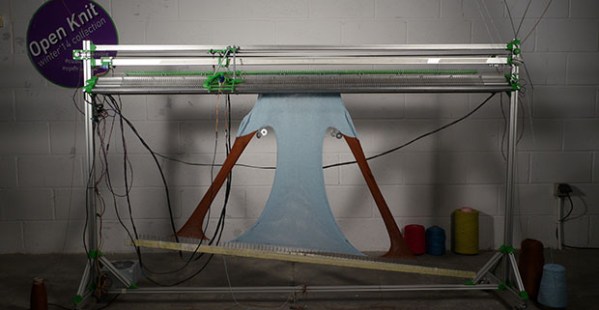
For all the hubbub about 3D printers leading a way into a new era of manufacturing, a third industrial revolution, and the beginnings of Star Trek replicators, we really haven’t seen many open source advances in the production of textiles and clothing. You know, the stuff that started the industrial revolution. [Gerard Rubio] is bucking that trend with OpenKnit, an open-source knitting machine that’s able to knit anything from a hat to a sweater using open source hardware and software.

We’ve seen a few builds involving knitting machines, but with few exceptions they’re modifications of extremely vintage Brother machines hacked for automation. OpenKnit is built from the ground up from aluminum extrusion, 3D printed parts, a single servo and stepper motor, and a ton of knitting needles.

The software is based on Knitic, an Arduino-based brain for the old Brother machines. This, combined with an automatic shuttle, allows OpenKnit to knit the sweater seen in the pic above in about an hour.

Since OpenKnit is inspired by the RepRap project, all the files, software, and assembly instructions will be up on Github shortly. there’s also a video available below, and a Flickr gallery right here.

Continue reading “OpenKnit, The Open Source Knitting Machine”

FT232RL: Real Or Fake?

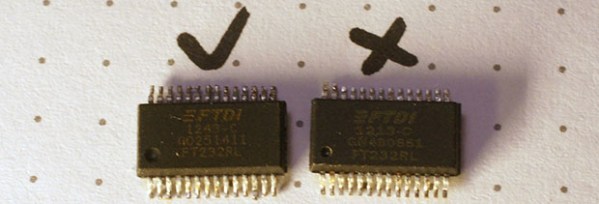
Above are two FTDI FT232RL chips, an extremely common chip used to add a USB serial port to projects, builds, and products. The one on the left is a genuine part, while the chip on the right was purchased from a shady supplier and won’t work with the current FTDI drivers. Can you tell the difference?

[Zeptobars], the folks behind those great die shots of various ICs took a look at both versions of the FT232 and the differences are staggering. Compared to the real chip, the fake chip has two types of SRAM etched in the silicon – evidence this chip was pieced together from different layouts.

The conclusion [Zeptobars] reached indicated the fake chip is really just a microcontroller made protocol compatable with the addition of a mask ROM. If you’re wondering if the FTDI chips in your part drawers are genuine, the real chips have laser engraved markings, while the clone markings are usually printed.

A Digital Condom A Reality Thanks To Arduino

[Bill Gates]’ foundation is currently offering up a ton of prizes for anyone who can improve the condom. It’s a laudable goal, and somewhat difficult; one of the main reasons why male condoms aren’t used as often as they should is the,  “male perspective… that condoms decrease pleasure as compared to no condom.”

While most of the work inspired by the [Gates] foundation is work investigating a change in the geometry of the condom, [Firaz Peer] and [Andrew Quitmeyer] of Georgia Tech managed to solve this problem with an Arduino.

The basic idea of the Electric Eel – yes, that’s the name – is to deliver short electric impulses, “along the underside of the shaft for increased stimulation”. These impulses are delivered in response to different sensor inputs – in the video example (surprisingly safe for work) they’re using a force resistor wrapped around the chest for an electrical stimulation with every breath.

Although this is only a prototype, the hope is the conductors in the condom can eventually be implanted along the inside surface of a condom during manufacturing.

Video after the break.

Continue reading “A Digital Condom A Reality Thanks To Arduino”

Audio Networking With GNU Radio

fsk

Thought GNU Radio was just for radio? Think again. [Chris] has been hard at work turning the signal generation and analysis of the best tool for software defined radio into a networking device for speakers and a microphone.

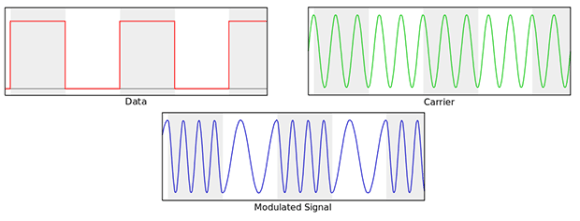
The setup uses GNU Radio to generate a carrier signal whose frequency is modulated with a data stream. With this modulated signal piped over a laptop’s speakers, [Chris] is able to send UDP packets across his desk using nothing but sound.

[Chris] had recently used a similar technique to transmit data via audio with GNU Radio, but this latest build is a vast improvement; this is now a duplex networking, meaning two computers can transmit and receive at the same time.

In the end, [Chris] created a strange, obsolete device called a “modem”. It’s not exactly fast; sending ‘Hello World’ takes quite a bit of time, as you can see in the video below.

Continue reading “Audio Networking With GNU Radio”

Retrotechtacular: Restoring A 19th Century Automaton

eyes

Made sometime in the 1790s or 1800s London, the Maillardet Automaton has a long and storied history. It was exhibited around England for several decades, brought over the Atlantic by [P.T. Barnum], nearly destroyed in a fire, and donated to the Franklin Institute in Philadelphia in the 1920s. From there, this amazingly complex amalgam of cogs, cams, and linkages eventually became the inspiration for the book – and movie – Hugo. Time hasn’t exactly been kind to this marvel of the clockmaker’s art; it has been repaired four times before receiving a complete overhaul in 2007 by [Andrew Baron].

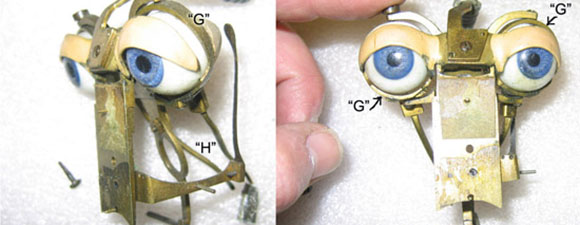
[Fran], one of Hackaday’s sources for awesome projects, recently visited the Franklin Institute and posted a series of videos on the reverse engineering of the Maillardet Automaton. Being nearly destroyed and repaired so many times didn’t make this an easy job; it’s extremely possible no one alive has ever seen the eyes of the Automaton move as originally designed.

Even though the Maillardet Automaton has one of the largest series of cams of any mechanical draftsman, that doesn’t mean it’s simply an enlargement of an earlier machine. The automaton’s pen is like no other writing device on Earth, with a stylus acting as a valve to dispense ink whenever the tip touches paper. The eyes have linkages to follow the pen as it traces a drawing. In 1800, this automaton would have been a singularity in the uncanny valley, and watching it put pen to paper is still a little creepy today.

Below you’ll find a video from [Fran] demonstrating all seven drawings the Maillardet Automaton can reproduce. You can also find a whole bunch of pics of the mechanisms along with the 2007 repair report on [Andrew Baron]’s site.

Retrotechtacular is a weekly column featuring hacks, technology, and kitsch from ages of yore. Help keep it fresh by sending in your ideas for future installments.

Continue reading “Retrotechtacular: Restoring A 19th Century Automaton”

STM32 Nucleo, The Mbed-Enabled, Arduino-Compatable Board

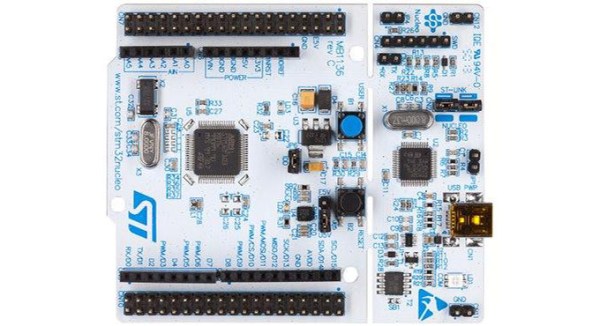
The STM32 line of microcontrollers – usually seen in the form of an ST Discovery dev board – are amazingly powerful and very popular micros seen in projects with some very hefty processing and memory requirements. Now, ST has released a great way to try out the STM32 line with the Nucleo board.

There are two really great features about these new Nucleo boards. First, they’re mbed compatable, making them a great way to get started in the ARM development world. Secondly, they have Arduino pin headers right on the board, giving you access to all your shields right out of the box.

Right now, there are four varieties of the Nucleo board based on the STM32F030, -F103, -F152, and -F401 microcontrollers. The STM32F401 is the high-powered variant, An ARM Cortex-M4 microcontroller running at 84 MHz, 512kB of Flash, and enough I/O for just about any project.

If you’d like to get your hands on one of the STM32 Nucleo boards, you can order a voucher to pick one up at Embedded World in Germany next week. Otherwise, you’re stuck ordering from Mouser or Farnell. Bonus: the high-end F401-based board is only $10 USD.