Custom Boards At Home Without Etching

PCB

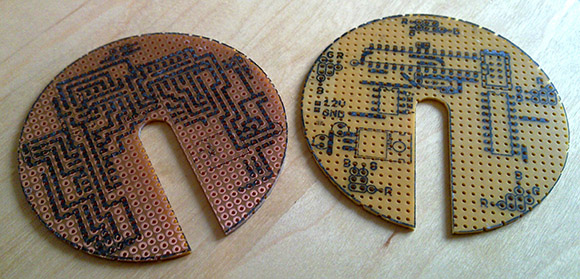
PC board houses are getting more accessable and less expensive all the time. Some of us are even getting very, very good at making our own circuit boards at home. There are times, though, when a project or prototype requires an extremely cheap custom board right now, something etching a custom board won’t allow. [KopfKopfKopfAffe] has a unique solution to this problem, able to create custom boards in under an hour without any nasty chemicals.

Instead of starting his build with copper-clad board, [KopfAffe] used every rapid prototyper’s friend, simple one-sided perf board. The shape of the board was milled out on a CNC machine, and both the top silk screen and bottom layer were marked off using the toner transfer method. After that, a custom circuit is just a matter of placing components and putting solder bridges between all the marked pads.

[KopfAffe] is only using this technique for single-sided boards, but we don’t see any reason why it couldn’t be employed for simple double-sided boards. This would still have the problem of making vias between the layers, but that’s still a problem with proper, home-etched double sided boards.

Auto Off For Any Circuit

autooff

Properly configured, your computer will go into sleep mode when left unattended for a long enough time. So will your cell phone, and just about every other piece of sufficiently complex electronics. Much simpler circuits, though, are left at the mercy of a SPST switch; if you forget to turn a flashlight off, it will be dead next time you need to use it. Wanting an auto-off circuit simple electronics, [Kyle] threw together this auto shutoff circuit.

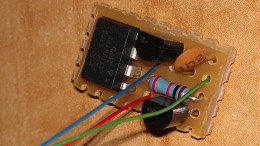
The basic idea behind the cirucuit is to use a microcontroller as a timer controlling two transistors. When [Kyle]’s circuit is power cycled, the timer inside an AVR starts, making a pin high, and when the timer is up, making the pin low again. This pin feeds into a PNP transistor which is in turn connected to a NPN transistor, creating a very tiny auto off circuit for anything with an SPST switch.

[Kyle] says there are a few improvements to be made – using MOSFETS to handle higher currents and possibly using a smaller microntroller like an ATtiny 4/5/9/10 to shrink the circuit’s volume. It’s a great idea, bringing the idea of a flashlight with auto shutoff into reality.

Testing Caps With A DIY ESR Meter

There’s a problem with collecting old tube amps and vintage electronics – eventually the capacitors in these machines will die. It’s not an issue of a capacitor plague that causes new electronics to die after a few years; with time, just about every capacitor will dry out, rendering antique electronics defective. The solution to getting old gear up and running is replacing the capacitors, but how do you know which ones are good and which are bad? With [Paulo]’s DIY ESR meter, of course.

An ideal capacitor has a zero equivalent series resistance, and failure of a capacitor can be seen as an increase in its ESR. Commercial ESR meters are relatively cheap, but [Paulo] was able to build one out of a 555 chip, a small transformer, and a few other miscellaneous components.

The entire circuit is built on stripboard, and if you’re lucky enough to find the right parts in your random parts bin, you should be able to build this ESR meter with components just laying around.

Sonic Screwdriver Meets TV-B-Gone

sonic

[furrysalamander] has a friend that is a really big Doctor Who fan. It happens that this friend has a birthday coming up, and [furrysalamander] wanted to get her something amazing. A Sonic Screwdriver is always a great gift, but [furrysalamander] wanted to put his personal touch on it. He ended up adding a TV-B-Gone to [10]’s screwdriver, turning a fictional deus ex machina into a functional device.

The body of the Sonic comes from this replica of [10]’s screwdriver from Think Geek. Inside, the screwdriver has space for a battery a circuit board to control the lights and sound normally expected of a sonic screwdriver. [furrysalamander] added a freeform circuit composed of an ATtiny85, a transistor, LED, and a few resistors to add the ability to turn just about any TV off.

Of course [furrysalamander] needed to program the ATtiny with the TV-B-Gone firmware, and lacking any AVR development tools he used a Raspberry Pi’s GPIO pins to write the firmware to the microcontroller. That’s something we’ve seen before, but [furrysalamander] is a champ for including the process in his Instructable.

The end result is a Sonic Screwdriver that doesn’t work on wood and can’t break a deadlock seal. It turns off TVs just fine, though, and looks great to boot. You can check out a demo of [furrysalamander]’s sonic in action after the break.

Continue reading “Sonic Screwdriver Meets TV-B-Gone”

Midwest RepRap Festival

We’re a US-centric site, but aside from events in New York or California, we don’t see many hacker, maker, or 3D printer events aimed at the parts of the country filled with corn and WalMarts. The 1st annual Midwest RepRap Festival aims to change that with enough events, speakers, and activities to make Elkhart, Indiana look like the hoppingist place around.

Officially, the festival started yesterday but the schedule of events really ramps up today. [Josef Prusa] will be taking the stage talking about the state of the RepRap, and a ton of 3d printing vendors will be there showing off their wares and selling some really cool stuff. There’s also tons of experienced RepRappers available to help you tune your machine to perfection; just as well, because the festival is going for the world record for the greatest number of 3D printers printing simultaneously.

If you’re around northern Indiana, you might want to check out the festival and send us a few pics or videos.

Stealing Cars And Ringing Doorbells With Radio

The cheap software defined radio platforms that can be built out of a USB TV tuner aren’t getting much love on the Hackaday tip line of late. Thankfully, [Adam] sent in a great guide to cracking sub-GHz wireless protocols wide open, and ringing doorbells, opening cars, and potentially setting houses on fire in the process.

The first wireless hack [Adam] managed to whip up is figuring out how a wireless doorbell transmitter communicates with its receiver. [Adam] connected a FUNcube software defined radio dongle (although any one of the many USB TV tuner dongles we’ve seen would also work) and used GNU Radio to send the radio signals received to a WAV file. When looking at this audio file in Audacity, [Adam] saw the tell-tale signs of digital data, leaving with a string of 1s and 0s that would trigger his wireless doorbell.

The FUNcube dongle doesn’t have the ability to transmit, though, so [Adam] needed a more capable software defined radio to emulate the inner workings of a doorbell transmitter. He found one in the Ettus Research USRP, a software designed radio that’s doing a good job of keeping [Balint], Hackaday SDR extraordinaire, very busy. By sending the data [Adam] decoded with the FUNcube dongle over the USRP, he was able to trigger his wireless doorbell using nothing but a few hundred dollars of radio equipment and software ingenuity.

Doorbells are a low-stakes game, so [Adam] decided to step things up a little and unlock his son’s car by capturing and replaying the signals from a key fob remote. Modern cars use a rolling code for their keyless entry, so that entire endeavour is just a party trick. Other RF-enabled appliances, such as a remote-controlled mains outlet, are a much larger threat to home and office security, but still one [Adam] managed to crack wide open.

Lighting Up A Workspace Twofer

desks

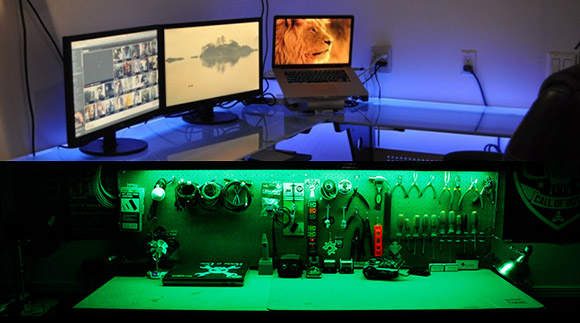
Sometimes a pair of extremely similar builds hit the Hackaday tip line within hours of each other. We’re not one to play favorites, so here’s two projects that put RGB LED strips in a desk and workbench.

[Charles] over at The Makers Workbench has long needed a lighting solution for his workspace. Flourescent lights are alright, but for real geek cred nothing but LED strips will do. He picked up an RGB strip on Amazon for $20 and now has a lighting solution that’s able to change colors above his workstation. Check out the video of his RGB workbench rave.

A computer desk is a workbench too, right? [Will] had the idea of letting people on the Internet control the lighting color of his desk. He’s asking people to head over to this site and asking people to schedule the color of his desk for an entire day. A Raspi pulls each day’s color off the server. With a few transistors, an RGB strip, a custom shield, and faking three PWM channels, [Will] has a new color at his desk every day.