Mining Bitcoins On A Nintendo

NES

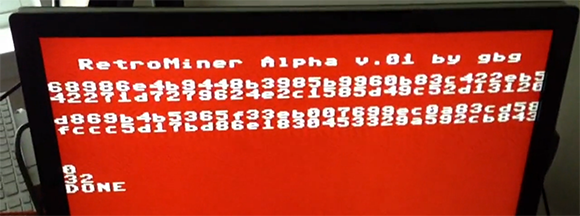
His friends know [gbg] as an aficionado of just about anything with a 6502 processor in it. He’s also interested in bitcoins. A while back, a friend asked if it would be possible to mine bitcoins with an old Nintendo Entertainment System. While this suggestion was made in jest, it’s not one of those ideas anyone can let go of easily. Yes, it is possible to mine bitcoins with an NES, and [gbg] is here to show us how.

Mining bitcoins is simply just performing a SHA256 hash on a random value from the bitcoin network and relaying the result of that calculation back to the Internet. Of course this requires an Internet to NES bridge; [gbg] brought in a Raspberry Pi for this task. There’s the problem of actually getting data into an NES, though, and that’s something only a USB CopyNES can handle. After doing some 32-bit math, the NES sends this out to the Raspberry Pi and onto the bitcoin network.

When you consider that even a high-end gaming computer has little chance of mining a bitcoin in any reasonable amount of time, there’s little chance RetroMiner will ever be able to mine a bitcoin. It’s all random, though, so while it’s possible, we’ll just appreciate the awesome build for now.
Fixing Tools With 3D Printers

saw

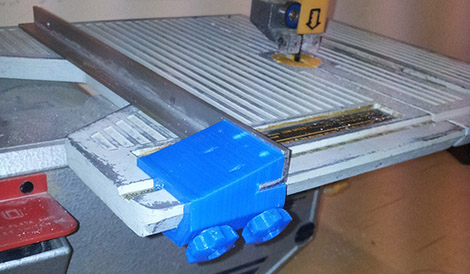
Over at the Manchester Hackerspace, [Bob] has been busy getting a 30-year-old bandsaw up and running. The saw worked great, but it was missing a fence, making straight cuts difficult to say the least.  The solution, of course, was to build a new fence, and [Bob] decided to capitalize on his hackerspace’s workshop by making a new fence with a 3d printer.

[Bob] began by taking careful measurements of the saw’s table and the channel running down the length of it. These measurements were plugged into OpenSCAD, and after a few iterations, [Bob] had an extremely well-fitting profile a fence could be attached to.

With the profile down, [Bob] created a new part in OpenSCAD that would hold an aluminum angle piece. This was attached to the plastic parts with screws, and the entire assembly clamps down to the saw with the help of a few 5mm bolts. For a machine that is usually dedicated to making 3D printer parts and Yoda heads, [Bob] did a great job making good use of his 3D printer.

A Homebrew Binary Wristwatch

watch

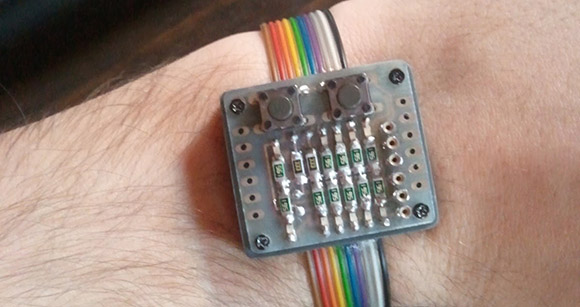
There are 2 types of people in the world; those who know binary, those who don’t, and those who know ternary. [Emanuele] thought a binary wristwatch is the pinnacle of nerd and set out to build his own. The resulting binary clock not only screams nerd as intended, but is also a functional time piece, as well.

The idea of a binary wristwatch came to [Emanuele] while he was working with PICs at school. Not wanting to let that knowledge go to waste, he used a PIC16F628 microcontroller for this build. There are four LEDs for the hours and six LEDs for the minutes, each attached to a separate microcontroller pin for easy programming.

To keep time, [Emanuele] kept the PIC in sleep mode most of the time, only waking it up when a an internal timer’s register overflows. The watch spends most of its time sleeping, sipping power from a coin cell battery with a battery life that should last weeks, at least.

The entire circuit is tucked away in a PVC enclosure with a wonderful rainbow ribbon cable band. We’re not so sure about how that feels against the skin all day, but it does exude the nerd cred [Emanuele] was looking for.

Writing New Firmware For A Handheld Radio

HAM

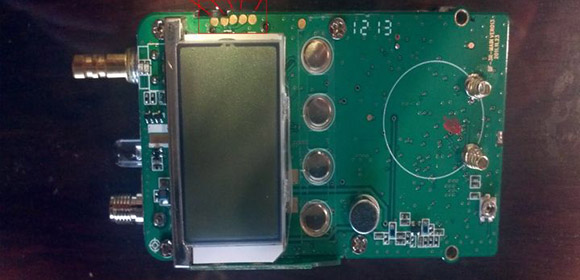
When playing around with a cheap, handheld, dual-band radio, [Lior], a.k.a. [KK6BWA], found a schematic for a similar and even cheaper radio. He realized the programming pads were very accessible and the dev tools for the radio’s microcontroller were available from the manufacturer. After these discoveries, there really was only one thing to do: write new firmware for a $40 radio, and making a great tool for playing around in the 2 meter and 70 cm bands.

The instructions for reflashing the firmware on this radio only require an Arduino and a handful of miscellaneous components. [Lior]’s new firmware for the uv3r radio isn’t quite finished yet, but he plans on adding some really impressive features. Things like a better UI for a four-button radio, a mode for tracking satellites, a digital mode, and a computer-controlled mode are all possible and on [Lior]’s project wishlist.

Getting a $40 radio to do your bidding with an Arduino is cool enough, but [Lior] says this mod for the uv3r can be taken even further: if you’ve got an amateur radio license, it’s possible to use the uv3r to control an Arduino or other microcontroller from miles away. It’s a great hack, right up there with the USB TV tuner/software defined radio thing we saw almost exactly one year ago.

You can check out a demo of some custom software running on the uv3r after the break. The radio listens for a DTMF tone (supplied by the uv3r’s big brother, the uv5r), and plays back a three-digit DTMF tone. There’s also a more through walk through of what [Lior]’s new radio can do as well.

Continue reading “Writing New Firmware For A Handheld Radio”

LulzBot Is Giving Away More Printers

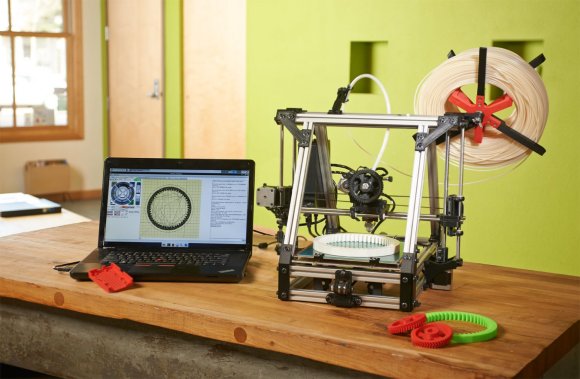
LulzBot, the awesomely named 3D printer manufacturer and parts supplier, is giving away eight of their AO-100 printers to eight lucky hackerspaces.

It’s not so much a contest, but instead a giveaway aimed at eight community-operated hackerspaces who come up with a great idea on how to use a 3D printer. If you’re part of a well-established hackerspace that doesn’t have a 3D printer yet, this is a great opportunity to get your hands on a very nice printer.

A while back, we acquired one of these LulzBot printers to print off some custom gaming controllers for gamers with physical disabilities (and to make some other cool stuff as well). Our boss man [Caleb] says the AO-100 is a great printer, and in my dealings and purchases with LulzBot, they seem like a great company with great support. We’re sure the hackerspaces that win these printers LulzBot is giving away will be able to put them to use quickly by making some really cool stuff.

Putting The Brains Of A Reverse Geocache On The Outside

ioio

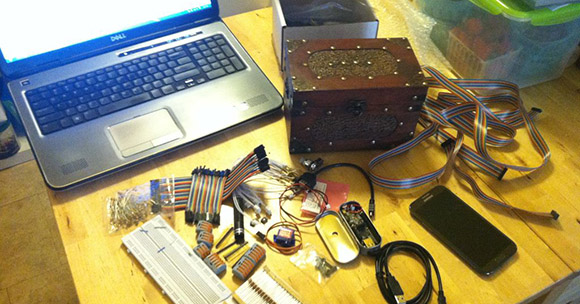
A reverse geocache – a box that only opens in a specific geographical area – is a perennial favorite here at Hackaday. We see a ton of different implementations, but most of the time, the builds are reasonably similar. Of course dedicating a GPS receiver solely to a reverse geocache isn’t an inexpensive prospect, so [Eric] came up with a better solution. He’s using a smart phone as the brains of his geocache, allowing him to keep the GPS and display outside the locked box.

The build began by finding an old box and modifying it so it can be locked with a servo. The only other bits of electronics inside the box are an IOIO board, a battery pack, and an I2C EEPROM for storing a few settings. On the phone side of things, [Eric] wrote an Android app to serve as both the programming interface, UI, and GPS hardware for his reverse geocache. It’s exactly like all the other reverse geocaches we’ve seen, only this time the controls are wireless.

[Eric] put up a video demoing his reverse geocache. You can check that out after the break.

Continue reading “Putting The Brains Of A Reverse Geocache On The Outside”

Measuring Meditation With A Heart Rate

meditation

We’ve seen our fair share of builds over the years that attempt to peer inside a user’s head and divine their state of mind. Whether the goal is to induce lucid dreaming or just reduce anxiety, we’re always impressed with how many ways you can detect moods with physiological measurements.  [Kirk] has been measuring his own physiology for months, and found the biggest change during meditation is the variability in his heart rate. Using that algorithm, he made an orb that changes colors when he’s meditating.

The hardware for the build uses a Bluetooth LE heart rate monitor connected to a smart phone communicating with an Electric Imp. After processing the heart rate data, the Imp triggers an RGB LED strip controlled with an Arduino.  The result is a plastic orb that glows whenever the user is displaying some sort of mindfulness, cross referenced with algorithm generated from mindlessly browsing the Internet.