Raspberry Pi Laptop Is Just A Little Too Big For A Pocket

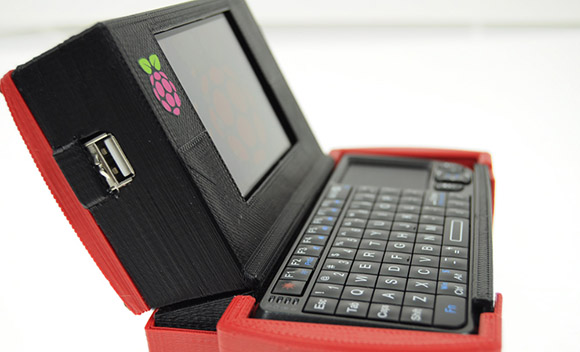
Over on the Parts People blog, [Nathan] created his own Raspberry Pi laptop. It’s got all the bells and whistles, including a keyboard, trackpad, battery, and even a 3D printed case.

Of course [Nathan]’s laptop contains a Raspi, but the other included parts are where this palmtop computer is turned into something useful. For powering the Pi and 3.5″ composite LCD, [Nathan] took apart the battery pack from an old Dell laptop. By throwing out the bits of plastic surrounding these rechargeable cells and reusing the battery connector, [Nathan] was able to power the Pi, and all the peripherals for 10 hours.

Also included in [Nathan]’s Raspi palmtop is a 64 GB SSD connected to the powered USB hub. This, along with the 4 GB boot SD card, provides more than enough storage for listening to a music library, or even watching a few TV shows on the 3.5″ screen,
 

Open Source Software Defined Radio Transceiver

SDR

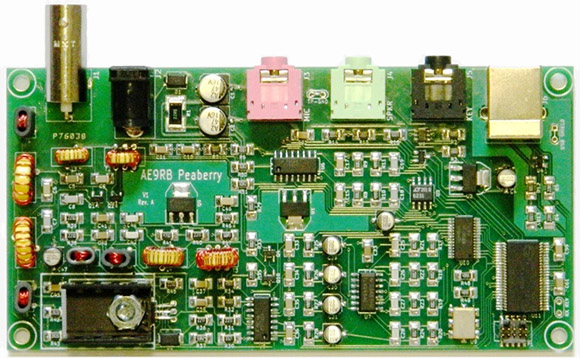
As the year draws to a close, we must look back and look at the advances in amateur radio this year. The RTL-SDR tuner hack, a USB TV Tuner to create a software defined radio receiver, is one of the greatest hacks of the last 12 months and a great justification for 2012 being the year of software defined radio receivers. 2013 is shaping up to have even more advances in the state of software defined radio. This time we’ll be transmitting as well, possibly with [AE9RB]’s Peaberry SDR transceiver.

The Peaberry SDR transceiver is a kit to both transmit and receive on every HAM band between 160 meters (1.8 MHz) to 17 meters (18 MHz). It does this through a USB interface and a 48kHz, 24-bit interface that is (or will shortly be) compatible with all the major SDR interfaces.

While the Peaberry SDR requires an amateur radio license to operate, we can’t wait to see what else will be coming to the software defined radio scene in the next year.

Thanks [Zach] for sending this one in.

Arduino Compatible Christmas Tree

tree

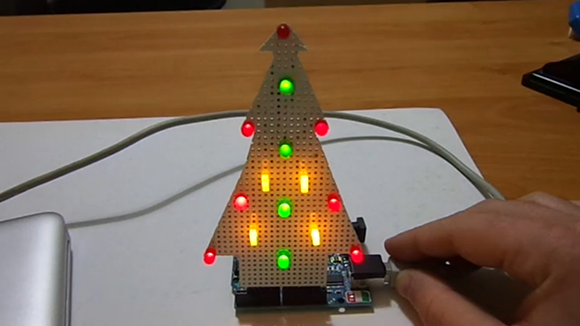
It wouldn’t be the holidays without an LED Christmas tree, and luckily [Danilo] brings the goods with an Arduiinofied LED Christmas tree (Italian, translation).

In the past week, we’ve seen LED Christmas trees of digital logic and a great freeform circuit version. Unlike these other builds [Danilo]’s LED tree uses a piece of protoboard masterfully cut into the shape of a Christmas tree. There’s no PCB for this build; just a lot of bare wires and a lot of patience.

Because [Danilo]’s tree makes use of the PWM pins on his Arduino, it was possible to connect his tree to the Arduino with a few 90 degree headers. This provides a great base for his tree and makes it possible to build a professional-looking enclosure for his project.

You can check out [Danilo]’s tree in action after the break.

Continue reading “Arduino Compatible Christmas Tree”

Modifying An EEG Headset For Lucid Dreaming

moddedmindwave4

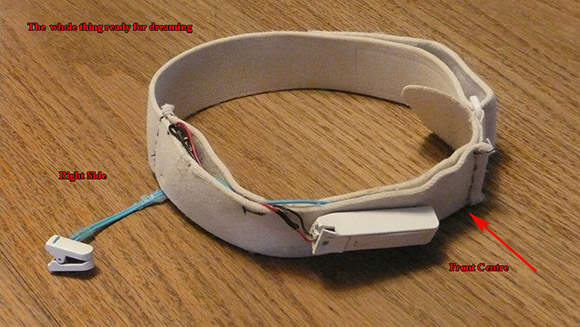
[Michael], [Tom], and a few other people on the Lucid Scribe Database project have been using off-the-shelf EEG equipment to invoke lucid dreaming. Yes, that’s where you take control of your dreams and become a god. This requires wearing an EEG setup while you sleep, and these products aren’t very comfortable sleeping wear. [Tom] decided to take apart a NeuroSky MindWave and turn it into something comfortable to wear all night.

The folks at the Lucid Scribe Database log their dreams with consumer-level EEG equipment, usually something made by NeuroSky. The NeuroSky MindWave is the smallest and cheapest EEG headset available, but it’s still a hard plastic device not conducive to sleeping.

[Tom] removed all the guts and electronic goodies out of his MindWave and attached them to an elastic headband. The MindWave has two sensors – a forehead and ear lobe sensor. For the forehead sensor, [Tom] simply soldered a piece of wire to a penny and attached it to the elastic. The ear lobe sensor in the stock MindWave is a simple clip that was kept in the stock configuration for [Tom]’s mod.

Now that [Tom] has a much more comfortable EEG setup, he can get on with improving his lucid dreaming skills and even try communicating via Morse from inside a dream.

Custom MOTD For The Raspberry Pi

motd

With so many uses for a Raspberry Pi in a headless configuration – especially with the impending release of the Raspi Model A – we’re surprised it has taken so long for someone to send in a way to create a custom message of the day that is displayed whenever you SSH into everyone’s favorite Linux board.

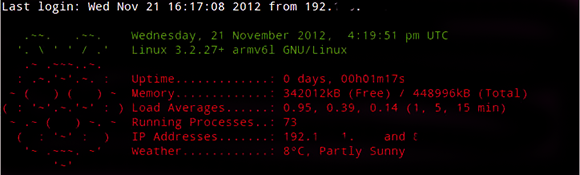
A MOTD is used by servers to display messages to new users, or simply system information for server admins. It’s a simple text file stored in /etc/motd, but with some proper beardly Unix wizardry it’s possible to display uptime, free memory, and even the weather wherever the Raspi is located.

[yanewby] over on the Raspberry Pi forums created a nice little MOTD that grabs weather data from the Internet and displays it alongside an ASCII rendering of the Raspberry Pi logo. Of course like everything in Unix, this MOTD can be modified to do just about anything, from checking your Twitter to sending a text message to your phone.

Two Computer Vision Builds From Cornell

land

[Bruce Land], professor at Cornell, is a frequent submitter to our tip line. Usually he sends in a few links every semester from undergraduate electronics courses. Now the fall semester is finally over and it’s time to move on to the more ambitious master’s projects.

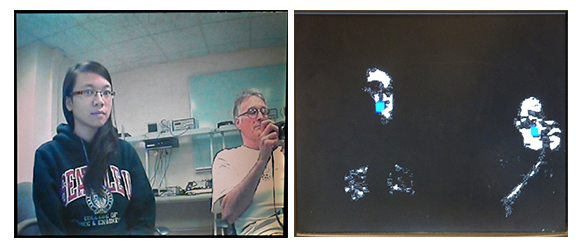
First up is a head-mounted eye tracker, [Anil Ram Viswanathan] and [Zelan Xiao] put together a lightweight and low-cost eye tracking project that will record where the user is looking.

The eye tracker hardware is made of two cameras mounted on a helmet. The first camera faces forward, looking at the same thing the user is. The second camera is directed towards the user’s eye. A series of algorithms detect the iris of the user’s eye and overlays the expected gaze position on the output of the first camera. Here’s the design report. PDF, natch.

Next up is a face tracking project implemented on an FPGA. This project started out as a software implementation of a face tracking algorithm in MATLAB. [Thu-Thao Nguyen] translated this MATLAB code to Verilog and eventually got her hardware running on an FPGA dev board. Another design report.

Having a face detection and tracking system running on an FPGA is extremely interesting; the FPGA makes face tracking a very low power and hopefully lower-cost solution, allowing it to be used in portable and consumer devices.

You can check out the videos for these projects after the break.

Continue reading “Two Computer Vision Builds From Cornell”

O Christmas Tree Of Digital Logic

tree

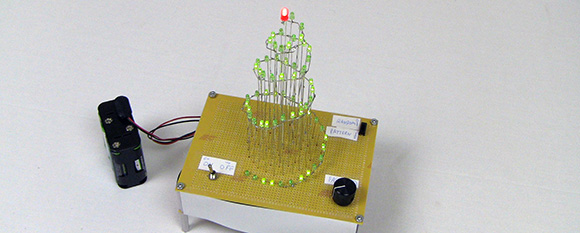
[Chris] over at PyroElectro is getting into the swing of the holidays with a LED Christmas tree build. Unlike the other electrical Christmas trees we’ve seen this holiday season, [Chris] designed his tree entirely with digital logic – no microcontrollers included.

The tree [Chris] constructed on a piece of perf board is a beautiful spiral arrangement of 64 green LEDs.While we’re sure getting all the LEDs soldered to the right height, [Chris] makes it look so easy to create 3D structures with circuits.

The LEDs are driven with a set of eight shift registers, themselves clocked by either a predictable 555 timer chip or a pseudo-random pattern generated with a circuit built from a few hex inverters. By setting the tree to the sequential mode, a pair of lights travel slowly down the spiral of the Christmas tree. If set to random mode, an random number of LEDs light up and walk down the array of LEDs.

Continue reading “O Christmas Tree Of Digital Logic”