Adafruit’s Got A New Board, An Official Arduino

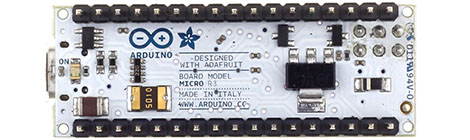
There’s a new Arduino in town, this time designed in conjunction with Adafruit. It’s the Arduino Micro, a very neat little board designed for breadboard use.

Ostensibly an upgrade of the long in the tooth Arduino Nano, the new Micro takes all the best features of the new Arduino Leonardo and shrinks them down to a convenient stick of gum-sized package. It’s powered by the ATmega32u4 microcontroller, and with a MicroUSB port is able to emulate keyboards, mice and other USB input devices.

Of course with any microcontroller dev board, comparisons must be drawn between the Arduino Micro and the very popular Teensy USB dev board. Like the Teensy boards (and the new Arduino Leonardo), the Micro is able to function as a USB keyboard or mouse. The Teensys, though, is loaded with LUFA making it able to emulate just about anything from mice, USB audio devices, and MIDI synths.

Hackaday Links: November 9, 2012

Yeah, it’s like Twitter but actually cool

Thingiverse – still the best place on the Internet to find cool 3D models to print out – has gone all Web 3.0 with their new Dashboard feature. Basically, you can think of this as Thingiverse’s version of Twitter. The dashboard allows you to see the latest updates from people you like, follow people, categories, and tags, and check out your all-important ‘who’s following me’ stats. Yes, to the Hackaday crowd it may sound a little lame, but it’s a great way to winnow the (awesome) wheat from the (slightly less awesome) chaff.

Hey, we goofed. And not by using the same image twice

Remember when we jumped on the Occupy Thingiverse bandwagon? Well, there were questions about the Thingiverse Terms of Service and confusion that Makerbot actually owns everything uploaded to Thingiverse. That’s completely wrong according to Makerbot’s lawyer [Rich McCarthy]. The whole issue dealt with “Moral Rights or attribution” – a French legal doctrine that isn’t part of US law (or the law of any English-derived legal system as far as we can tell). Yeah, we goofed.

Now u cn snd SMS msgs wit n ‘ino & cell sheld

[Meir] sent in a cellular library for microcontroller projects that allows for simple sending and receiving of SMS messages. Yes, it’s been done before, but [Meir] hid all the hardware interaction with the cellular shield – a good design practice – to make the code nice and tidy.

And you thought PVC was bad…

Just in time for Thanksgiving, [Lou] shows us the fastest way to make mashed potatoes: an oxygen and propane powered potato gun. The build uses oxy and propane tanks you can pick up for a few bucks at any hardware store, steel pipe for the barrel, a grill igniter, and a few pipe fittings. It’s awesome, and we’ve got to hand it to [Lou] for this one. Now to build one and test it out on our indestructible test dummy.

It’s just like the Raspberry Pi! They’re that backordered!
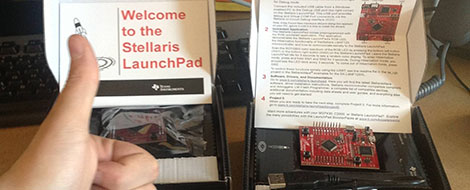
Remember the Stellaris Launchpad, the very cool (and very inexpensive) ARM dev board put out by TI? Yeah, they’re shipping now. News of this comes from [Ryan Holtz] at Autodesk after the FedEx guy came knocking a few days ago. The good news is they’re shipping, the bad news is the price increased slightly to $13.

 

Storing 32 Bits Of Data In A Piece Of Glass

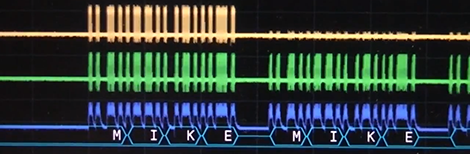
After finding an old piezoelectric delay line in an old TV, [Mike] decided to figure out how it works and in the process stored his name in sound waves reflecting inside a piece of glass

[Mike] was intrigued by these old-fashioned delay lines after watching [Dave] from EEVblog’s teardown of an circa 1985 camcorder. [Dave] found a piezoelectric delay line in his camcorder – a device that is able to store digital data by sending a sound wave into a glass plate, letting the sound wave bounce through the plate. and picking up the sound on the other end. It’s actually not too dissimilar to a mercury delay line used in the earliest computers.

After sending a pulse through his piezoelectric delay line, [Mike] picked up an echo almost exactly 64 microseconds later. After hooking up a simple circuit constructed out of a 74-series chip, [Mike] found he could ‘loop’ the delay line and keep a pulse going for up to 3 milliseconds.

Three milliseconds isn’t much, but by injecting serial data into the delay line, [Mike] was able to spell out his name in binary, as seen above. It’s just 32 bits stored for a fraction of a second, making it a very volatile, low-capacity memory, but functionally equivalent to the old mercury delay lines of yore.

It’s certainly not what [Mike] or [Dave]’s delay line was designed to do; these video delay lines were used to hold the previous line of video for a form of error correction. Outside [Mike]’s workbench and a few museums, though, you won’t see a delay line used as a form of computer memory. A very cool build and an awesome history lesson, and we thank [Mike] for that.

Netduino Gets A Huge Upgrade

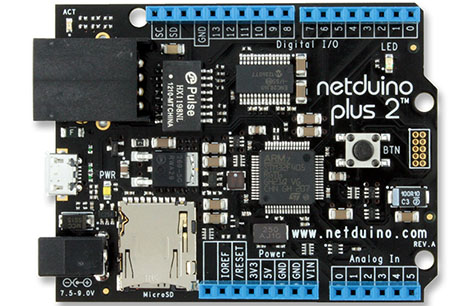
The Netduino, a dev board built around the .NET Micro framework with the goal of being compatible with Arduino shields just got a huge upgrade.

The new Netduino Plus 2 features an upgraded STM32 ARM Cortex-M4 uC running at 168 MHz, improving on the original Netduino’s ARM7 running at 47 MHz. In addition to some more processing power, the STM32-based microcontroller has twice the RAM and six times as much Flash memory. Also, Ethernet (10Mbps), a MicroSD card port, and of course compatibility with all Arduino shields – including the new Arduino ‘Revision C’ boards for the Leonardo – remains intact.

In keeping with the design goals of the Netduino, the new board uses the .NET Micro Framework running under Windows. It looks like OS X and Linux users won’t be left out in the cold for long, though; there’s a project to port the .NET Micro stuff over to Mono.

Tip ‘o the hat to [Jason] for sending this one in.

Zelda Is The Princess, Now Link Is Too

[Mike] is a huge fan of The Legend of Zelda: The Wind Waker and now that he has a daughter it’s a great time to pass this epic quest down to the next generation. There’s a problem with explaining the plot to her daughter, though: even though the player can name the character after themselves, there’s no way to change the gendered pronouns. Yes, it’s a problem that could have been solved by a cameo by Professor Oak asking, “Are you a boy or a girl?’ but [Mike] came up with a better solution: changing all the pronouns with a ROM hack.

There are a few ‘problems’ with altering the dialogue with a ROM hack. Most importantly, all the new pronouns need to be the same length as the words they replace. [Mike] is using the word ‘milady’ to replace ‘my lad’ and ‘master,’ but also had to take a page from critiques of modern epics and replace ‘swordsman’ with ‘swordmain.’

So far, everything is working as planned and the [Mike]’s daughter [Maya] is enjoying seeing herself sail her dragon ship and battle foes. It’s a great effort to bring some semblance of gender neutrality to a classic game, and an awesome project for a really great dad.

Thanks to [Guillaume] for sending this one in.

The Band’s Name In Lights, RGB LEDs To Be Exact.

A few of [michu]’s friends formed a band named Kalikut Now and needed an awesome stage show. The band made a few 80cm-high letters of their band name, cut a few pieces of acrylic, and wired them up with a few LED modules. The work of connecting these letters to a computer and programming them fell on [michu], and we’ve got to say he did a pretty good job.

You may remember [michu] from his StripInvaders and PixelInvaders projects, basically a few RGB LED modules that can communicate with an Arduino over an SPI interface. With these huge letters, [michu] ran into a problem: he had 11 meters of cabling between the clock and data lines, far beyond the maximum recommended length for any datasheet.

[michu] looked around the Internet for common problems with SPI interfaces and found a lot of good advice from a lot of very smart people. The issue with the SPI bus was eventually solved by correctly wiring the grounds of his LED modules, building a few dead-simple SPI buffers, and reducing the clock speed of the SPI bus.

After countless hours, the band’s name is in lights, and RGB LEDs to boot. Everything can be controlled with Abelton Live, and looks absolutely fantastic as seen in the video after the break.

Continue reading “The Band’s Name In Lights, RGB LEDs To Be Exact.”

Raspberry Pi Gets RISC OS, Can Now Play Elite

The processor in the Raspberry Pi – an ARM11 built by Broadcom – actually has a long and storied history. Much as how the Intel i7 in a top-of-the-line desktop can still run code written for the original IBM PC, the ARM chip in the Raspberry Pi is also based on decades-old technology.

The first ARM-based computer was the Acorn Archimedes, a mid-80s computer with 512kB of RAM and no hard drive. The Archimedes ran RISC OS, a very nice graphical operating system written explicitly for the ARM architecture. RISC OS is now available for the Raspberry Pi, finally bridging the gap between educational computers from 1987 and 2012.

Of course, a very much updated version of 25-year-old operating system running on a Raspberry Pi doesn’t mean much without a ‘killer app,’ does it? For the original Acorn Archimedes the killer app – and one of the best video games of the 80s – was Elite, a space trading and combat game that featured vector-style ships. [Pete Taylor] downloaded the Raspi RISC OS image and got Elite running using an Archimedes emulator and, of course, the Archimedes port of Elite.

It’s a pretty neat development if you’re in to alternative OSes and one of the best space-based games ever made. Well worth a download, at the very least.