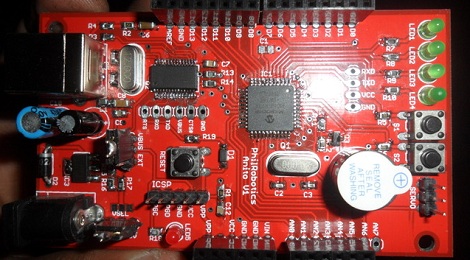
PhilRobokit Anito Is Not An Arduino

A few people over at the Philippine hackerspace PhilRobotics a PIC-based dev board that takes a lot of cues from ‘the microcontroller board everyone loves to hate,’ the Arduino.

There are a few differences between the PIC16F877a used in the Anito and the ATMega328 used in the Arduino: The PIC has a little less than half the Flash memory of the ‘Mega and less RAM, but has a slightly higher clock rate. It would have been nice to have a dev board with Arduino style headers powered by one of those new PIC32MX chips, if only because of a few really, really awesome projects we’ve seen. We’ll take whatever we can get, though, even if it provides a little more ammo for the PIC/AVR holy war.

One really interesting aspect of the Anito is the IDE. Written in Python, the PhilRoboKit IDE has all the features of everyone’s favorite IDE that is written in Wiring, plus a few extra features: autocomplete is a huge bonus, as is the ability to upload programs over Pickit2 ISP header. The IDE is available for Windows and Linux (no Mac port yet), and should be enough to get you off the ground in the PIC dev world.


Sonic Screwdriver Controls Your TV, Doesn’t Work On Wood

Sure, you could pretend to be the Doctor with a simple plastic sonic screwdriver. It might even have a LED on the tip, and if you’re really splurging a tiny speaker for sound effects. Yep, you could make due with an inelegant version of the Doctor’s Gallifreyan army knife, or you could get this amazingly detailed sonic screwdriver replica.

Instead of a plastic or resin replica, this replica of the 11th Doctor’s sonic screwdriver is made out of die-cast, copper plated metal with a jade green  polycarbonate tip. This replica has a few tricks up its sleeve; instead of just lighting up and providing a few sound effects at opportune times, it also can serve as a programmable infrared remote with a gesture interface  thanks to a three-axis accelerometer. If that’s not enough, the copper ‘rods’ just below the tip also serve as a touch interface for the microcontroller on board.

For as many jaw dropping light saber builds we’ve seen we’re genuinely surprised we haven’t seen more sonic screwdriver builds. It’s really cool this toy can serve as a remote control, but we’re betting a few Hackaday readers can replicate this replica with an extendable jewel cage and maybe even a Bluetooth gesture controller.

If you’d like your own sonic screwdriver, you can pick one up at ThinkGeek (for the US) or Forbidden Planet (for the UK). After the break is a video released by ThinkGeek showing off the this truly awesome remote control.

Tip ‘o the hat to [Zerocool] for sending this one in.

Continue reading “Sonic Screwdriver Controls Your TV, Doesn’t Work On Wood”

Building A CRT And Bathing Yourself In X-rays

For the Milan design week held last April, [Patrick Stevenson Keating] made a cathode ray tube and exhibited it in a department store.

The glass envelope of [Keating]’s tube is a very thick hand-blown piece of glass. After coating the inside of the tube with  a phosphorescent lining, [Keating] installed an electrode in a rubber plug and evacuated all the air out of the tube. When 45,000 Volts is applied to the electrode, a brilliant purple glow fills the tube and illuminates the phosphor.

Since the days of our grandfathers, CRTs have usually been made out of thick leaded glass. The reasoning behind this – and why your old computer monitor weighed a ton – is that electron guns can give off a substantial amount of x-rays. This usually isn’t much of a problem for simple devices such as a Crookes tube and monochrome CRTs. Even though [Keating] doesn’t give us any indication of what is being emitted from his tube, we’re fairly confident it’s safe for short-term exposure.

Despite being a one-pixel CRT, we can imagine using the same process to make a few very interesting pieces of hardware. The Magic Eye tube found in a few exceptionally high-end radios and televisions of the 40s, 50s, and 60s could be replicated using the same processes. Alternatively, this CRT could be used as a Williams tube and serve as a few bits of RAM in a homebrew computer.

You can check out the tube in action while on display after the break, along with a very nice video showing off the construction.

Continue reading “Building A CRT And Bathing Yourself In X-rays”

Two-stage Rocket Climbs To 15 Km, Promptly Gets Lost

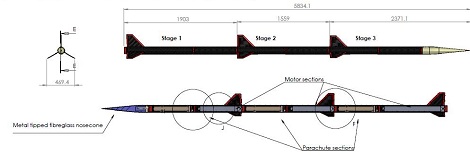
Last month, the Cambridge University Spaceflight society launched two stages of their Martlet 1 three-stage rocket. After seeing our call for rocket builds, they sent in a launch report. We’re glad they did; it’s an amazing piece of work that screams into the atmosphere faster than the speed of sound.

The society is designed the three-stage Martlet 1 with the goal of reaching 15km (50,000 feet) over a launch range at Ben Armine in Scotland. This launch was a test of stage separation, intended to work out any bugs in the system before going to the full-sized rocket.

When Martlet 1 takes off, it’s 1st stage engine fires for 5 seconds and coasts for another 9 seconds. In the video after the break, the guys expected to hear the pop of the second stage igniting after 14 seconds. The team forgot to account for the fact the rocket would be 3km in the air at that time, and thanks to the slowness of sound the second stage was heard though the clouds at 25 seconds after launch.

With rockets, hardly anything goes exactly as planned, so unfortunately the team only recovered the bottom half of their rocket. After searching over 60 square km for the second stage, the guys realized it might be lost to the moors of Scotland. Hopefully the second stage will turn up soon so the full 3 stage stack can be realized.

Check out the launch videos after the break.

Continue reading “Two-stage Rocket Climbs To 15 Km, Promptly Gets Lost”

Turning The InnoTab Into A Linux Tablet

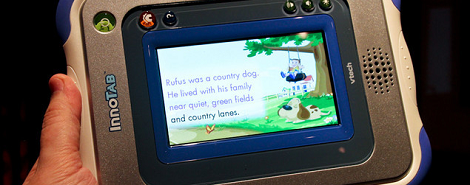
A few weeks ago we caught wind of [Mick] breaking out his screwdrivers and soldering iron to get a serial console on his son’s VTech InnoTab. [Mick] was able to get the touchscreen working and successfully ported SCUMMVM to the device, but there was still a long road ahead to get  the source for this pint-sized tablet.

[David Anders] from elinux.org wrote in to tell us VTech is now giving away their source for the InnoTab, something they’ve been holding back so far. [Dave] is now verifying the VTech release is 100% complete, so if you’d like to give him a hand, drop him a line.

If you’re thinking this is your ticket to an inexpensive and powerful Linux tablet, prepare to be disappointed. The InnoTab is an ARM 11 running at 180 MHz with a paltry 64 MB of RAM. That’s not exactly top-of-the-line hardware, but at the very least you’ll be able to play Doom on it.

Remote Control With An XBee And A Propeller

If you’ve been playing with electronics for long enough, eventually you’ll need a nice remote control transmitter to control your RC car, airplane, or any other robotics project you have lying around. With these robotics projects comes the problem remote control, and the XBee Handheld Controller may be just the ticket to remotely control any project that comes off your workbench.

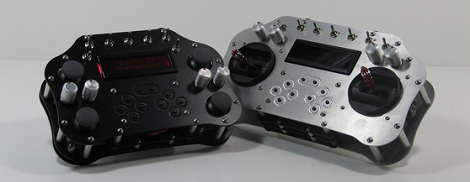
This isn’t the first remote controller we’ve seen that does just about everything, but it is the first one to include an XBee wireless transceiver to easily interface to your robotics project. The controller comes in two models, the Q4, which uses four Playstation-like joysticks, and the Q2, which uses proper remote control gimbal joysticks. Both the controllers have a slew of buttons, toggle switches, four rotary pots and a 2×20 LCD display.

After the break you can check out [Paul]’s pitch explaining what these controllers can do and showing off a hexapod robot under the control of his Q4 controller. A very neat project, and we can’t wait to see this controller out in the field.

Continue reading “Remote Control With An XBee And A Propeller”

Teaching A Computer To Learn

[Łukasz Kaiser] programmed a computer to play Tic-tac-toe. That doesn’t sound very remarkable until you realize he never told his computer the rules of Tic-tac-toe. The computer learned the rules by itself after watching a video of two people playing the game (link to actual paper – PDF warning).

[Łukasz] wrote a small program in C++ to recognize the placement of objects on a Tic-tac-toe, Connect 4, and Breakthough board. This program sifts through winning and losing games along with illegal moves to generate a Lambda calculus-like rule set for the relevant game. Even though [Łukasz] has only programmed a computer to learn simple games such as Tic-tac-toe, Connect 4, and Breakthrough, he plans to move up to more complex games such as Chess.

The fact that [Łukasz] programmed a computer to actually learn the rules of a game gives us pause; in one of the fabulous lectures [Richard Feynman] gave to freshman physics students in 1964, the subject of Chess came up. [Feynman] drew parallels between learning Chess and performing research. Every move is hypothesis testing, and when a very strange move occurs – castling, en passant, and the promotion of a pawn, for instance – the theory of the rules of the game must be reworked. Likewise, when extremely strange stuff happens in physics – particle/wave duality, and the existence of black holes – scientific theory is advanced.

Yes, teaching a computer to learn the rules of Tic-tac-toe may seem irrelevant, but given the same learning process can be applied to other fields such as medicine, economics, and just about every science, it’s not hard to see how cool [Łukasz]’ work is.

via extremetech