Make Your Own Integrated Circuits At Home

The Nyan Cat you see above is only 600 micrometers from head to tail. To put that into perspective, that’s about 10 times the diameter of a human hair. Also, that Nyan is etched into 200 nanometer thick copper foil and is the work of the HomeCMOS team, who is developing a hobbyist-friendly process to make integrated circuits and MEMS devices at home.

The project is far from complete; HomeCMOS has yet to produce a working IC but a few experiments – getting wet etching down pat and even building an almost working quantum qbit – are remarkable given the small amount of equipment and tools involved.

The HomeCMOS team has yet to actually make an integrated circuit or MEMS device, [Jeri Ellsworth] has shown this is possible by making transistors and integrated circuits at home. While there won’t be chips with millions of transistors coming out of the HomeCMOS lab anytime soon, it’s more than possible to see a few small-scale integration-level tech such as a few logic gates or a regulator.

Bootable Emulator For The DCPU

[Notch], the guy behind Minecraft, is currently working on a new game called 0x10c. This game includes an in-game 16-bit computer called the DCPU that hearkens back to the 1980s microcomputers with really weird hardware architecture. [Benedek] thought it would be a great idea to turn his ThinkPad into a DCPU, so he wrote a bootable x86 emulator for the DCPU that is fully compliant with the current DCPU spec.

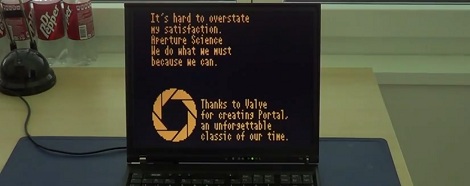
This bootable DCPU emulator comes from the fruitful workshop of [Benedek], the brains behind drawing fractals on the DCPU, emulating bit-flipping radiation, and even putting the Portal end credits inside [notch]’s 0x10c computer.

[Benedek] wrote this new in x86 assembly, allowing it to be booted without an OS from a USB flash drive on any old laptop. This allows for direct hardware communication for everything implemented for the DCPU so far.

If you’d like to run your bare-metal DCPU, [Benedek] made all the files avaiable. Since the entire emulator is only 1800 lines of x86 assembly, it’s possible to load this off a floppy disk; an ancient tech we’ll be seeing in [notch]’s new game.

Oh. One more thing. When we were introduced to 0x10c, we said we’ll be holding a contest for the best hardware implementation of the DCPU. We’re still waiting on some of the hardware specs to be released (hard drives and the MIDI-based serial interface), so we’ll probably be holding that when there is a playable alpha release. [Benedek]’s bootable emulator is a great start, though.

Ask Hackaday: How About Some Model Rocket Hacks?

There’s nothing like the smell of black powder in the morning, along with the excitement and burnt propellant in the air that comes after launching a model rocket. All those 60s, 70s, 80s and 90s kids out there may remember the classes of model rocket engines – generally A, B, C, and D sized engines used to push your cardboard tube with balsa fins skyward.

A lot has changed in the world of model and amateur rocketry in the last few years. In 2009, the Tripoli Rocketry Association won a lawsuit against the Bureau of Alcohol, Tobacco, Firearms and Explosives to allow the sale of Ammonium perchlorate rocket engines to anyone. This lawsuit took almost 10 years to come to a head, but finally anyone can walk into Hobby Lobby and come out with D, E, F, and G engines in hand. Even our old favorite, Estes rockets, has gotten into the game by putting out a few awesome G-powered kits. With these off-the-shelf motors, anyone (in the US, at least) can launch a G-powered model rocket weighing under 1500 grams (3.3 lbs) without the need for a certification.

With that in mind, we’re putting out a call for model rocket hacks. If you put together an microcontroller-powered altimeter project, awesomeSend it in. On board video camera? Great! Even if you built a huge replica of the Titan IIIe (or the Estes Star Rider, a personal favorite), send that thing in. If you’re going for a huge Saturn V, the record to beat is a 1/10 scale model, so get on it.

Adding More Frequencies To Your Software Defined Radio

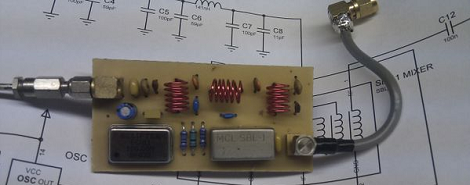
[regveg] was looking for a way to receive signals outside the normal 64-1700MHz range his TV tuner software defined radio dongle can get. After finding a few $100+ upconverters on the Internet, he stumbled across a DIY project that greatly expands the frequencies his RTLSDR can receive.

[George]’s upconverter uses heterodyning to increase the frequencies received by a SDR dongle. The basic idea is mixing a signal from an antenna with a 100MHz frequency oscillator. The resulting output will be λ + 100MHz and λ – 100MHz, allowing for a wider range of frequencies that can be received by the SDR TV tuner dongle.

Now [regveg] has a board and schematic that makes it possible to receive just about anything with his TV tuner dongle. Interestingly, this upconverter contains less than $10 in parts and is easily etched at home thanks to a single-sided construction and through-hole parts.

As a small aside, [Andrew] sent in a tip a few days ago telling us his RTL dongle didn’t have any ESD protection. This is a very bad thing, but the good news is the fix is very cheap: just solder in a 10 cent diode and you’re good to go.

Going To The Park With Your Augmented Reality Girlfriend

Lonely? Bored? Really into J-pop? If you’re any of these things, here’s the build for you. It’s an augmented reality system that allows you to go on a date with one of Japan’s most popular virtual singers.

The character chosen to show off this augmented reality girlfriend tech is [Hatsune Miku], a voice synthesizer personified as a doll-eyed anime  avatar. [Miku] is an immensely popular character in Japan, with thousands of people going to her concerts, so choosing her for this augmented reality girlfriend project was an obvious choice.

The build details for this hack are a little sparse, confounded by the horrible Google Translate results of the blog linked in the YouTube description. From what we can gather from the video and this twitter account, the build is based on an ASUS Xtion Kinect clone and a nice pair of video goggles.

We’re expecting the comments for this post to fill up with, ‘Japan is really weird’ comments, but we can see a few very, very cool applications of this tech. For instance, think how cool it would be to be guided around a science museum by [Einstein], or around Philadelphia by [Ben Franklin].

Set Your Arduino Free With Wifino

[Tod] wrote in to tell us about his latest project. It’s called wifino, and aims to set your Arduino free by offering a web-based IDE, online storage for your Arduino sketches, and even WiFi enabled hardware to upload sketches wirelessly.

The wifino was conceived with the same train of thought as the codebender IDE we saw earlier this week. Instead of only providing a web-based programming environment, the wifino works in conjunction with wifino hardware, meaning you can upload sketches over a wireless connection.

On the software side of things, the wifino IDE features code editing, compiling, and uploading right from a browser. There are plans for a github-style interface in the works, allowing for the easy sharing of Arduino sketches from makers around the world.

[Tod] is planning on getting a Kickstarter underway in the next few weeks to get the wifino boards out into the wild. We’ll be sure to keep you updated with any info or specs that come our way.

You can check out [Tod] uploading code from the Windows and iOS clients after the break.

Continue reading “Set Your Arduino Free With Wifino”

Data Mining And Saving Money With Octopart’s Historical Pricing

[Greg Shikhman] is at Octopart this summer as a software development intern. In between the time he’s spending getting coffee for the other devs, he came up with historical pricing for thousands of components available at Octopart

There’s a lot of cool data out there, like this bit of pricing info for a 555 timer. We’re guessing a few people were out of stock of 555s around the end of May, explaining why they were selling (well, available for) $1.68 a piece. If you’re trying to source components, it might be worth your while to check out Octopart’s historical price index. Buying a PIC microcontroller last August was a roll of the dice; in one day the price changed from $5 to just over $2.

With all this data, it’s even possible to data mine for real life events unrelated to shipping and stocking issues. Japanese manufacturer Renesas was hit pretty hard by last year’s earthquake, and this shows up in the historical prices for one of their microcontrollers. Not bad for an intern’s project.