OpenGL On The Raspi

Perhaps we’ve been concentrating too much on the hardware side of the Raspberry Pi. Sure, connecting the Raspi to the outside world through GPIO pins is cool, but let’s not forget we’re dealing with a full-fledged Linux box here. [chris] is doing his best to keep us in check with by bringing the power of OpenGL graphics to the Raspberry Pi.

Previously, OpenGL ES was only available for xorg but [chris] successfully added support for Raspbian. There’s a great physics demo [chris] put together showing off 128 spheres and cubes bouncing around a plane.

Right now, [chris] is looking for people to contribute samples and tutorials for making accelerated 3D graphics on the Raspi. You can grab all the code over at [chris]’ Git and contact him over on the Raspberry Pi forums if you’d like to help out.

As with any graphics demo, check out the videos after the break.

Continue reading “OpenGL On The Raspi”

Lift Beer With Quadcopters, Win Prizes

If you have a quadcopter and are looking for a beer delivery device, HobbyKing is putting on a beerlift competition The rules for the HobbyKing beer lift are pretty simple: lift the most beer with a quad/hex/octo copter and win a HobbyKing gift card.

There are 3 classes: Unlimited, which means a vehicle of any size goes, a 700 class for copters with a motor-to-motor diameter of 700 mm or less, and a Disaster class for the coolest crash.

So far the largest lift is a monsterous 2 meter octocopter by [Muresan Alexandru Camil] capable of lifting just over 47kg. In the 700 class, a bizarre looking 9-rotor copter built by the Whac-A-Mole flying team was able to lift 28kg.

The disaster category, a smaller quad built by [Gabriel Devault] was barely able to lift four cans of Coors Light water, while the current disaster class leader made a few valiant efforts to lift a keg. Protip: if you’re doing a blooper reel, Yakety Sax is definitely the way to go.

Android Controlled Monitor Stand Uses Marbles As Ball Bearings

[mobile_earth_explorer] sent in an Instructable he put together documenting an Android-controlled rotating monitor stand he built.

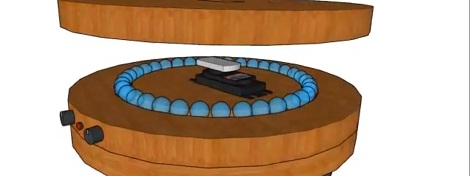
The stand itself is three disks turned on a lathe out of a 18mm thick board. After turning these disks, [mobile_earth_explorer] hopped over to his bench grinder and made a semicircular tool to carve out the track for the ball bearings.

Once the disks could rotate freely on each other, the only thing left was to carve out a space for the servo, Arduino, a pair of pots, and the wiring. The pots control the maximum speed of the monitor stand as well as provide a manual rotation control for when your phone is across the room.

[mobile_earth_explorer] wrote the Android app so up to five of these swiveling monitors can be controlled by just one Arduino; yes, that might be overkill for home or office use, but we’re sure it would be highly useful for some sort of presentation.

You can check out a few videos going over the conception and construction of [mobile_earth_explorer]’s monitor stands after the break.

Continue reading “Android Controlled Monitor Stand Uses Marbles As Ball Bearings”

Turning A Bunch Of Solenoids Into A Performance Of Stomp

Say you have a handful of solenoids, a copy of MaxMSP, an Arduino, and access to a whole bunch of parts in a textile museum. What do you do? If you’re like [Luke], you’ll probably come up with an Arduinofied performance of Stomp, played on dozens of old gears, light fixtures, and various other metal parts.

To control what noise sounds when, [Luke] used a Touch OSC interface running on an iPad to send MIDI information to Ableton. From there, MAX/MSP sends messages to an Arduino to actuate the solenoids on cue. The interface is set up so anyone can make their own compositions by reusing patterns into loops of solenoids making noise. Sure, it’s not the dulcet tones you would expect from a more traditional instrument, but [Luke] manages to put on a good show.

While [Luke]’s instrument may sound overly mechanical and dissonant, it’s entirely possible to replace the objects he’s hitting with the solenoids with something a little more melodious. Putting a few solenoids in a cave wouldn’t be a bad idea; too bad it’s already been done.

3D DLP Printer Builds An Orange TARDIS

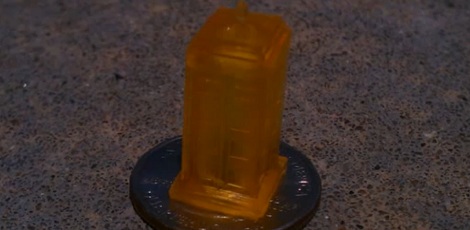
This micro-sized TARDIS is the latest print from [Ron Light]’s Sedgwick 3D DLP printer. Yes, it’s orange, but the print quality for such a small object is pretty astounding.

The Sedgwick 3D printer is currently available as a kit on Kickstarter. For five hundred bones, the Sedgwick provides all the parts – minus a DLP projector and resin – to make your own miniature Type 40 with a broken chameleon circuit. There’s a lot more this printer can do, from miniature cathedrals to hollow geodesic spheres.

This is the latest in what will be a long line of DLP projector / resin 3D printers, and the most affordable one to date. The last one we saw was an awesome $2400 machine that included a projector and resin. At $500 for a projector-less kit, the Sedgwick still handily beats even the cheapest option we’ve seen so far.

[Ron Light] is from Kansas City, and our boss man [Caleb] ran into him at the KC Maker Faire a few weeks ago. You can check out that little interview and a few videos of the Sedgwick doing its thing after the break.

Continue reading “3D DLP Printer Builds An Orange TARDIS”

Television Built From A Tin Can

A tin can and string telephone just doesn’t impress the kids anymore. Luckily, now you can  turn that tin can telephone into a television, as [aussie_bloke] over on the Narrow-Bandwidth Television forum showed us.

[aussie_bloke]’s tin can TV is a mechanical television, a TV where the scanning lines of a CRT is replaced with a spinning disk with very small holes.(if you have a better analogy in this day of LCDs, tell us). Instead of the usual Nipkow disk, [aussie_bloke] used a small tin can.

The image displayed on this TV isn’t very large; there are only 30 scan lines and the pattern of the holes results in a display 10.5mm in width by 7.85mm high. Basically, this display is microscopic but it’s still very impressive.

Sure, you may not be able to sit your kids down in front of this can-powered TV and let them watch Yo Gabba Gabba for hours on end, but it’s more than enough to impress those technically minded kids.

You can check out a video of [aussie_bloke]’s can TV after the break. Thanks [gary] for sending this in.

Continue reading “Television Built From A Tin Can”

Raspberry Pi Prototyping Boards Available At Adafruit

If you’re one of the lucky few with a Raspberry Pi, adafruit has two things you might be interested in if you’re into GPIO hacking.

First up is the Pi Cobbler kit. It’s a 2×13 ribbon cable with a breakout PCB ready to attach to a solderless breadboard; perfect for playing around with (or cobbling together… get it?) the GPIO pins on your Raspi.

Next up is the Pi Plate kit that comes complete with enough perfboard space, screw terminals, and female headers to kill a yak. All the GPIO, I2C, and SPI pins are broken out on the Pi Plate, making it very easy to prototype a semi-permanent Raspi circuit.

They might be just prototyping boards now, but we expect these Pi Plates to quickly evolve into a truly useful device with the addition of a few level shifters, port expanders and a few ADCs and DAC thrown in for good measure. If you’re still on the fence and thinking about buying a Raspi, I ordered one last week from element14 and now have an expected ship date of November 5th. These things must be really popular.