Press Play On Tape For Your Fignition

[Julian Skidmore] has been busy improving the Fignition, a tiny AVR-powered educational computer, to support loading programs from a cassette tape.

We first saw the Fignition after the BBC decided to cover an old-school hacker dedicated to improving computer education with a simple ‘bare-metal’ computer. [Julian]’s Fignition harkens back to the days of very simple computers like the BBC Micro and the TRS-80, and encourages students to work with PEEKs and POKEs instead of the decades of cruft that have accumulated on our laptops and desktops.

Because the Fignition is designed to hacker and student-friendly, it’s entirely possible to build a keyboard, or even build a Fignition on stripboard. Now, these students have much improved hardware that allows for saving and loading programs to tape (or any audio recorder) , and even a graphic video mode with 160×160 resolution.

We know it seems a little weird, but kids graduating High School this year were born in 1994, and in all probability have never laid their eyes on a Commodore 64, Sinclair Spectrum, or the other 1980s microcomputers an entire generation learned on. The Fignition is an attempt to stem the tide of ignorant masses unaware of how far the computer has progressed in the last 30 years, and we love it for that.


Bodging Up A Diesel Motorcycle

[Alex] has been working on a diesel motorcycle project for a few months now, and the project is finally bearing fruit. It’s quite an accomplishment for something [Alex] describes as an industrial Chinese engine, a modded Honda Superdream, and a few Royal Enfield parts thrown in for good measure.

[Alex] bought his Honda CB400 from someone who had already done a diesel motor conversion; a 200cc single-cylinder motor provided just enough horsepower to putt around town. [Alex] wanted a bike that could keep up with highway speeds, so he replaced the wimpy 200cc motor with a 406cc diesel engine used for industrial purposes and an amr500 supercharger.

Although we’ve seen a few insane motorcycle builds, most of Hackaday’s bike builds focus on electric or scavenged parts motorcycles. If you’ve got an awesome motorcycle build you’ve been working on, send it in on the tip line.

You can check out the video of [Alex] testing out his new motor with vegetable oil (for him, it’s easier than getting diesel fuel) after the break.

Continue reading “Bodging Up A Diesel Motorcycle”

[Dino]’s One-year Extravaganza Is A Laser Oscillograph

Readers of Hackaday may have noticed the weekly posts featuring whatever [Dino Segovis] of Hack A Week has cooked up in the last seven days. For [Dino]’s one-year anniversary, he’s pulled out all the stops and put together one of his coolest hacks to date. It’s a laser oscillograph that projects waveforms on a screen just like an oscilloscope. What’s more, the entire contraption is built out of a dead hard drive and a few motors and mirrors [Dino] had lying around.

The build uses an old hard drive to draw the vertical component of the waveform. Because hard drives usually use a voice coil to move the heads around the platter, it’s very easy to connect a hard drive directly to the headphone output of [Dino]’s laptop. Playing a sine wave on his computer makes the drive heads move up and down, but [Dino] still another dimension. For that, he used a rotating mirror that reflects the wave onto a paper screen.

[Dino]’s finished build isn’t that much different from an oscilloscope or projection TV. It’s possible for [Dino] to improve upon his build and make a genuine vector display with the addition of additional electronics and optics, but we’re not expecting that until at least the two-year anniversary.

Check out [Dino]’s build video after the break.

Continue reading “[Dino]’s One-year Extravaganza Is A Laser Oscillograph”

Putting Multitasking On An AVR

[vinod] wanted to familiarize himself with AVR assembly programming, but wanted to do something a little more ambitious than simply blinking an LED. While the completed build does blink a few LEDs, we love that e decided to implement multitasking on his microcontroller.

The program [vinod] came up with uses round robin scheduling to give one of the seven programmed tasks a little bit of compute time every time a timer is triggered. Although it’s extremely simple compared to “real-life” real-time operating systems like VxWorks, it’s still an impressive achievement.

In the video after the break, [vinod] shows off his task-switching with seven LEDs. The white LED is a PWM task, while the six other LEDs are simple toggling tasks  that switch a LED on and off at set intervals independent of each other. This would be hard – if not impossible – to do without some sort of scheduling. Nice work, [vinod].

Continue reading “Putting Multitasking On An AVR”

Turning A Rotary Tool Into A PCB Drill Press

Drilling holes in PCBs is nearly always an exercise in compromise; the holes are small, precision is paramount, and the common solutions, such as a Dremel drill press, aren’t of the highest quality. In a quest to find the best way to drill holes in PCBs, [reboots] even went so far as to get a pneumatic dental drill, but nothing short of a high-quality micro drill press would do. Not wanting to spend hundreds of dollars to drill a few holes, [reboots] did the sensible thing and made one from scratch.

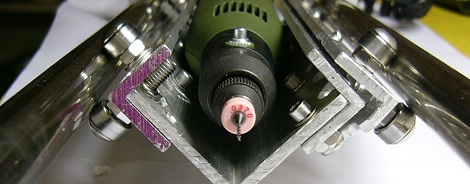
[reboots] ended up buying a Proxxon Micromot 50 after reading the consistently good reviews around the Internet. To use this rotary tool as a drill press required more work, though. Two precision steel rods from a dot matrix printer were salvaged and pieces of aluminum C-channel and small bearings were bolted together into a very high-precision drill press. Only hand tools were used to build this drill press, and the results are amazing.

[reboots] was originally inspired to check out Proxxon tools from one of Hack a Day’s rare tool reviews. The Proxxon TBM115/220 earned the skull ‘n wrenches seal of approval (and found its way into other Hack a Day-ers labs), but sometimes a few hundred dollars is too much of an investment for something only used occasionally. Considering [reboots]’ scrap aluminum drill press is a better tool than the sloppy consumer rotary tool presses, we’ll call this a success.

SimpleCortex, For When An Arduino Is Too Wimpy

Sometimes, an Arduino just doesn’t have enough horsepower. Whether you’re gathering loads of sensor data and sending it over the web via Ethernet, or just trying to build a home-brew video game, it’s very easy to run into the limitations of the Arduino platform. [Rik] and his fellow classmates may have a solution to this problem with their SimpleCortex development board.

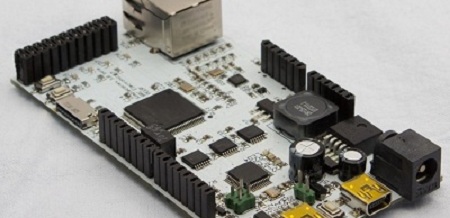
The SimpleCortex began as an answer to the Arduinos [Rik] and his classmates had to use at school.  The SimpleCortex gets its name from an ARM Cortex M3 microcontroller running at 120MHz; more than fast enough to do some very interesting things, and 512kB of Flash to hold much larger programs.

The Arduino IDE is admittedly terrible, and big projects are a pain in the butt with a tiny 8-bit micro. SimpleCortex improves upon this development environment by using the free CoCenter IDE put out by CooCox. The CoCenter IDE supports debugging and code completion, standard features on any serious desktop programming environment.

The SimpleCortex has Arduino-compatable header pins, so it should be easy to use existing shields, like the 3G modem we saw this week and the NTSC video IO shield that can do object tracking. While the specs of the SimpleCortex put it in a distant second to the Raspberry Pi, sometimes you just don’t need Linux, but a standard AVR or PIC isn’t quite enough.

There’s no word on when this board will be available, but the team is working with ITead Studio to officially release boards into the wild.

Self-stabilizing Autonomous Bicycle

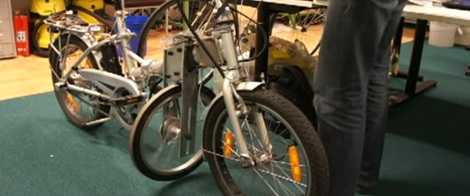
For [Gunnar]’s diploma thesis, he wanted to build an autonomous bicycle. There’s an obvious problem with this idea, though: how, exactly does a robotic bicycle stand upright? His solution to balancing the bicycle was a reaction wheel that keeps the bicycle upright at all times.

A bicycle is basically an inverted pendulum; something we’ve seen controlled in a number of projects. To balance his driver-less bike, [Gunnar] used a stabilizing wheel and an IMU to make sure the bicycle is always in the upright position. The bike measure the tilt and angular velocity of itself, along with the speed of the stabilizing wheel. To correct a tilt to the left, the stabilizing wheel spins clockwise, and corrects a rightward tilt by spinning counterclockwise.

While [Gunnar]’s solution of a bike wheel used as a gyroscope is clever – it uses common bicycle wheel, hugely reducing costs if someone wants to replicate this project – there’s not a whole lot of ground clearance. The size of the stabilizing wheel could probably be reduced by replacing the 7.4 kg steel wheel with a Tungsten, Osmium, or Lead disk, possibly becoming so small it could fit inside the frame. Still, though, a very nice build that is sure to turn a few heads.

Continue reading “Self-stabilizing Autonomous Bicycle”