Controlling A DSLR With A Nintendo DS

At Hack a Day, we’ve seen dozens of intervalometer builds that open and close a camera shutter remotely. [Luke Skaff] decided to take these builds to the next level by automating a camera’s focus and shutter with a Nintendo DS.

[Luke]’s build is based on the Open Camera Controller project that puts the power of an intervalometer, sound trigger, sequencer, and HDR bracket shooting into the hands of professional photogaphers. The Open Camera Controller is built to run on a Nintendo DS with an AVR-based card attached to the Game Boy Advance cartridge port.

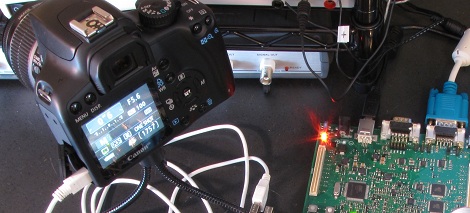
The Open Camera Controller attaches to a camera’s shutter port, but [Luke] stepped things up a little bit by using a USB host controller and implementing the picture transfer protocol. Now, instead of [Luke]’s controller telling his camera when to open and close the shutter, the focus of the camera can be adjusted as well. [Luke]’s build uses an Xilinx CoolRunner-II CPLD and a USB host controller to convert the DS cartridge port to a USB port every DSLR can connect to.

[Luke] still has a mess of wires on his hand, but even we can see the power that inexpensive automation would bring to the world of digital photography.
Continue reading “Controlling A DSLR With A Nintendo DS”

Avoid Shaky Camera Movements With Gyroscopic Stabilization

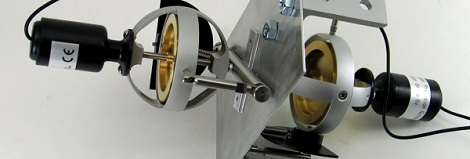
Right after “no editing whatsoever”, the “shaky camera” is the bane of YouTube viewers the world over. [David] came up with a nice solution to the problem of shaky cameras that uses gyroscopes to even out the bumps of making a great movie.

Most cameras attached to moving frames – from the zip-line cameras at NFL games to police helicopters and aerial reconnaissance drones – have some sort of gyroscopic stabilization. Even though gyroscopic stabilization has been around for more than 60 years, the designs haven’t changed that much. [David] dug up a few patents dating from the 50s and set to work replicating the design.

[David] bought a pair of [Glenn Turner]’s fabulously heavy and expensive-looking powered gyroscopes and began bolting them onto a piece of sheet metal. Per the 1950 patent, the gyroscopes were mounted 90 degrees apart and bolted onto the camera.

From the video demo (after the break), there’s a marked difference between filming a stroll though a parking lot with the gyros on and gyros off. While the pair of motor driven gyroscopes look a little ungainly and are a bit too loud for our tastes, the solution is much less expensive than the $1600 professional gyro [David] based his build on.

Continue reading “Avoid Shaky Camera Movements With Gyroscopic Stabilization”

Control An Arduino From Android Over Bluetooth

Whether you’d like to do some real-time logging of data, or just want to control a project with your Android phone, [Thomas]’s Arduino-Android Bluetooth connection instructable is sure to be useful

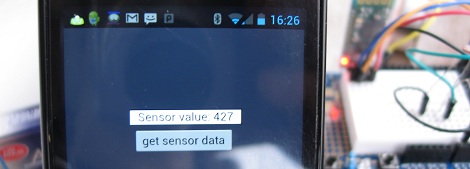
[Thomas]’ build uses the very inexpensive JY-MCU Bluetooth module that’s available on eBay or dealextreme. This Bluetooth module ties directly into the Tx and Rx lines of the Arduino so a wireless serial connection between an Android device can be established. On the Android side of the build, Python for Android and the Scripting Layer for Android allow for reading wireless sensor data over Bluetooth.

While connecting an Android device to an Arduino is also possible with an IOIO  or an Android Open Accessory dev kit, we haven’t seen much (barring this) about controlling or reading simple electronics with Android over Bluetooth. Sometimes you just don’t need an awesome dev board to bodge up a simple project, so we hope [Thomas]’s very nice instructable will help get a few more builds off the ground.

The Spud Gun To End All Spud Guns

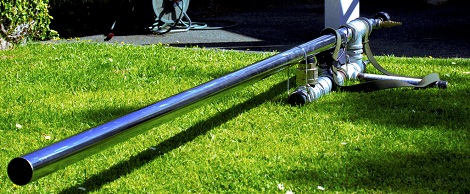
In Norse mythology, Mjöllnir is the hammer of Thor, forged in a contest to create the most wondrous and munificent tool for the gods of Asgard. While we’re not aware if [MrCrowley] recently made a bet with Loki, his version of Mjöllnir, a gigantic spud gun powered by MAPP gas, is wondrous enough for our tastes.

Unlike most of the other spud guns we’ve seen, [MrCrowley] eschewed the use of PVC pipe and fittings in his build because that would explode on the first test fire. Instead, the gun uses galvanized and stainless steel for the majority of the construction. That’s not to say this spud gun is necessarily safe, though: as he demonstrates in the video after the break, golf balls exit the barrel with a comparable energy to most rifle rounds.

For an interesting take on an ignition system, [MrCrowley] built a remote ignition system out of a wireless doorbell and a 100kV stun gun. While this does allow for remote firing, the entire build seems safe enough – from behind the muzzle, at least – to be carried with a rifle strap.

It should go without saying that this is incredibly dangerous and you shouldn’t build this if you’re not planning on your last words being, “Wanna see something cool? Hold my beer.” That being said, [MrCrowley] knows what he’s doing, and you can check out the video of Mjöllnir in action after the break.

Continue reading “The Spud Gun To End All Spud Guns”

Testing An Open Source PID Controller With Steak

Sous vide cookers aren’t anything new, but [Phil] wanted to build the first sous vide using the osPID, an open source PID controller just released in the last month.

The build uses the osPID Open Source PID controller we saw last week that comes with inputs for a thermocouple and pair of relays capable of switching a hot plate or immersion heater. The osPID is based on the Arduino and was created by [Brett Beauregard], author of the Arduino PID library.

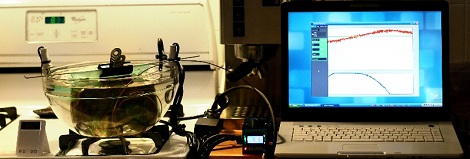
Getting to the meat and potatoes of the build, [Phil] connected a 300 Watt immersion heater to the osPID and put the heater in a bowl of water. A delicious looking cut of beef tenderloin was shoved into a ziplock bag and suspended in the bowl of warm water for a few hours. With the heater and thermocouple attached to the osPID, the temperature was set at 130° F and the entire device was left alone for a few hours. Looking at [Phil]’s recipe for tenderloin with lemon parsley butter whets our taste buds, so we’ll hope [Phil]’s dinner came out just fine.

Becoming The YouTube Loading Animation

Whether you’re used to dropped wifi connections, or your housemates are using up all the bandwidth for streaming, we’ve all see the spinning octet of disks that is the YouTube loading animation. [technocrat] thought it would be a great idea to actually become YouTube and set out on designing a physical manifestation of the loading animation.

[technocrat] used eight ping-pong balls as the main structure of the build. After drilling each ping-pong ball and gluing white LEDs in, the only thing left was to connect everything up to an Arduino. The code loops through each LED and provides the ‘light trail’ animation YouTube has burned into our memory.

To complete the build, [technocrat] attached his physical loading animation to a black t-shirt emblazoned with the YouTube logo to make everything more understandable. While it may not be as colorful as the beachball of death or as conceptual as the Windows ‘spinning hourglass’, we’re really liking this build. Check out the video after the break.

Continue reading “Becoming The YouTube Loading Animation”

Over Engineering Windshield Wipers To Sync To Music

In the late 90s, Volkswagen aired a series of awesome television advertisements that won a few awards relevant to those in advertising circles. One of these ads was titled Synchronicity and showed a VW Jetta’s windshield wipers (among other things) syncing to music as the car drove down a rainy alley. [ch00f] thought beat tracking wipers would make for a great project, and we love the sheer amount of engineering that went into this build.

The build began with [ch00f] taking apart his wiper motor to get some specifics for his build. Ideally, a rotary encoder would be very useful for this project, but designing a durable encoder would be a pain anyway. [ch00f] had to settle with the ‘parking pins’ on the wiper gear motor that allow the wipers to be driven in intermittent mode.

[ch00f] spent a great deal of time writing code that would guarantee a constant wiper speed, but that didn’t solve the problem of phase, or having the wipers begin or end their cycle on the beat. This problem was somewhat solved (as you can see in the video after the break) by using a feed forward system – basically, the software would predict the change in phase needed and correct it by changing the speed.

The build still isn’t perfect, although that’s mainly due to the placement of wiper parking switch on the wiper motor. [ch00f] plans on spending a little more time correcting the wiper speed/phase control with software, but what he’s got now is still very impressive.

Continue reading “Over Engineering Windshield Wipers To Sync To Music”