FPGA Bitcoin Miner Is Probably The Most Power Efficient.

[fpgaminer], [li_gangyi], and [newMeat1] have been working together for the last few months to build an FPGA bitcoin miner that blows GPU mining rigs out of the water in terms of power efficiency. The board requires only 6.8 watts for 100 Mhashes/second, but [li_gangyi]’s blog says the team expects to hit 150-200 Mhashes with some improvements. That’s efficiency GPUs can’t touch.

Bitcoins are a digital currency that are ‘mined’ by calculating hashes that verify bitcoin transactions. While mining operations can be performed on a CPU, graphics cards and FPGAs beat CPUs by several orders of magnitude in terms of how many hashes can be performed per second.

The heart of the board is a Spartan-6 LX150 FPGA – a pricey bit of kit – and the team is selling each board for $440 USD. For that amount of money, you could buy two ATI 6770s at half the price and crunch four times as many hashes a second. At less than 7 watts, though, we wouldn’t worry too much about cooling the rig and the electricity costs will be very low.

High Voltage: Controlling A Flyback Transformer With An Arduino

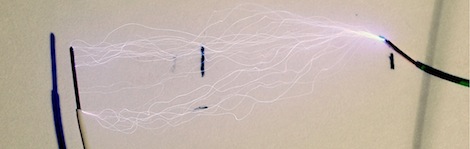
If you’d like to build a Jacob’s ladder, an ignition system for a flamethrower, or for some ungodly reason you need 15 kilovolts for a prop replica or cosplay build, this one is for you. It’s an easy to build high voltage power supply that interfaces with an Arduino.

After harvesting a flyback from the power board of a CRT, [Andrew Moser] added a new primary coil to the transformer. This boosts 12 volts that can be easily controlled by an Arduino to something that will arc an inch and a half. The next step building the flyback driver. [Andrew] used a MOSFET and MOSFET driver for this circuit (although he says this guy works without the driver). After that, all that’s left to do is write some software and test it out.

Of course this comes with the boilerplate warning, “If you don’t know what you’re doing, you might die.” That being said, if you ever wanted to test out an Arduino’s resistance to EMP, this is the project for you. Check out the flyback powering a Jacob’s ladder after the break.

Continue reading “High Voltage: Controlling A Flyback Transformer With An Arduino”

High Voltage Hacks: Shrinking Coins

The anthem for the Great Recession might be something along the lines of, “That we’re gonna do it anyway, even if doesn’t pay.” Some men just want to watch the world burn, so Hackerbot Labs posted a great walkthrough about shrinking coins and in the process making our pocket change worth just a little bit more.

Their build pushes 15,000 Joules (from a 10kV 300μF cap) through a coil of wire wrapped around a coin. This creates a magnetic field in the coil and the coin. These two fields repel each other, and there’s only one way that it can end: the coin shrinks and the coil of wire explodes. The team at Hackerbot Labs linked to a great theory of operations that does a great job explaining the physics has some awesome pictures.

During our research, we saw a few questions about the legality of altering currency. According to the U.S. Code, shrinking coins only illegal if it’s done fraudulently, like shrinking a penny down to the size of a dime to fool a pay phone or vending machine. Check out a video of the Hackerbot Labs setup putting as much energy as 100 heart defibrillators into a coin after the break.

Continue reading “High Voltage Hacks: Shrinking Coins”

Heathkit Is Back From The Dead

Although now it’s impossible for a DIY nut to build electronics for less money than a factory, this wasn’t always the case. For 45 years, Heathkit produced inexpensive kits for just about everything. Heathkit closed it’s kit business in 1992, but now they’re back. They’re starting out with a few DIY kits at first, namely an ultrasonic garage parking assistant and a wireless swimming pool monitor.

Heathkit is calling all builders to submit their ideas for future kits. While this comeback rings of some other outlets with a rich heritage, Heathkit is still remembered fondly; Barry Goldwater jetted out to the Heath HQ twice a year for kits. Not many people are that attached to Realistic and Optimus gear.

If you’re wondering about the kind of stuff Heathkit offered, feel free to check out the 1984 catalog that features computers with 128kB of RAM available for only $1899.00 (yes, a very competitive price)

Tip ‘o the hat to [Jeffrey Bail (N1BMX)].

Meet Radio Shack’s New Parallax Lineup

It looks like Radio Shack is pretty serious about their new found commitment to their focus on the DIY, inventor, creator and geek demographics. [Ken Gracey], Parallax forum guru, put up a post on the Parallax stuff that will be sold at Radio Shack. Everything is priced, “below spousal approval level,” but no word on what those prices are.

Here’s the (probably not conclusive) list we gleaned from the pics: 2-axis joystick, gyroscope, GPS, compass and altimeter modules, an infrared sensor, 2×16 backlit LCD, BASIC stamp 2 board, and an XBee 2-pack that we assume would be priced above girlfriend approval levels.

We’re curious about how many (and in what quantity) of these items will be stocked at the East Nowheresville strip mall, and again there’s no mention of improving the selection of individual components.

At Hack A Day, we were thinking how amazing a Radio Shack ‘component vending machine’ would be. A modified pick and place machine that will dole out caps, resistors, other components, and has the potential to be competitive with online stores. Anyone feel like sending that suggestion in?

Robotic Artist Listens To Your Criticism

[Ben Grosser] built an interactive painting robot that’s pretty far removed from the LED and Arduino builds we usually see. The robot is adapted from one of the many CNC routers we’ve featured over the years. The control system is written in Python and uses genetic algorithms and a microphone to decide what to paint next.

Robot artists have been around for decades now. When [Harold Cohen] exhibited his robotic artist AARON, gallery patrons lined up to watch a robot paint. The paintings were originally just a monochrome line drawing that was later colored in by [Cohen]. [Ben] made his robot paint directly onto canvas with oil paints, so there’s no question of what the computer intends the final product to be.

[Ben] came up with a really neat build, but we’re wondering about having this robot artist on display inside a cavernous exhibition hall. Surely the echos from the servos and stepper motors would be picked up by the mic and interpreted by the painting algorithm. Barring some control systems, it would probably be the robot’s commentary on its own decent into madness.

Check out a video of the robot in action after the break, followed by a violin/robot duet the shows how the audio is interpreted.

Continue reading “Robotic Artist Listens To Your Criticism”

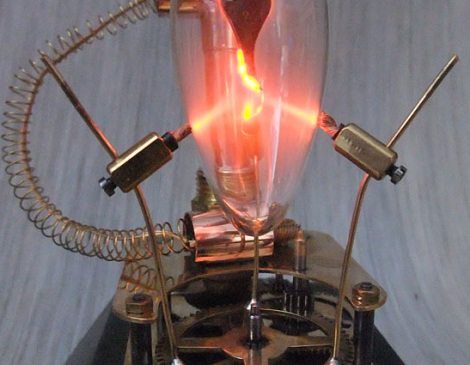
High Voltage Plasma Lamp Is Also Tasteful Steampunk

Instructables user [Admiral Aaron Ravensdale] just finished a high voltage plasma bulb build that makes creative use of off-the-shelf parts. As a self-described steampunk, [Adm. Ravensdale] also earned some cred by included working gears in his build.

The heart of the build is a “flicker flame” candle light bulb. These light bulbs have two flame-shaped plates inside the bulb to act as electrodes. Instead of the Argon that normally fills an incandescent light bulb, the candle bulb is filled with Neon. When excited, Argon gives off a rather unnatural purple glow – not very convincing for a simulated candle and certainly not steampunk. The Neon in the flickering candle bulb gives off a brilliant orange, perfect for simulating a flame and will surely impress the duchess during afternoon tea.

After the right plasma bulb was found, [The Admiral] scavenged the rest of the high voltage electronics from disposable cameras. Attaching three electrodes to a brass gear, the entire mechanism was made to spin using parts from an old clock and a CD drive motor. We’re always impressed with the scavenging abilities of steampunkers – we’d still be waiting for our gears to arrive if we attempted this. Check out the video of this really cool and very inexpensive plasma bulb after the break.

Continue reading “High Voltage Plasma Lamp Is Also Tasteful Steampunk”