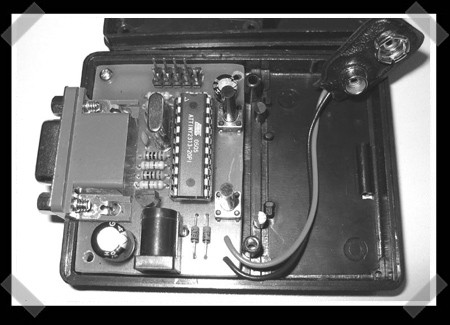
Deogen, Tiny Monitor Tester


Deogen is a small, self contained device for testing monitors. It was designed back in 2000 to reduce the amount of space and effort required to test monitors in a computer shop. The initial design used an AT90S1200 microcontroller to generate test patterns for the monitors. Being about the size of a portable CD player, it was much easier to take to any monitor and plug in for testing.

Version two of the device, pictured above, is much smaller, being about the width and height of a credit card. The depth is slightly larger than a 9 volt battery. Compared to the last vga test project we ran, this one is tiny. The unit boasts a decent set of features, such as; eight test patterns at four different resolutions, battery or DC power, and small form factor.

The processor of version two is an ATtiny2313 at 20MHz, and controls the H sync and V sync signals directly. The RGB is converted to analog using a resister network. The power circuit is custom made for low power consumption, though they note that a 78L05 equivalent unit could be used in its place.

The plans for the PCB and the software are available from their site. Head on over and check out some pictures of it in action.

[Thanks, Philip Fitzgerald]
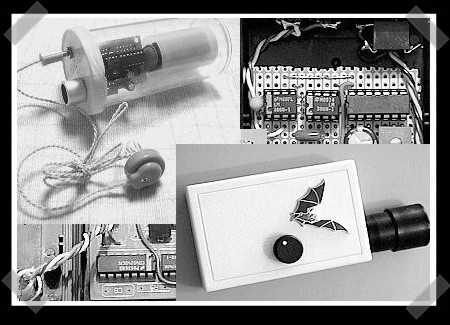
Build A Simple Bat Detector


[Tony Messina] had been fascinated with bat’s echolocation since he was a kid. After he retired, he decided to act on this fascination and built a simple bat detector.

The simple bat detector uses frequency division to lower the bat’s chirping to a frequency we can hear. For example, if a bat is calling at 91kHz the system will divide it by 16 and put out 5.7kHz. The system is digital, so all amplitude is lost. You’ll just hear clicks like a Geiger counter. Being digital has its advantages though. Unlike similar analog devices that have to be tuned to a small frequency range, the simple bat detector can detect a much wider window.

Continue reading “Build A Simple Bat Detector”

Tablo, Fabric Gesture Controller


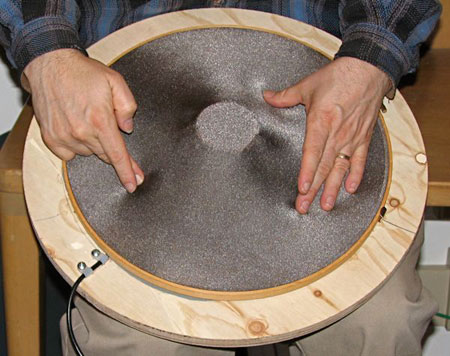
[Adrian Freed] posted this interesting fabric gesture controller called Tablo. It uses a stretchy conductive fabric, laid over a framework to create a curve known as the Witch of Agnesi. Holding the center of the fabric up is an inverted bowl covered with sections of conductive material. The whole thing is wired to a microcontroller that measures the resistance fluctuations when you press on the fabric. It is capable of measuring displacement and pressure as well as being multitouch.

They mention that the simple interface allows it to be used as a foot input as well as a hand input. We’d love to see a video of it in action.

UnMouse Cheap Multitouch Prototype


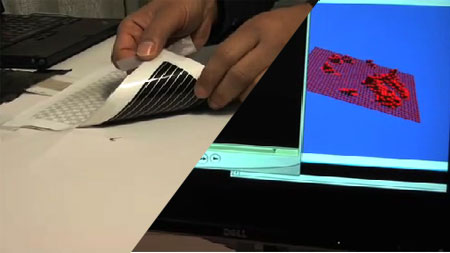
A Microsoft research team has delivered a prototype called the UnMouse that could really be a big hit. This unit is a mouse pad sized sensor that is multitouch and pressure sensitive. It is flexible and thin enough to roll up. The article mentions that the construction of the device is “dirt cheap”. This is very exciting; is this the next mouse?

The idea of having low cost multitouch input is very enticing. While there are many ways to do multitouch right now, most are limited by their large size due to projector/camera setups or high cost such as the iPhone. A portable (fits in your laptop bag) pressure sensitive multitouch input device is something that a lot of people have been craving for a while.

Just imagine the uses. Audio engineers could create new interfaces on the fly. You could draw a key map on piece of paper and just lay it on top. Graphic designers could use different sized and shaped brushes. Gamers could make their own ergonomically comfortable gaming layouts. How about covering one in Velcro and attaching buttons to it?

Russian Homemade Telescope


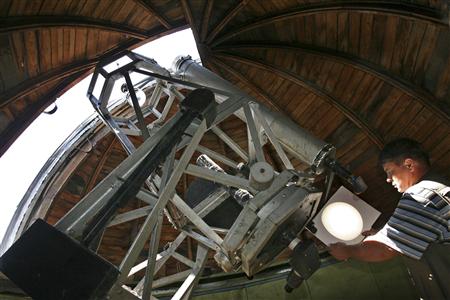
In the Russian city of Barnaul, some enthusiasts are gathering their resources to revive a home made telescope and observatory. Built by [Mikhail Levchenko], in the mid 70’s, the telescope is quite impressive. [Levchenko] kept his hobby somewhat of a secret so as not to arouse the suspicions of his neighbors, but its pretty hard to hide a tower as tall as a house with a domed observatory on top. The telescope itself has a 16 inch glass lens that provides 500x magnification. His hobby would turn out to have a pretty big impact on the town. People would come to him hoping that his telescope could tell their fortunes. Not a believer in horoscopes, he tried to educate people with lessons in astronomy and physics. One man was said to have given up drinking after seeing Saturn.

[Levchenko] passed away in 2002 and his observatory fell into disrepair. Local thieves tried to steal pieces for scrap and the whole structure has sunken somewhat. Some of those who were inspired when young by [Levchenko] have decided to renovate it for the eclipse. Barnaul will be a prime location for viewing. The total renovation and possible relocation will cost around 2 million dollars.

In the past, we covered a high powered telescope made by some girl scouts, and this $40 USB telescope looks fun too.

Robot Red Snapper


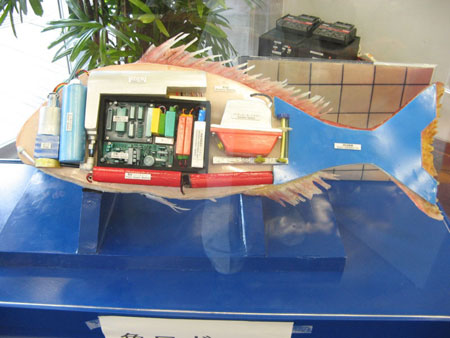
Engineers at the University of Kitakyushu have built this red snapper robot. Intended for wildlife surveys, this robot sports an array of sensors as well as a hand painted silicon body. It is decidedly more realistic looking than the Robofish and the Essex University robot fish. They say that the life like construction will aid in getting information about natural behavior of sea animals since it won’t stand out. It features a “unique” propulsion system that allows it to swim like a real fish. More information on that system would be nice. You can see more pictures of it here, but the descriptions are all in Japanese.

Continue reading “Robot Red Snapper”

Bubbloo Interactive Floor Display


Bubbloo is an interactive display at the Denver Art Museum. They appear to be embracing a more interactive approach to displaying some of their art and information. One of their displays, shown above, features a pair of projection systems working together to make a game. As you pop the bubbles, the artwork is displayed. You can see it definitely helps keep the kids amused.

While the technology used isn’t exactly new, its a good example of how effective interactive displays can be. Even if they are just there to distract the kids so the parents can look at art.

The floor projection systems don’t seem as though they would be that difficult to make. We’ve seen interactive projection displays using Wiimotes made in peoples homes, but what about one of these? How would you handle the input without an accessory like a light pen or reflective tape? The Wisdom Well uses Frustrated Total Internal Reflection and rear projection. Reactrix, a manufacturer of these systems uses infrared sensors as well as some kind of floor sensor. [Lawrence Lau] has made one, but didn’t post any information. If you make one and let us know.