Arduino-Controlled Marquee Arrow Points The Way To Whatever You Like

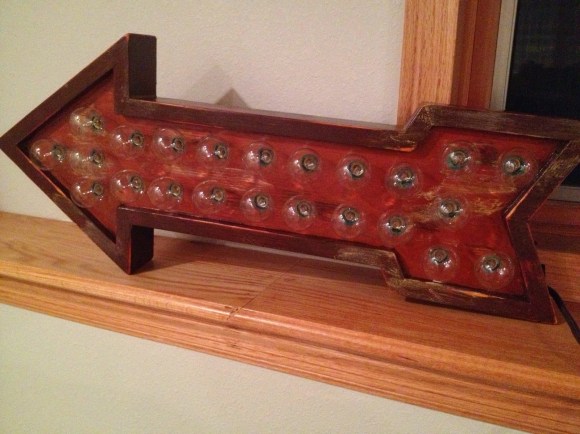
Reader [pscmpf] really digs the scrolling light look of old marquee signs and as soon as he saw some Christmas lights with G40 bulbs, he was on his way to creating his own vintage-look marquee arrow.
We must agree that those bulbs really do look like old marquee lights or small vanity globes. [pscmpf] started by building, varnishing, and distressing the wooden box to display the lights and house the electronics. He controls the lights with an Arduino Pro and an SSR controller board. The 24 lights are divided into ten sections; each of these has its own solid-state relay circuit built around an MC3042 as the opto-coupler, with a power supply he made from a scrap transformer.

[pscmpf] shares some but not all of his code as it is pretty long. There are five patterns that each play at three different speeds in addition to a continuous ‘on’ state. In his demonstration video after the jump, he runs through all the patterns using a momentary switch. This hack proves that Arduino-controlled Christmas lights are awesome year-round.

Continue reading “Arduino-Controlled Marquee Arrow Points The Way To Whatever You Like”

Peltier Mini-Fridge Preserves Chip Quik, Marriage

[Charles] uses Chip Quik to solder his SMD parts, and that stuff can keep for more than six months if it’s kept cool. His wife banned all non-food items from their refrigerator, so he had to think fast and came up with this Peltier effect Chip Quik cooler.
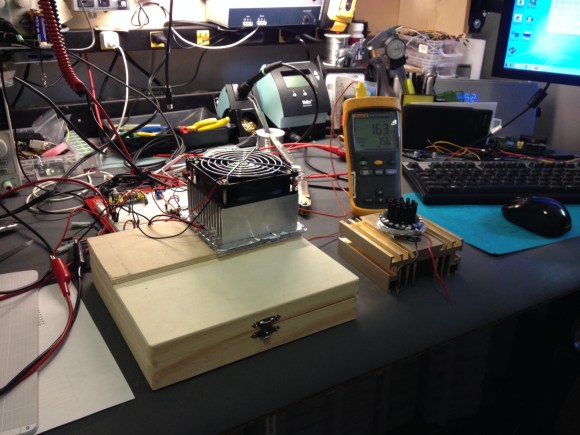
He first looked into that man cave essential, the mini-fridge, but they’re too expensive and use too much power. [Charles] got a nice wooden box from a hobby store and some reflective insulation from Lowe’s. He first tried using a couple of heat sinks but they weren’t going to cool things down enough. Once he got a Peltier cooling kit, he was in business. The temperature in his workshop averages 80°F, and he says the box gets down to 58°F. This is cold enough to keep his paste fresh.

[Charles] plans to use a PC power supply in the future rather than his bench supply. He estimates that his Peltier cooler uses 25-50% of the power that a mini-fridge would, and now his wife won’t overheat. Many great things can be accomplished with the Peltier effect from air conditioning to sous-vide cooking to LED rings. What have you used it for?

Happiness Is Just A Flaming Oxy-Fuel Torch Away

The Egg-Bot is pretty awesome, we must say. But if you have one, you end up with lot of delicate, round things rolling around your abode and getting underfoot. Warmer weather is just around the corner, so segue from spring gaiety to hot fun in the summertime with the MarshMallowMatic kit from [Evil Mad Scientist].

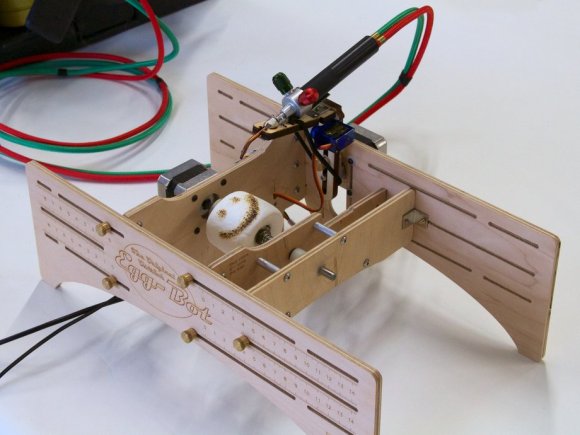
The MarshMallowMatic is a CNC oxy-fuel precision marshmallow toaster based on the Ostrich Egg-Bot design. Constructed from flame-retardant plywood, it is sure to add an element of delicious danger to children’s birthday parties and weekend wingdings alike. You don’t have to get too specific with those BYOM invitations because this bad boy will torch standard and jumbo marshmallows like a boss.

The kit includes a 5000°F oxy-fuel torch and a 20 ft³ oxygen tank, but the tank comes empty and you’ll have to supply your own propane, acetylene,  or hydrogen. It comes with adapters to fit disposable propane and MAPP cylinders, which are also not included. However, you will receive a fine selection of sample marshmallows to get you started. Watch the MarshMallowMatic fire up some happiness after the break. You could toast a special message and load it into this face-tracking confectionery cannon to show how much you care.

Continue reading “Happiness Is Just A Flaming Oxy-Fuel Torch Away”

Dr. Frankenstein’s Wireless Xbox One Steering Wheel

Buy an Xbox One controller and hack it immediately? That’s exactly what [tEEonE] did so he could merge it with a Simraceway SRW-S1 steering wheel. He loves racing games and was psyched to play Forza 5. He already had the steering wheel, but it’s strictly a PC peripheral. [tEEonE] wanted the wheel to control the steering, gas, and brakes and found both the XB1 controller and the SRW-S1 well-suited to the hack.
For steering, [tEEonE] substituted the SRW-S1’s accelerometer for the XB1’s left joystick pot. He connected the X and Y to analog pins on an Arduino Pro. Then he mapped the rotation angles to voltage levels using a DAC and wired that to the XB1 joystick output. The XB1 controller uses Hall effect sensors and magnets on the triggers to control the gas and brake. He removed these and wired the SRW-S1 paddles to their outputs and the XB1 controller is none the wiser.

He also rigged up a 3-point control system to control the sensitivity and calibrate the angles: a button to toggle through menu items and two touch modules to increment and decrement the value. These he wired up to a feedback interface made by reusing a 15-LED strip from the SRW-S1. Finally, he had space left inside the housing for the XB1’s big rumble motors and was able to attach the small motors to the gas and brake paddles with the help of some 3-D printed attachments. Check out this awesome hack in action after the break.


Continue reading “Dr. Frankenstein’s Wireless Xbox One Steering Wheel”

LEGO® My Single-Phase Induction Motor

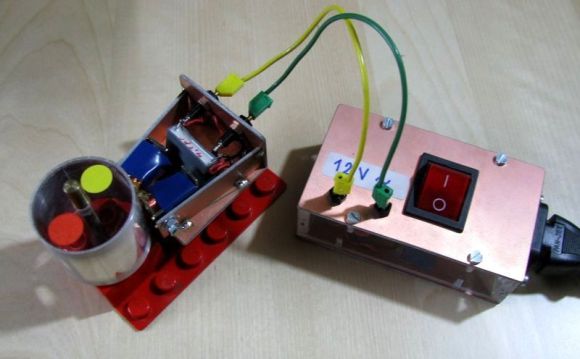
[Diato556] made a really cool single-phase induction motor with parts mounted on Duplo blocks. He has posted an Instructable where he uses these modular parts to  demonstrate the motor and the principles of induction as described after the jump.


Continue reading “LEGO® My Single-Phase Induction Motor”

Energy-Saving Fireplace Thermostat

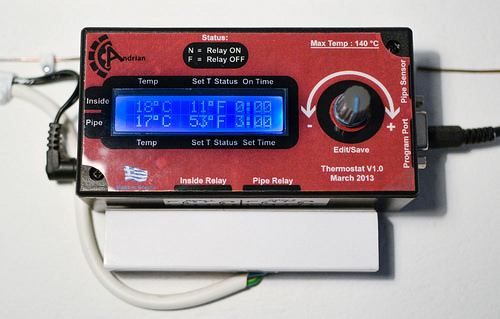
[Andrian] has a boiler stove that heats water and sends it to a radiator. As the fireplace heats the water in a boiler a temperature sensor opens the a valve to send the warm water to the radiator. The radiator sends its cool water back to the boiler to be reheated. The valve is slow, so before the boiler can send all the water to the radiator, it’s getting cool water back causing the valve to close while the heat is built back up. To prevent the valve from working so hard and wasting energy, [Andrian] designed a better thermostat to control the valve operation.

The thermostat uses one LM85 temperature sensor to check the water in the boiler and another one for the ambient temperature. Once the boiler water reaches the desired temperature, the valve is opened via relay. The system waits for half an hour and then checks the boiler temperature again. The brains of this operation is an ATMega168 with a 32.768kHz crystal as the RTC. Code and PCB files are available in his repo.

We love to see these types of hacks that challenge the status quo and increase the efficiency of appliances. We applaud you, [Andrian], for turning your dissatisfaction into a positive plan of action and for sharing your experience with the rest of us!

If you want to up the eco-friendliness of heating water a bit, you could heat the water with a compost heap.

An Etch-A-Sketch To Fetch The Time

For someone who has never used stepper motors, real-time clocks, or built anything from scratch, [Dodgey99] has done a great job of bending them to his will while building his Etch-A-Sketch clock.

He used two 5V stepper motors with ULN2003 drivers. These motors are mounted on the back and rotate the knobs via pulleys. They are kind of slow; it takes about 2 1/2 minutes to draw the time, but the point of the hack is to watch the Etch-A-Sketch. [Dodgey99] is working to replace these steppers with Nema 17 motors which are much faster. [Dodgey99] used an EasyDriver for Arduino to drive them. He’s got an Arduino chip kit in this clock to save on the BOM, but you could use a regular Arduino. He left out the 5V regulator because the EasyDriver has one.

[Dodgey99] has published three sketches for the clock: one to set up the RTC so that the correct time is displayed once the Etch-A-Sketch is finished, some code to test the hardware and sample the look of the digits, and the main code to replace the test code.

The icing on this timekeeping cake is the acrylic base and mounting he’s fashioned. During his mounting trials, he learned a valuable lesson about drilling holes into an Etch-A-Sketch. You can’t shake an Etch-A-Sketch programmatically, so he rotates it with a Nema 17. Check it out after the jump.

If you’re paying attention, you’ll realize we just saw the exact opposite of this project a few hours ago: a CNC tool (laser cutter) controlled by turning Etch-A-Sketch knobs.

Continue reading “An Etch-A-Sketch To Fetch The Time”