Heat Shrink Tubing And The Chemistry Behind Its Magic

There’s a lot to be said in favor of getting kids involved in hacking as young as possible, but there is one thing about working in electronics that I believe is best left as a mystery until at least the teenage years — hide the shrink tube. Teach them to breadboard, have them learn resistor color codes and Ohm’s Law, and even teach them to solder. But don’t you dare let them near the heat shrink tubing. Foolishly reveal that magical stuff to kids, and if there’s a heat source anywhere nearby I guarantee they’ll blow through your entire stock of the expensive stuff the minute you turn your back. Ask me how I know.

I jest, but only partly. There really is something fun about applying heat shrink tubing, and there’s no denying how satisfying a termination can be when it’s hermetically sealed inside that little piece of inexplicably expensive tubing. But how does the stuff even work in the first place?

Continue reading “Heat Shrink Tubing And The Chemistry Behind Its Magic”
Google Calendar Interface For Your Internet Of Lawns

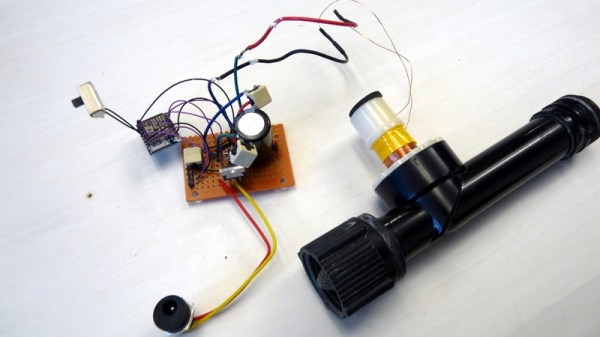
If you live somewhere where summers are hot and dry, you can instantly tell which homes don’t have automatic sprinklers installed. Or they may have them installed, but like the blinking “12:00” on that VCR of yore, the owners may not have mastered the art of programming the controller. To be fair, the UI on most residential irrigation controllers is a bit wanting, which is the rationale behind letting Google Calendar tell your sprinklers when it’s time to water.

Granted, someone who is mystified by setting a digital clock is not likely to pull off [ClemRz]’s build. It’s still pretty simple stuff, though, centered around an ESP8266 as it is. And calling the result an “irrigation system” is a little bit of a stretch, given that it could only support a single zone with a solenoid valve harvested from a defunct sprinkler timer. But as a proof-of-concept, or to water a small area, it hits all the marks. The ESP8266 drives the latching solenoid valve through an H-bridge chip after reading your Google Calendar and looking for upcoming events to open or close the valve. The Google Script and the ESP8266 code default to failsafe so that a mistake doesn’t leave the valve open and run up your water bill or drain your well.

It’s easy to see how this can be expanded to control a multi-zone irrigation system and support a smartphone UI for instant control of the valves. Overrides based on weather forecasts would be a nice feature too. Or you could just read the soil moisture levels directly with backscatter sensors.

Customize Your Ratios With A 3D-Printed Gearbox

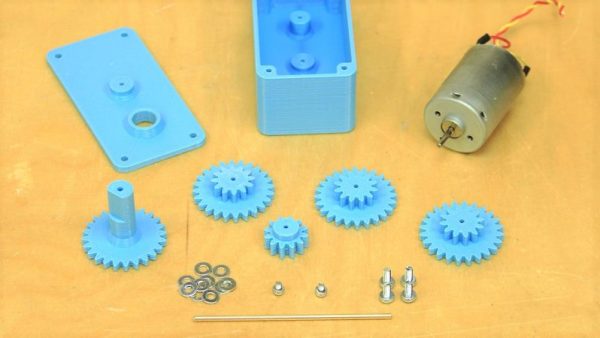
Small DC motors are easy to find — you can harvest dozens from old printers and copiers. You might even get a few with decent gearboxes too. But will you get exactly the motor with exactly the gearing your project needs? Unlikely, but you can always just print a gearbox to get exactly what you need.

There’s nothing fancy about [fortzero]’s gearboxes. The motors are junk bin specials, and the gears are all simple spur gears 3D-printed from PLA. There are four gears in the train, each with a 2:1 reduction, giving a 16:1 overall ratio. The gears ride on brass shafts that are press-fit into the housing, and there’s not a bearing in sight — just a few washers to keep the gears spaced apart and plenty of grease. Despite the simplicity, the gearboxes turned out to be pretty capable, lifting a 3.5 kg load. The design files are available and should make it easy for you to get just the ratio you want for the motor you have.

Of course more complicated gearboxes are possible with a 3D printer, including a split-harmonic planetary gear, or a strain wave gear using a timing belt. No 3D printer? No problem! Just build a LEGO gearbox.

Continue reading “Customize Your Ratios With A 3D-Printed Gearbox”

Lights Out In Québec: The 1989 Geomagnetic Storm

I found myself staring up at the sky on the night of March 13, 1989, with my girlfriend and her parents in the backyard of their house. The sky was on fire, almost literally. Red and pink sheets of plasma streamed out in a circle from directly overhead, with blue-white streaks like xenon flashes occasionally strobing across the sky. We could actually hear a sizzling, crackling sound around us. The four of us stood there, awestruck by the aurora borealis we were lucky enough to witness.

At the same time, lights were winking out a couple of hundred miles north in Québec province. The same solar storm that was mesmerizing me was causing fits for Hydro-Québec, the provincial power authority, tripping circuit breakers and wreaking havoc. This certainly wasn’t the first time the Sun threw a fit and broke systems on Earth, but it was pretty dramatic, and there are some lessons to be learned from it and other solar outbursts.

Continue reading “Lights Out In Québec: The 1989 Geomagnetic Storm”

Custom Media Center Maintains Look Of 70s Audio Components

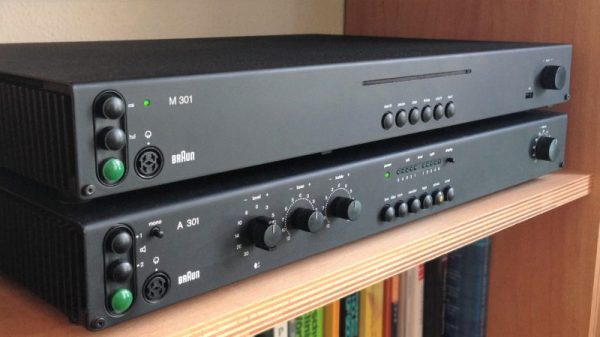
Slotting a modern media center into an old stereo usually means adding Bluetooth and a Raspberry Pi to an amp or receiver, and maybe adding a few discrete connectors on the back panel. But this media center for a late-70s Braun hi-fi (translated) goes many steps beyond that — it fabricates a component that never existed.

The article is in German, and the Google translation is a little spotty, but it’s pretty clear what [Sebastian Schwarzmeier] is going for here. The Braun Studio Line of audio components was pretty sleek, and to avoid disturbing the lines of his stack, he decided to create a completely new component and dub it the “M301.”

The gutted chassis of an existing but defunct A301 amplifier became the new home for a Mac Mini, Blu-Ray drive, and external hard drive. An HDMI port added to the back panel blends in with the original connectors seamlessly. But the breathtaking bit is a custom replacement hood that looks like what the Braun designers would have come up with if “media center” had been a term in the 70s.

From the brushed aluminum finish, to the controls, to the logo and lettering, everything about the component that never was shows an attention to detail that really impresses. But if you prefer racks of servers to racks of audio gear, this media center built into a server chassis is sure to please too.

Thanks to [Sascho] and [NoApple4Me] for the nearly simultaneous tips on this one.

Industrial Indicator Makes The Move From PLC To FPGA

Industrial controls are fun to use in a build because they’re just so — well, industrial. They’re chunky and built to take a beating, both from the operating environment and the users. They’re often power guzzlers, though, so knowing how to convert an industrial indicator for microcontroller use might be a handy skill to have.

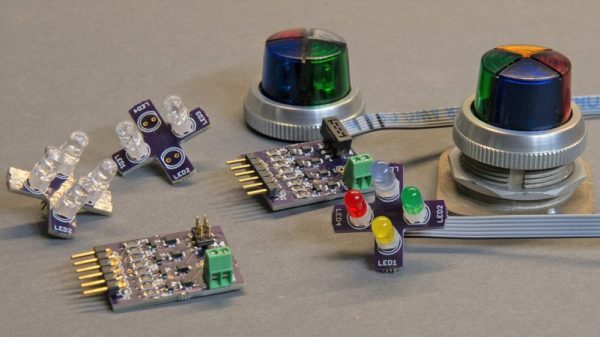
Having decided that an Allen-Bradley cluster indicator worked with the aesthetic of his project, a Halloween prop of some sort, [Glen] set about dissecting the controls. Industrial indicators usually make that a simple task so that they can be configured for different voltages in the field, and it turned out that the easiest approach to replacing the power-hungry incandescent bulbs with LEDs was to build a tiny PCB to fit inside the four-color lens.

The uniquely shaped board ended up being too small for even series resistors for the LEDs, so a separate driver board was also fabbed. The driver board is set up to allow a single 5-volt supply and logic levels of 3.3-volt or 5-volt, making the indicator compatible with just about anything. The finished product lends a suitably sinister look to the prop.

If you’re not familiar with the programmable logic controllers such an indicator would be used with in the field, then maybe you should try running Pong on a PLC for a little background.

Vintage Telegraph Sounder Clicks Again

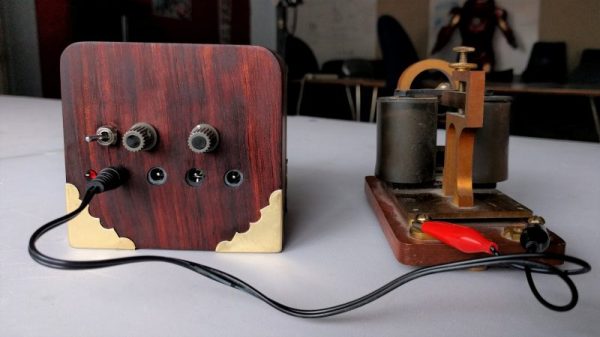
It’s sad, when you think about it: a retired railroad telegraph operator, who probably once pounded out code at 40 words per minute, with a collection of vintage sounders silently gathering dust on a shelf. [kthrace] decided to do something about that, and built this Morse sender to bring those old sounders back to life.

As archaic as Morse might seem, it’s a life skill, one the 92-year old former brass-pounder for whom this was built was eager to practice again. There are code practice oscillators, of course, but dits and dahs are no substitutes for the electromagnetic clicks and clacks that once filled this old fellow’s days. There’s not much information on the circuit, but it looks like [kthrace] chose a RedBoard to read Morse from an SD card and drive some relays to support up to four sounders; that’ll make a racket! The case is custom made and nicely complements the wood and brass of the J.H. Bunnell and Co. sounder, which still sounds great after all these years.

Test your Morse skills in the video below – copying code is a lot harder from a sounder than from an oscillator. Find yourself in need of practice? We’ve got you covered.

Continue reading “Vintage Telegraph Sounder Clicks Again”