Manhattan Marauder’s Map

If you solemnly swear that you are up to no good, and you happen to spend most of your time in Manhattan below the mid-90s, then you will appreciate this Raspberry Pi-based Manhattan Marauder’s Map.

Not that a Harry Potter-themed map was necessarily [GawkyFuse]’s intention when creating this interesting build; it’s just that the old-time print of Manhattan — it shows Welfare Island in the East River, which was renamed Roosevelt Island in 1971 — lends a nice vintage feel to the build. Printed on plain paper, the map overlays a 64×32-LED matrix, which is driven by a matrix HAT riding atop the Pi 3.

[GawkyFuse] uses the OwnTracks app on his and his wife’s iPhone to report their locations back to CloudMQTT. The Pi subscribes to the broker and updates his location in red and her location in blue as they move about the city; a romantic touch is showing a single purple dot when they’re together. There’s no word on what’s displayed when either leaves the map area, but the 2048-pixel display offers a lot of possibilities.

We’ve seen a Weasley clock or two around these parts before, but strangely no Marauder’s Maps like this one. Although this Austrian tram-tracking map comes pretty close to [GawkyFuse]’s nice design.

[via r/raspberry_pi]
Microswitches: Past The Tipping Point

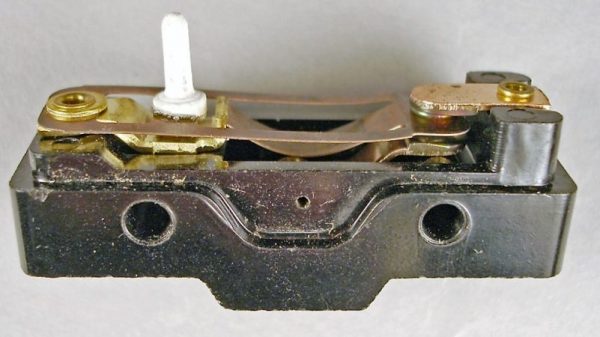
You find them everywhere from 3D printers to jet airliners. They’re the little switches that detect paper jams in your printer, or the big armored switches that sense when the elevator car is on the right floor. They’re microswitches, or more properly miniature snap-action switches, and they’re so common you may never have wondered what’s going on inside them. But the story behind how these switches were invented and the principle of physics at work in the guts of these tiny and useful switches are both pretty interesting.

Continue reading “Microswitches: Past The Tipping Point”

Hackaday Prize Entry: Wearable Micro Pump Treats Your Fever For You

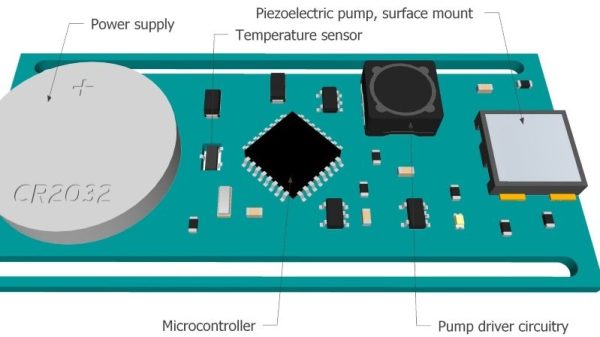
Would you strap a tiny pump to your body and let it dose you with medication based on your current vital signs? Most people wouldn’t, while some would appreciate the convenience, and many have no choice. [M. Bindhammer]’s 2017 Hackaday Prize entry, dubbed Sense-Aid, seeks to democratize the drug delivery process somewhat by building a sensor package linked to a tiny surface-mount pump into a single wearable device.

His chosen initial therapeutic area is fever, given that it’s easy to diagnose non-invasively with a simple thermistor and straightforward to treat with antipyretics like acetaminophen. Aside from the obvious regulatory hurdles such a device would face, he’s got a bunch of technical challenges to address. Surprisingly, sourcing a surface-mount pump is not one of them, although finding a medication to pump with it is. Anecdotally, a professor acquaintance of ours used to relate his sure-fire hangover cure: an aspirin tablet dissolved in the polar aprotic solvent dimethyl sulfoxide (DMSO) and absorbed directly through the skin for immediate relief. The story may have been apocryphal, and it certainly sounds like a bad idea, but such solvents may be one way of pumping medications non-invasively.

Obviously, this is only a concept at this point, as [M. Bindhammer] hasn’t even built a prototype yet. But that’s exactly what the first phase of the 2017 Hackaday Prize is all about: Design Your Concept. It may seem like a crazy idea, but at least it’s an idea, and that’s the first step. Have you submitted your idea yet? There’s still plenty of time.

Desktop Factory Teaches PLC Programming

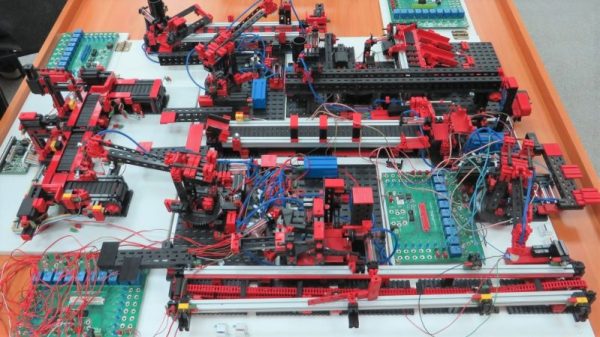
How to train young engineers in industrial automation is a thorny issue. Most factories have big things that can do a lot of damage and cost tons of money if the newbie causes a crash. Solution: shrink the factory down to desktop size and let them practice on that.

Luckily for [Vadim], there’s an off-the-shelf solution for miniaturizing factory automation: FischerTechnik industrial training models. The models have motors, conveyors, pneumatic cylinders, and sensors galore, but the controller is not exactly the industry standard programmable logic controller (PLC). [Vadim] set out to remedy this by building an interface between the FischerTechnik models and a Siemens PLC. He went through a couple of revisions of his board, including one using rivets from the sewing store to interface with the FischerTechnic connectors. Eventually, he settled on more robust connectors and came up with a board that lets students delve into PLC programming without killing anyone. The video below shows it going through its paces; we can only imagine where playing with these kits as a kid would have led us.

As great as [Vadim]’s system is for training engineers, we can also see it helpful in getting kids interested in a career in industrial automation. We recently covered a similar effort to show kids big science using LEGO Mindstorms. Both of these can help get STEM kids to see the wider world of technical careers and perhaps steer them into automation. After all, the people who make the robots are probably going to be the last ones obsoleted, right?

Continue reading “Desktop Factory Teaches PLC Programming”

Interactive Board Prompts Moves For Checkers And Chess

In terms of equipment, chess and checkers are simple games — just a handful of pieces and a checkered gameboard. The simplicity belies the underlying complexity of the games, though, and goes a long way toward explaining their popularity over the millennia.

Increasing the complexity with an interactive game board for chess and checkers might seem counterintuitive, then. But [Bogdan Berg]’s project aims to not only teach checkers and chess but to make games a little more exciting and engaging. Looking a little like a tabletop version of the interactive dance floors we’ve been seeing a lot of lately, the board is built from laser-cut acrylic with plywood dividers to isolate all 64 squares. Neopixels and Hall-effect sensors are mounted to custom PCBs that stretch the length of a row and are wired to an Arduino Mega with lots of IO. Game pieces are colorful fridge magnets. [Bogdan]’s current program supports checkers and keeps track of where the pieces have been moved relative to their starting position and prompts users with possible legal moves.

[Bogdan]’s board already looks like a lot of fun in the video below, and we like the quality of the build and the unobtrusive nature of the interactivity. When he gets around to implementing chess, though, he might want something fancier than fridge magnets for game pieces.

Continue reading “Interactive Board Prompts Moves For Checkers And Chess”

Hackaday Prize Entry: Breathe Your Troubles Away

Navy SEALs and other highly trained special forces operators all know a simple, basic fact – you’ve got to breathe to live. That seems self-evident, but breathing control is immensely important to being able to perform at a high level in stressful situations. But even if you never anticipate being under fire, you can learn the SEAL way of breathing with this visual aid.

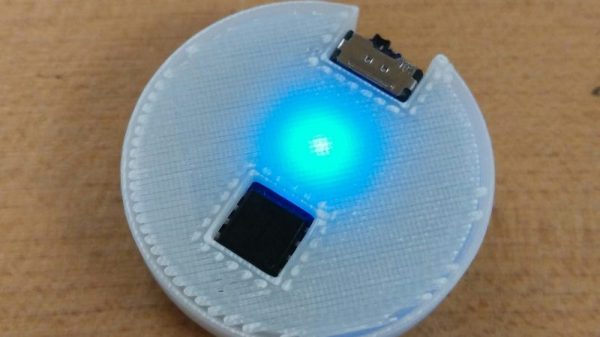
Lest you think that Box Breathing, also known as the four-square breathing technique, is some sort of New Age nonsense, recent research has uncovered the neurological basis for the feeling of calm that can come over someone taking slow, deep, even breaths. But in the heat of the moment, remembering to square your breaths can be a little difficult. [Lim Han Yang] decided that a portable visual cue could help, so he put an ATTiny85, an LED, and a coin cell battery on a tiny circular PCB and spun up a simple translucent dome out of PLA. The blue LED has a soothing appearance behind the diffuser as it goes through a 16-second cycle, ramping up in brightness for four seconds, holding steady for four, then dimming and finally staying dark. The idea is to breathe in sync with the light to get relief from stress.

No build files are posted yet, but we hope to see them soon – we can think of a few people this would benefit greatly. In the meantime, if you’re still looking for that New Age breathing experience, you can always breathe with the psychedelic flowers.

Measuring Tiny Masses Acoustically

How do you measure the mass of something really, really tiny? Like fish-embryo tiny. There aren’t many scales with the sensitivity and the resolution to make meaningful measurements in the nanogram range, so you’ve got to turn to other methods, like measuring changes in the resonant frequency of a glass tube. And that turns out to be cheap and easy for the home gamer to reproduce.

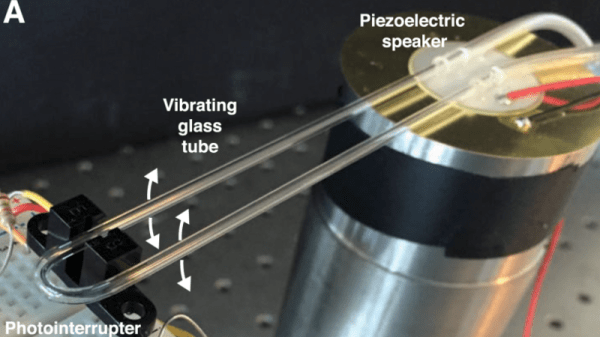
In a recent scholarly paper, [William Grover] et al from the University of California Riverside outline the surprisingly simple and clever method of weighing zebrafish embryos, an important model organism used in all sorts of developmental biology and environmental research. [Grover]’s method is a scaled-up version of a suspended microchannel resonator (SMR), a microelectromechanical device that can measure the mass of single cells or even weigh a virus particle. Rather than etch the resonator out of silicon, a U-shaped glass tube is vibrated by a piezoelectric speaker and kept at its resonant frequency by feedback from a cheap photointerrupter. When an embryo is pumped into the tube, the slight change in mass alters the resonant frequency of the system, which is easily detected by the photointerrupter. The technique can even be leveraged to measure volume and density of the embryos, and all for about $12 in parts.

In the lab, [Grover]’s team uses a data acquisition card and LabVIEW to run the resonant loop, but there’s no reason a DIY version of this couldn’t use an Arduino. In fact, tipster [Douglas Miller] expects someone out there will try this, and would appreciate hearing the details. You can ping him on his hackaday.io page.