Two-Piece Boxes Thanks To Laser-Cut Flex Hinges

It sounds like a challenge from a [Martin Gardner] math puzzle from the Scientific American of days gone by: is it possible to build a three-dimensional wooden box with only two surfaces? It turns out it is, if you bend the rules and bend the wood to make living hinge boxes with a laser cutter.

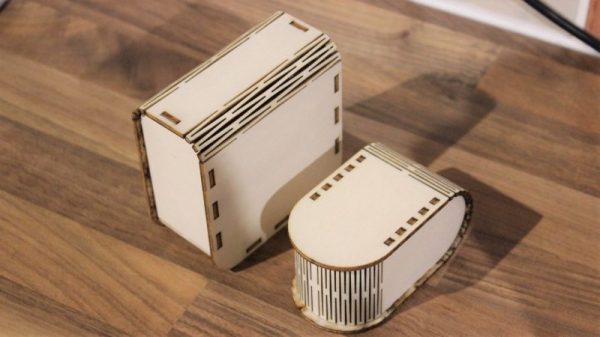
[Martin Raynsford] clearly wasn’t setting out to probe the limits of topology with these boxes, but they’re a pretty neat trick nonetheless. The key to these boxes is the narrow to non-existent kerf left by a laser cutter that makes interference fits with wood a reality. [Martin]’s design leverages the slot and tab connection we’re used to seeing in laser-cut boxes, but adds a living flex-hinge to curve each piece of plywood into a U-shape. The two pieces are then nested together like those old aluminum hobby enclosures from Radio Shack. His GitHub has OpenSCAD scripts to parametrically create two different styles of two-piece boxes so you can scale it up or (somewhat) down according to your needs. There’s also a more traditional three-piece box, and any of them might be a great choice for a control panel or small Arduino enclosure. And as a bonus, the flex-hinge provides ventilation.

Need slots and tabs for boxes but you’re more familiar with FreeCAD? These parametric scripts will get you started, and we’ll bet you can port the flex-hinge bit easily, too.


A Walk-In Broadcast Transmitter

[Mr. Carlson] likes electronics gear. Mostly old gear. The grayer the case, the greener the phosphors, and the more hammertone, the better. That’s why we’re not surprised to see him with a mammoth AM radio station transmitter in his shop. That it’s a transmitter that you can walk into while it’s energized was a bit of a surprise, though.

As radio station transmitters go, [Mr. Carlson]’s Gates BC-250-GY broadcast transmitter is actually pretty small, especially for 1940s-vintage gear. It has a 250 watt output and was used as a nighttime transmitter; AM stations are typically required to operate at reduced power when the ionosphere is favorable for skip on the medium frequency bands. Stations often use separate day and night transmitters rather than just dialing back the daytime flamethrower; this allows plenty of time for maintenance with no interruptions to programming.

If you enjoy old broadcast gear, the tour of this transmitter, which has been rebuilt for use in the ham bands, will be a real treat. Feast your eyes on those lovely old bakelite knobs and the Simpson and Westinghouse meters, and picture a broadcast engineer in white short sleeves and skinny tie making notations on a clipboard. The transmitter is just as lovely on the inside — once the plate power supply is shut down, of course, lest [Mr. Carlson] quickly become [the former late Mr. Carlson] upon stepping inside. Honestly, there aren’t that many components inside, but what’s there is big – huge transformer, giant potato slicer variable caps, wirewound resistors the size of paper towel tubes, and five enormous, glowing vacuum tubes.

It’s a pretty neat bit of broadcasting history, and it’s a treat to see it so lovingly restored. [Mr. Carlson] teases us with other, yet larger daytime transmitters he has yet to restore, and we can’t wait for that tour. Until then, perhaps we can just review [Mr. Crosley]’s giant Cincinnati transmitter from the 1920s and wait patiently.

Continue reading “A Walk-In Broadcast Transmitter”

The Other Way To Brick A Mac Classic

Why would you build a mini Mac Classic using LEGO and a Raspberry Pi? Well, why wouldn’t you?

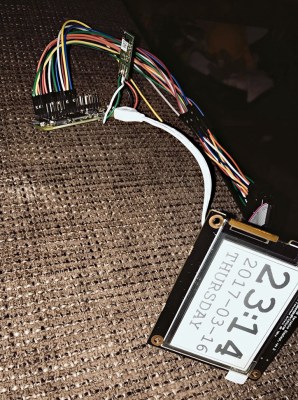
[Jannis Hermanns] couldn’t find a reason to control this outburst of nostalgia for the good old days of small, expensive computers and long hours spent clawing through the LEGO bin to find The Perfect Piece to finish a build. It turns out that the computer part of this replica was the easy part — it’s just an e-paper display driven by a Raspberry Pi Zero. Building the case was another matter, though.

After a parti-colored prototype with whatever bricks he had on hand, a session of LEGO Digital Designer led him to just the right combination of bricks to build an accurate case, almost. It turns out that the stock selection of bricks in LDD won’t allow for the proper proportions for the case, so he ordered the all-white bricks and busted out the Dremel. LEGO purists may want to avert their eyes from the ABS gore within, but in the end the case worked out and the whole build looks great.

Fancy a full-size Mac Classic reboot? How about this iPad docking station? Or if tiny and nostalgic is really your thing, this retro-future terminal build is pretty keen too.

[via r/raspberry_pi]

Landscape To Portrait At The Click Of A Mouse

Modern 16:9 aspect ratio monitors may be great for watching a widescreen movie on Netflix, but for most PDFs, Word documents, and certain web pages, landscape just won’t do. But if you’re not writing the next great American novel and aren’t willing to commit to portrait mode, don’t — build an auto-rotating monitor to switch your aspect ratio on the fly.

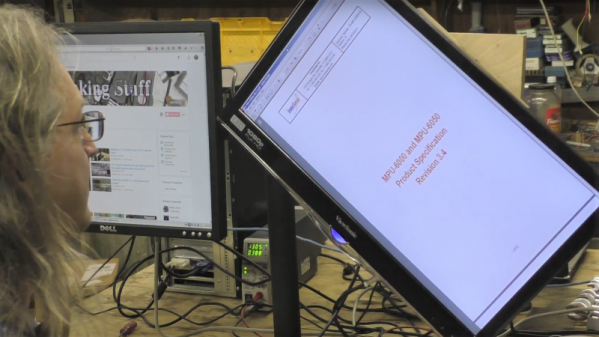
Like many of us, [Bob] finds certain content less than suitable for the cinematic format that’s become the standard for monitors. His fix is simple in concept, but a little challenging to engineer. Using a lazy susan as a giant bearing, [Bob] built a swivel that can be powered by a NEMA 23 stepper and a 3D-printed sector of a ring gear. Due to the narrow clearance between the top and bottom of the lazy susan, [Bob] had to do considerable finagling to get through holes for the mounting hardware located, but in the end the whole thing worked great.

Our only quibble would be welding galvanized pipe for the stand, which always gives us the willies. But we will admit the tube notching turned out great with just a paper template. We doubt it would have been much better if he used an amped-up plasma-powered tubing notcher.

Continue reading “Landscape To Portrait At The Click Of A Mouse”

EDM For The Cheap And Adventurous

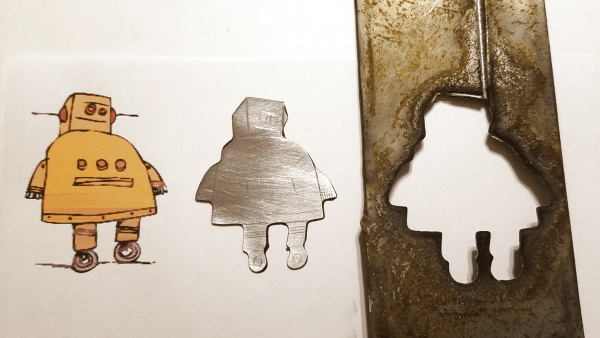
Laser cutters, waterjets, plasma cutters, CNC routers – most hackerspaces and even many dedicated home-gamers seem to have some kind of fancy tool for cutting sheet goods into intricate shapes. But with no access to a CNC machine and a need to cut a complex shape from sheet metal, [AlchemistDagger] cooked up this bare-bones and somewhat dangerous EDM rig to get the job done.

Electric discharge machining has been around for decades and is used a lot for harder metals like titanium and tool steel. The process makes sense to anyone who has seen contacts pitted and corroded by repeated arcing – an electric arc is used to remove metal from the workpiece, with a dielectric fluid used to cool the workpiece and flush away debris. For [AlchemistDagger]’s purposes, a lot of the complicated refinements, like high-frequency power supplies and precise tool positioning, were ignored. He built a simple linear slide to manually control the tool position, and the power supply was just a bridge rectifier connected to the 120-volt mains with some filter capacitors and a big light bulb as a ballast resistor. While the video below shows electrical conduit being notched, [AlchemistDagger] also made a brass cookie-cutter style tool to cut the Instructables logo from steel.

Obviously, mixing water and electricity is a recipe for disaster is you’re not careful, but this low-end EDM technique is a good one to file away for a rainy day. And if you’re looking for a little more sophistication in your homebrew EDM rig, we’ve got you covered there too. Continue reading “EDM For The Cheap And Adventurous”

LEGO Liquid Handler And Big Biology

A career as a lab biologist can take many forms, but the general public seems to see it as a lone, lab-coated researcher sitting at a bench, setting up a series of in vitro experiments by hand in small tubes or streaking out a little yeast on an agar plate. That’s not inaccurate at all – all of us lab rats have done time with a manual pipettor while trying to keep track of which tube in the ice bucket gets which solution. It’s tedious stuff.

But because biology experiments generally scale well, and because more data often leads to better conclusions, life science processes can quickly grow beyond what can be handled manually. I’ve seen this time and again in my 25 years in science, from my crude grad school attempts to miniaturize my assays and automate data collection to the multi-million dollar robotic systems I built in my career in the pharmaceutical industry. Biology can get pretty big in a hurry. Continue reading “LEGO Liquid Handler And Big Biology”

Linear Clock Slows The Fugit Of The Tempus

We feature a lot of clocks here on Hackaday, and lately most of them seem to be Nixie clocks. Not that there’s anything wrong with that, but every once in a while it’s nice to see something different. And this electromechanical rack and pinion clock is certainly different.

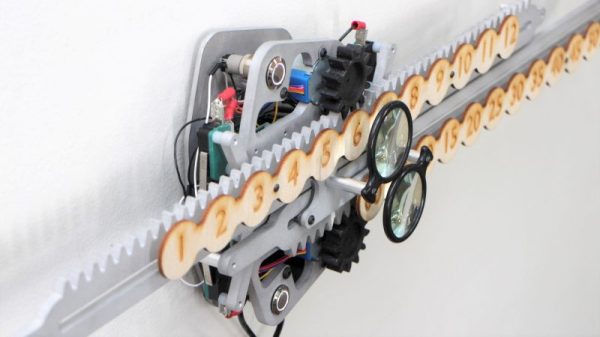
[JON-A-TRON] calls his clock a “perpetual clock,” perhaps in a nod to perpetual calendars. But in our opinion, all clocks are perpetual, so we’ll stick with “linear clock.” Whatever you call it, it’s pretty neat. The hour and minute indicators are laser cut and engraved plywood, each riding on a rack and pinion. Two steppers advance each rack incrementally, so the resolution of the clock is five minutes. [JON-A-TRON] hints that this was a design decision, in part to slow the perceived pace of time, an idea we can get behind. But as a practical matter, it greatly simplified the gear train; it would have taken a horologist like [Chris] at ClickSpring to figure out how to gear this with only one prime mover.

In the end, we really like the look of this clock, and the selection of materials adds to the aesthetic. And if you’re going to do a Nixie clock build, do us a favor and at least make it levitate.

Continue reading “Linear Clock Slows The Fugit Of The Tempus”