The Briny Depths Give Wine An Edge, But How?

Though Hackaday scribes have been known to imbibe a few glasses in their time, it’s fair to say that we are not a wine critic site. When a news piece floated by about a company getting into trouble for illegally submerging crates of wine though, our ears pricked up. Why are vintners dumping their products in the sea?

Making wine, or indeed any alcoholic beverage, starts with taking a base liquor, be it grape juice, apple juice, barley malt solution, or whatever, and fermenting it with a yeast culture to produce alcohol. The result is a drink that’s intoxicating but rough, and the magic that turns it into a connoisseur’s tipple happens subsequently as it matures. The environment in which the maturation happens has a huge influence on this, which is one of many reasons why wine from the cellar of a medieval chateau tastes better than that from an industrial unit in southern England. The Californian company was attempting to speed up this process by leaving the bottles beneath the waves. Continue reading “The Briny Depths Give Wine An Edge, But How?”


GTA 6 Hacker Found To Be Teen With Amazon Fire Stick In Small Town Hotel Room

International cybercrime, as portrayed by the movies and mass media, is a high-stakes game of shadowy government agencies and state-sponsored hacking groups. Hollywood casting will wheel out a character in a black hoodie and shades, probably carrying a metallic briefcase as they board an executive jet.

These things aren’t supposed to happen in a cheap hotel room in your insignificant hometown, but the story of a British teen being nabbed leaking the closely guarded details of Grand Theft Auto 6 in a Travelodge room in Bicester, Oxfordshire brings the action from the global into the local for a Hackaday scribe. Bicester is a small town best known for a tacky outlet mall and as a commuter dormitory stop on the line to London Marylebone, it’s not exactly Vice City.

The teen in question is one [Arion Kurtaj], breathlessly reported by the BBC as part of the Lapsus$ gang, which is a sensationalist way of talking up a group of kids expert at computer infiltration but seemingly inept at being criminals. After compromising British telcos he was exposed by another group and nabbed by the authorities, before being moved to the hotel for his own safety.

Here the story becomes more interesting for Hackaday readers, because though denied access to a computer he purchased an Amazon Fire stick presumably at the Argos in the Sainsburys next door, and plugged it into the Travelodge TV. Using this he was able to access cloud services, we’re guessing a virtual Linux environment or similar, before continuing to compromise further organisations including Rockstar Games to leak that GTA 6 footage. He’s yet to be sentenced, but we’re guessing that he’ll continue to spend some time at His Majesty’s pleasure.

The moment of excitement in one’s hometown and the sensationalist reporting aside, we can’t help feeling sad that a teen with that level of talent evidently wasn’t given the support and encouragement by Oxfordshire’s education system necessary to put it to better use. Let’s hope when he’s older and wiser the teenage conviction won’t prevent him from having a useful career in the field.

2023 Cyberdeck Challenge: KOAT0 Portable Terminal

We’ve had cyberdecks as part of the scenery for long enough now that there are a series of common elements that appear across many different builds. The Raspberry Pi, for instance, or the mechanical keyboard, with a 3D printed body. [RobsonCuto]’s KOAT0 Portable Terminal has some of those in a particularly slim and neat design. The orange and grey color scheme is great really pops. Where this deck really shines though, is the display.  He’s eschewed LCDs or OLEDs, even CRTs, and gone for an unusual choice in a dot-matrix VFD.

The VFD in question is commonly available on AliExpress where it appears to be used for displaying Chinese characters. It’s not an obvious choice for a cyberdeck, so once the tidy-looking case is complete the real challenge in this project becomes how to drive it from the Pi. To that end, he appears to have some kind of text output working but still needs to complete a framebuffer driver. We applaud the effort and we really like the display.  We’re curious as to how its meager resolution might best be used in a Linux device.

All in all, this is a ‘deck we’d be happy to use ourselves if it were an option. We particularly like the on-the-arm style of use, and we’re pretty sure it’s the first time we’ve seen one of these displays on these pages.

Privacy And Photography, We Need To Talk

One of the fun aspects of our global community is that there are plenty of events at which we can meet up, hang out, and do cool stuff together. They may be in a Las Vegas convention center, a slightly muddy field in England, or a bar in Berlin, but those of us with a consuming interest in technology and making things have a habit of finding each other. Our events all have their own cultures which make each one slightly different from others.

The German events, for example, seem very political to my eyes — with earnest blue-haired young women seeking to make their mark as activists, while the British ones are a little more laid-back and full of middle-aged engineers seeking the bar. There are some cultural things which go beyond the superficial though and extend into the way the events are run, and it’s one of these which I think it’s time we had a chat about.

Our Community Takes Privacy Seriously

The relevant section about photography in the SHA2017 code of conduct.

The hacker community differs from the general public in many ways, one of which is that we tend to have a much greater understanding of privacy in the online age. The Average Joe will happily sign up to the latest social media craze without a care in the world, while we quickly identify it as a huge data slurp in which the end user is the product rather than the customer.

The work of privacy activists in our community in spotting privacy overreaches may pass unnoticed by outsiders, but over the years it’s scored some big wins that benefit everyone. Part of this interest in privacy appears at our events; it’s very much not done to take a photograph of someone at a hacker event without their consent. This will usually be clearly stated in the code of conduct, and thus if taking a picture featuring someone it’s imperative to make damn sure they’re OK with it. Continue reading “Privacy And Photography, We Need To Talk”

Flexure PCB Actuators Made Before Your Very Eyes

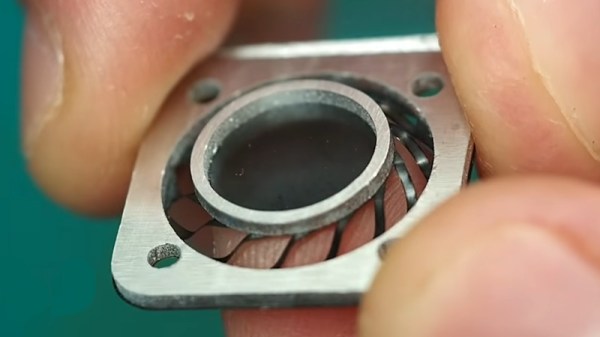
When we see something from [Carl Bugeja], we expect to see flexible PCBs and magnets being pushed to do unexpected things. His latest video in which he designs a set of PCB actuators using flexure joints certainly doesn’t fail to please.

His intent is to create a simple actuator in which a magnet is placed over a coil, and moves upward within the confines of he flexure which surrounds it. And rather than try individual designs one after the other he’s created a huge all-in-one test array of different flexure actuators, each having a slightly different design and construction to whichever one is next to it. There are plenty of magnet flips as he tests them, and using this approach he’s quickly able to eliminate the designs which work less well.

To give an idea how these actuators might be best used, he tried them in a few applications. Their lifting force is relatively tiny, but he found them possibly suitable for a haptic feedback device. Of particular interest is that as the structure is a PCB it’s relatively straightforward to run a line to the magnet and turn it into a touch sensor. The idea of an all in one sensor and haptic feedback component is rather appealing, we think.

If you’ve not seen Carl’s work before, we’ve encountered him many times over the years.

Continue reading “Flexure PCB Actuators Made Before Your Very Eyes”

Impossible WiFi On An Ancient Mac Portable

The Macintosh Portable was possibly one of the coolest computing devices to be seen with back at the end of the 1980s, providing as it did a Mac in a slightly nicer version of the hefty luggable portables of the day than the PC world could offer. Inside was a mere 68000, but it ran Mac OS system 6 and looked light years ahead of any comparable PC in doing so.

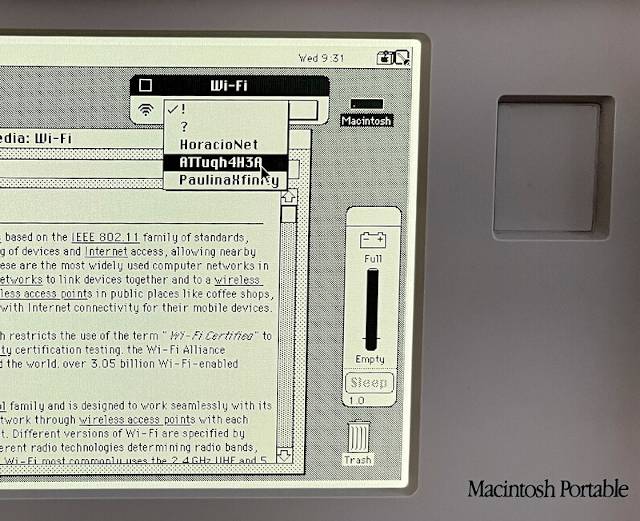
Back in 1989 it wasn’t even the norm for a computer to have built-in Ethernet, and WiFi was still a gleam in the eye of some Dutch engineers, so how has [Joshua Stein] managed to get his Mac Portable on a wireless network here in 2023? The answer contains a few surprises.

When seeing a WiFi upgrade for a classic retrocomputer the usual expectation is that it’s done by emulating a modem connection to the Internet over a serial port. But this wireless network card is a bit different, it’s a real network card capable of being used for much more than just connecting to the Internet.

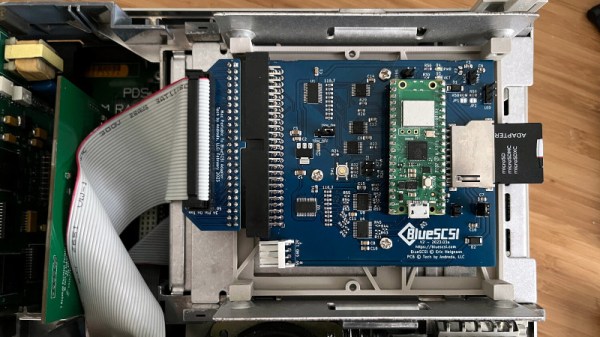
We have to admit to not knowing that there were SCSI Ethernet interfaces back in the day, and it’s one of these that he’s created. He’s building on a decade’s work in producing disk emulators for the SCSI bus, and he’s taken the code for a Raspberry Pi Pico version and adapted the SCSI driver part to interface with the onboard WiFi on a Pico W. Altogether it’s a beautiful piece of work, and you can color us impressed.

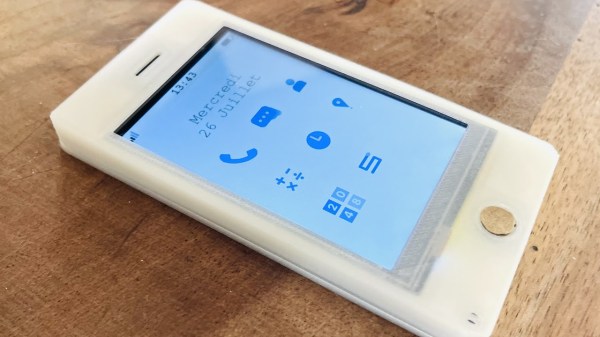
An Open Source Mobile Phone Based On The ESP32

As microcontrollers become ever faster and cheaper, something we’ve been expecting has been an open source smartphone based not upon a high-end chip, but on a cheap commodity one. In the electronic badge arena we’ve come pretty close, but perhaps it’s left to [Gabriel Rochet] to deliver the first one that brings everything together. His Paxo phone is now on version 4, and while the French-language website link stubbornly resists translation with Google translate, English speakers can find a description of its capabilities along with the software in a GitHub repository.

The hardware is surprisingly straightforward, with a resistive touch screen and a PCB featuring power management, an ESP32 main processor, and a GSM module. The 2G connectivity may not be the fastest, or even available in your country, but otherwise the feature set looks more than reasonable for a basic mobile phone.

We like this project a lot, because as we said it starts to deliver on the promise of the 2018 EMF badge and the 2022 MCH badge. We think the former badge’s designers might find something of interest in it.