Hackaday Report: Will 2022 Bring A New Dawn For The Chip Shortage?

As the world begins to slowly pull itself out of the economic effects of the pandemic, there’s one story that has been on our minds for the past couple of years, and it’s probably on yours too. The chip shortage born during those first months of the pandemic has remained with us despite the best efforts of the industry. Last year, pundits were predicting a return to normality in 2022, but will unexpected threats to production such as the war in Ukraine keep us chasing supplies? It’s time to delve into the root of the issue and get to the bottom of it for a Hackaday report.

The Chips Are Down
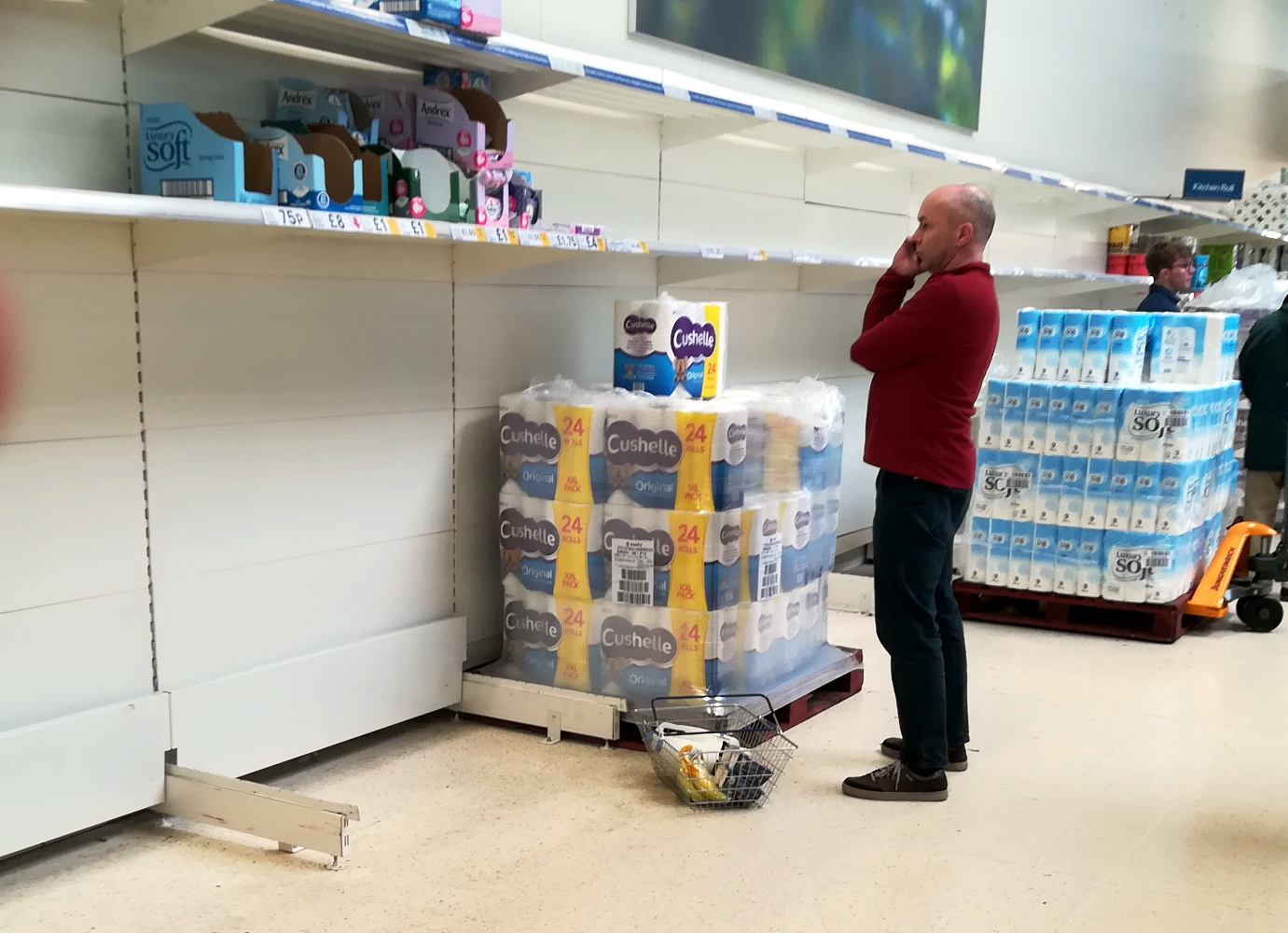
Empty supermarket shelves in March 2020
Consumers were more interested in toilet paper than chip supply during the lockdown.

Going back to 2020, and as global economies abruptly slowed down in the face of stringent lockdowns it’s clear that both chipmakers and their customers hugely underestimated the effect that the pandemic would have on global demand for chips.

As production capacity was reduced or turned to other products in response to the changed conditions, it was soon obvious that the customers’ hunger for chips had not abated, resulting in a shortfall between supply and demand.

We’ve all experienced the chaos that ensued as the supply of popular varieties dried up almost overnight, and as fresh pandemic waves have broken around the world along with a crop of climate and geopolitical uncertainties it’s left many wondering whether the chip situation will ever be the same again.

Green Shoots In Idaho

An Idaho License plate: "Famous potatoes"
Idaho leads the way in a chip shortage recovery! inkknife_2000, CC BY-SA 2.0

Amidst all that gloom, there are some encouraging green shoots to be seen. While it’s perhaps not quite time to celebrate, there’s a possibility for some cautious optimism. This month brought the hope that Potato Semiconductor might be cutting the sod on a new production capacity for their ultra-fast digital logic in Idaho, and with other manufacturers following suit it could be that we’ll once again have all the chip capacity we can eat.

But the other side of the chip business coin lies with the customer: we all see the chip shortage from our own semi-insider perspective, but have the tastes of the general public returned towards chips? Early signs are that as consumer confidence returns there are encouraging trends in chip consumption taking root, so we’d be inclined to advise our readers to have cautious optimism. If all goes well, you’ll be having your chips by summer.

The prospects for a new dawn in chip production capacity in 2022 look rosy, but there’s a further snag on the horizon courtesy of the Russian invasion of Ukraine. Like so many industries in a globalised economy, the chip industry depends heavily on supplies, consumables, and machinery from beyond the borders of wherever the plants themselves may lie.

In the case of Ukraine there’s a particular raw material whose supply has been severely interrupted, and though we hope for a speedy resolution of the conflict and a consequent resumption of production, the knock-on effect on the production of chips in the rest of the world can not be underestimated. Despite the ramp-up in output led by Idaho, the production of chips globally still relies heavily on Ukrainian sunflower oil. There’s a possibility that an acceptable substitute might be found in canola oil, but it will remain to be seen whether the chip-eating consumers will notice the taste difference.

If you would like to help the people of Ukraine in their hour of need, here are some organisations working on the ground to whom you can donate.

Header image: Daniel Kraft, CC BY-SA 3.0.

Converting Your Bike To Electric: Why You Should, And When You Shouldn’t

A decade ago I was lucky enough to work for an employer that offered a bicycle loan scheme to its employees, and I took the opportunity to spend on a Brompton folding bike. This London-made machine is probably one of the more efficiently folding cycles on the market, and has the useful feature of being practical for longer journeys rather than just a quick run from the train. A 3-speed hub gearbox is fine for unhurried touring, but sadly my little folder has always been a bit of a pain on the hills. Thus around the start of the pandemic I splashed out again and bought a Swytch electric upgrade kit for it, and after a few logistical and life upheavals I’ve finally fitted it to the bike. I’ve ridden a few electric bikes but never had my own, so it’s time to sit down and analyse the experience. Is an electric bike something you should have, or not?

A Box Of Bits Becomes An Electric Bike

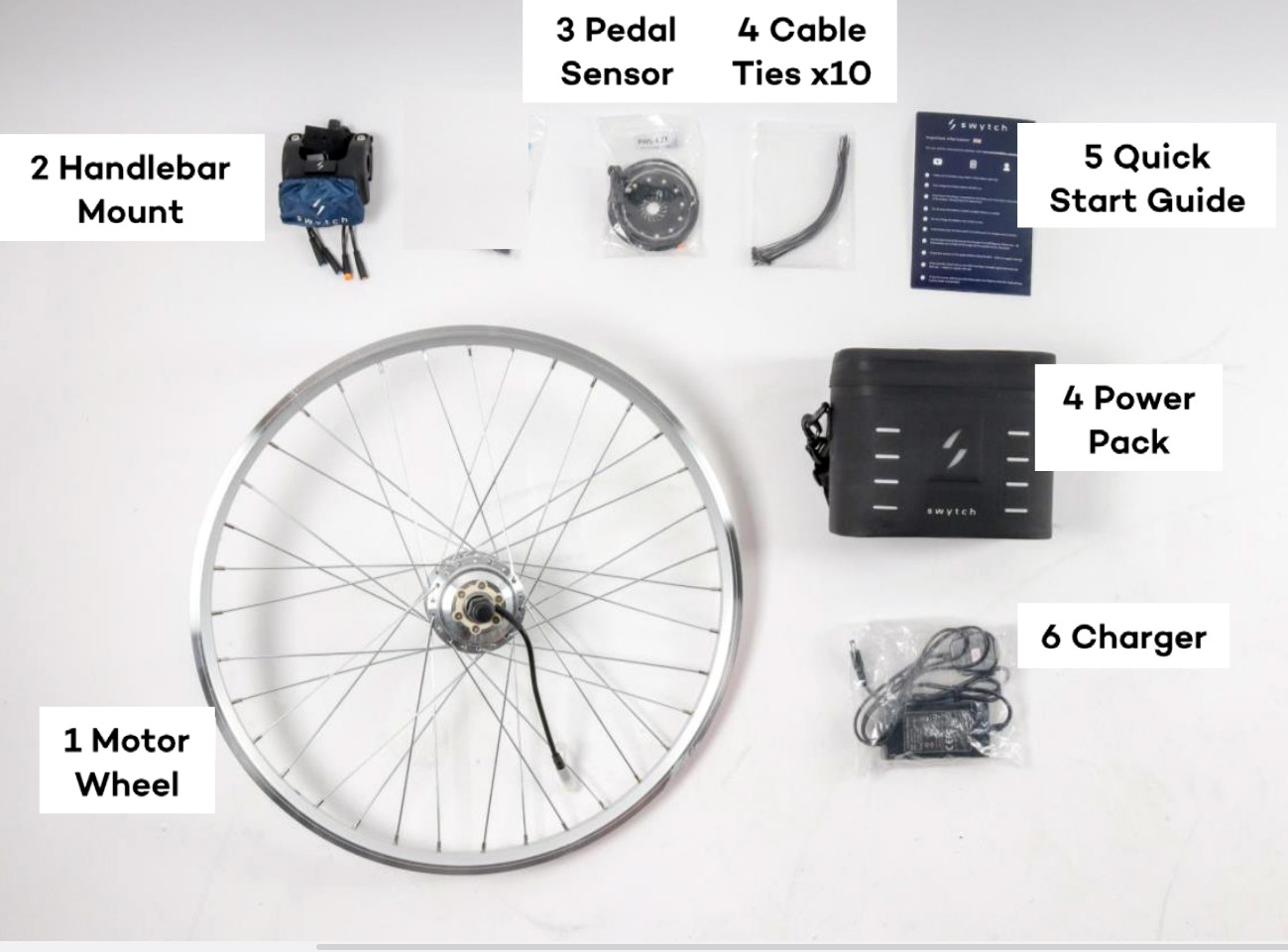
All the parts of a Swytch kit
All the parts of a Swytch kit. From the Swytch assembly manual.

Swytch sell their kits via crowdfunding rounds, so I’d been on a waiting list for a while and got an early-bird price on my kit. It took quite a while to arrive, much longer than the expected time in mid-2020 because of the pandemic, finally being delivered some time in February last year. It came in a modestly-sized cardboard carton which would be an easy carry on the Brompton’s luggage rack, containing neatly packed a new front wheel with motor, as well as the battery and all sundry parts.

Fitting the kit shouldn’t stretch the capabilities of a Hackaday reader, with probably the trickiest part being the positioning of a Hall-effect sensor near the crank. The kit works by providing a motor assist when you pedal, so part of it is a set of magnets on a plastic disk with various attachments for different cranks and pedal sets. The Brompton front wheel is removed and its tyre and tube transferred to the Swytch one, which is then put on the bike. Once the magnet disk and Hall sensor are attached, the cables follow the existing ones and emerge at the handlebars where a sturdy bracket for the battery box is fitted. Continue reading “Converting Your Bike To Electric: Why You Should, And When You Shouldn’t”

Hacker Camps Are Back. To Get You In The Mood, Here’s A Story From 1997

The past couple of years of the COVID pandemic have been rough in some unexpected ways, and it’s clear that our world will never be quite the same as it was beforehand. In our community, the hackerspaces are open again, and while the pandemic hasn’t gone away this year shows the promise of hosting the first major hacker camps to be held since 2019. We’re sure a number of you will be making your way to them. To give a taste of what is to come we’ve got a rare glimpse into hacker camps past.

The Netherlands events are held every four years outside pandemic disruptions, and we’re going back as far as 1997 for HIP, or Hacking In Progress, where [Christine Karman] kept a daily diary of the event. 25 years later it’s both a familiar account of a hacker camp and an interesting glimpse into a time when for much of the wider population an Internet connection was still a novelty. Continue reading “Hacker Camps Are Back. To Get You In The Mood, Here’s A Story From 1997”

Reverse Engineering Your Own Bluetooth Audio Module

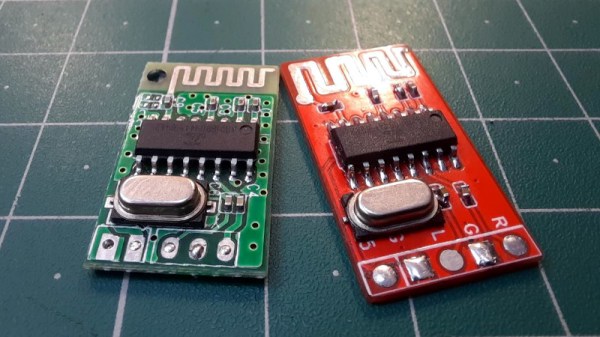
There was a time when we would start our electronic projects with integrated circuits and other components, mounted on stripboard, or maybe on a custom PCB. This is still the case for many devices, but it has become increasingly common for an inexpensive ready-built module to be treated as a component where once it would have been a project in its own right. We’re pleased then to see the work of [ElectroBoy], who has combined something of both approaches by reverse engineering the pinout of a Chinese Bluetooth audio chip with minimal datasheet, and making his own take on an off-the-shelf Bluetooth audio module.

The JL_AC6939B comes in an SOIC16 package and requires a minimum number of components. The PCB is therefore a relatively simple proposition and indeed he’s fitted all parts and traces on one side with the other being a copper ground plane. It’s dangerous to assume that’s all there is to a board like this one though, because many an engineer has come unstuck trying to design a PCB antenna. We’d hazard a guess that the antenna here is simply a wavy PCB line rather than an antenna with a known impedance and bandwidth, at the very least it looks to have much thicker traces than the one it’s copying.

It’s possible that it’s not really worth the effort of making a module that can be bought for relative pennies ready-made, but to dismiss it is to miss the point. We make things because we can, and not merely because we should.

A Robot Game To Open Your Hackerspace

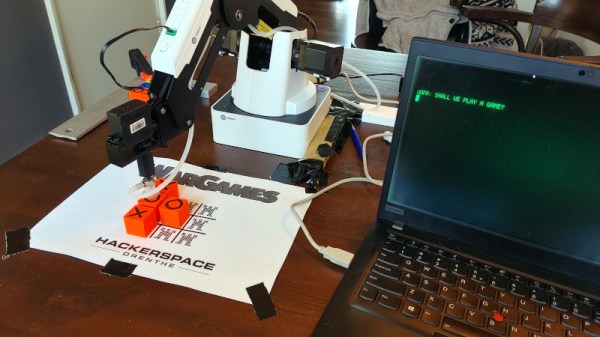
It’s always good to welcome a new hackerspace to the fold, and thus we’re pleased to hear about the upcoming opening of Hackerspace Drenthe, on the north-eastern edge of the Netherlands. Starting a new space during a global pandemic is something of a feat. As part of their opening something is required to demonstrate a robot for the curious public, and what could be more accessible than a robot arm playing tic-tac-toe!

It would be correct to say that a robot moving blocks with precision is not necessarily a ground-breaking achievement, but in its purpose of providing eye-candy for a hackerspace opening while also serving as an experiment for some of the students from the school adjacent to the space it is a success. The interface is a pleasingly retro War Games style terminal, and the software is written in Python. For the curious all can be found on a GitHub repository, and should you be in that region of Europe you can find Hackerspace Drenthe in the Netherlands border town of Coevorden and attend their opening on the 2nd of April.

Continue reading “A Robot Game To Open Your Hackerspace”

Label Your SMD Tapes With An Inkjet Printer

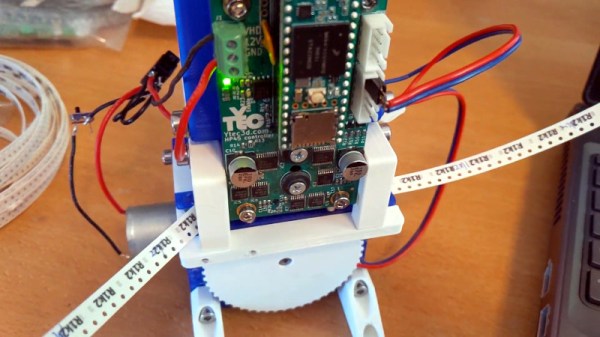
If you’ve ever had to use SMD components on tape outside the realm of the automated assembly machines for which they were designed, you’ll know that one tape looks very like another and it can be very annoying to keep track of which is which. We can’t help admiring [Yvo de Haas’] inkjet printer for SMD tapes then, which efficiently prints whatever identifying marks you need on the back of your tapes.

The printer uses the venerable HP45 inkjet cartridge, and teams it with a 3D printed mechanism and [Yvo]’s self-designed driver board. A worm gear motor and a sprocket take care of advancing the tape through the mechanism past the printhead, and there is a well-assembled piece of software to drive it all. With extremely comprehensive build instructions it should be within the reach of anyone who handles component tape, and from our experience of hand-labeling tape for kits we can see that it could be a Godsend. Take a look at it in action in the video below.

So far the tape-handling machinery we’ve seen has mostly been for cutting sections rather than labeling. We can see that this printer paired with a tape cutter should be essential equipment for anyone starting a kit business.

Continue reading “Label Your SMD Tapes With An Inkjet Printer”

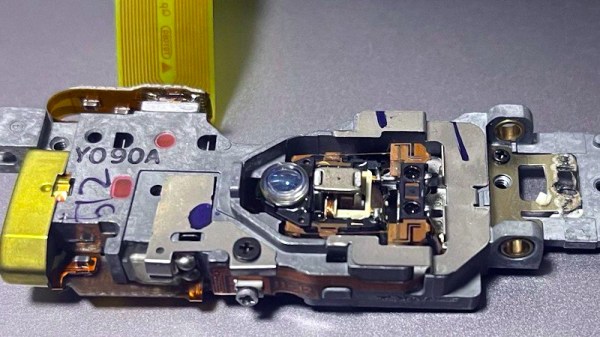
A MiniDisc Optical Head Has A Few Surprises Up Its Sleeve

There was an odd era at the start of the 1990s when CDs had taken the lead from vinyl in pre-recorded music, but for consumer recordable formats the analogue cassette was still king. A variety of digital formats came to market to address this, of which Sony’s MiniDisc was the only one to gain significant traction outside the studio. These floppy-disk-like cartridges held a magneto-optical medium , and were the last word in cool until being swept away around the end of the decade by MP3 players. Hackaday alum [Nava Whitford] has disassembled a MiniDisc optical head to document how the physical part of the system worked.

The first surprise is that the MiniDisc was in fact a two-in-one system. The recordable discs were magneto-optical and wrote data by heating the disc with a laser under a magnetic field, while the pre-recorded discs used etched pits and lands in a similar way to the CD. Remembering the technical buzz around the system back in the day, either we audio enthusiasts glossed over this detail, or more likely, Sony’s PR did so to emphasize the all-new aspect of the system.

The teardown goes in depth into how while like a CD player there is a photodiode array involved, the extra components are a diffraction grating and a Wollaston prism, an optical component which splits polarized light into two beams. The photodiode array is more complex than that of a CD player, it’s speculated that this is to detect the different polarized beams as well as for the task of maintaining alignment with the track.

All in all this is a rare chance to look at something we know, but which few of us will probably have dismantled due to its relative scarcity compared to CD mechanisms. Definitely worth a look. Meanwhile if this era is of interest, take a look at a Hack Chat we did a while back looking at the MiniDisc’s would-be competitor.