A Fractal Papercraft Tree

Sometimes there are projects that we introduce with a bit of context, some background, and other times as with [RayP2]’s fractal papercraft tree, we introduce them simply because they are beautiful.

It’s a deceptively simple design of a repeating pattern of the same shape getting ever smaller with each iteration, and terminating in a tetrahedron with branches from each of its faces. It’s not origami, instead it’s a cut-and-glue design, and its construction is a surprisingly involved affair with some lateral thinking required to bend the tabs on the smaller branches. The design was first prototyped with plain paper, before a final version was made with card stock. The part that makes it exceptional is that he used shiny gold card stock with the gold side on the inside, meaning that when lit from the trunk the end of each branch glows attractively. Fitting the light required a modification to the trunk design, but this doesn’t take away from the whole.

The result is an attractive sculpture, a talking point, and something with a mathematical angle to boot, which we like. It’s certainly not been the first papercraft ptoject we’ve shown you, though perhaps these paper retrocomputers are a little less artistic.
Welcome To The Future, Where Your Microwave Thinks It’s A Steam Oven

It’s fair to say that many of us will have at some time inadvertently bricked a device by applying the wrong firmware by mistake. If we’re lucky then firing up some low-level reflashing tools can save the day and return the item in question to health, but we’re guessing that among you will be plenty of people who’ve had to discard a PCB or replace an inaccessible microcontroller chip as a result.

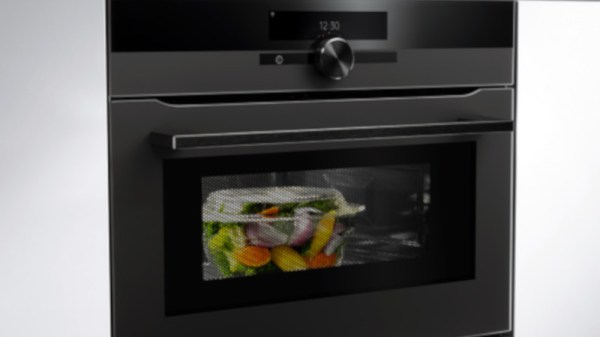
Spare a thought then for the consumer appliance manufacturer Electrolux, whose AEG subsidiary has bricked combi microwave ovens acrosss a swathe of Western Europe (Dutch, Google Translate link). They managed this improbable feat by distributing an over-the-air update that contains the firmware for a steam oven instead. Worse still, the update has disabled over-the-air updates, meaning that any fix requires physical access to the oven.

We can’t help sympathising with whichever poor AEG engineer has had the ultimate in bad days at work, but at the same time we should perhaps consider the difference between a computer and an appliance, and whether there should be a need for an oven to phone home in the first place. Sure, such devices have been computer-controlled for decades, but should a microcontroller doing a control task need constant updates?

We’re guessing this oven has some kind of cloud aspect to it which allows AEG to slurp customer data the user to control it via their app, but even so it should serve as a warning to anyone tempted by an internet-connected kitchen appliance. If the internet isn’t necessary for the food to be cooked, don’t connect it.

We feel sorry for anyone who might have put a pizza in the oven just before it was bricked, and watched in disappointment as their tasty meal remained uncooked.

Render HTML And CSS On An ESP32

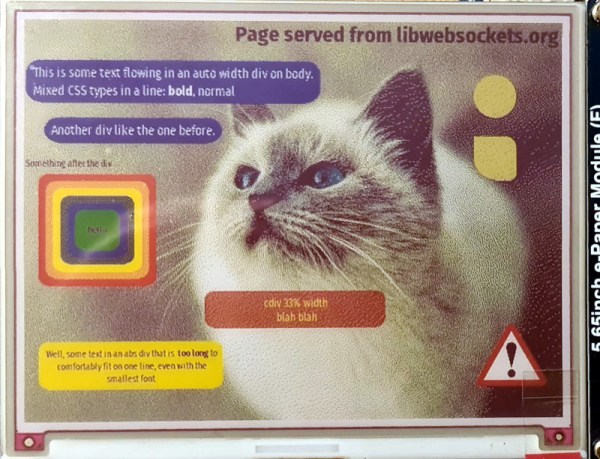
As the available computing power from affordable microcontrollers continues to increase, there is an inevitable blurring of the line between them and the lower tier of application processors capable of running Linux-based operating systems. For the most part a microcontroller busies itself with behind-the-scenes tasks, but as so many projects here have demonstrated, they can be pretty capable when it comes to user-facing applications too. Now [Andy Green] has extended the possibilities with affordable silicon, by producing a proof-of-concept HTML + CSS renderer over h2 on ESP32 for libwebsockets. Surf the web on a microcontroller without settling for a text-only experience? Why not!

He freely admits that this is far from being a complete HTML rendering engine, in that while it parses and renders HTML and CSS with JPEG and PNG image support, it does so only with a subset of HTML and is not tolerant of any malformations. There is also no JS support, which is hardly surprising given the available resources.

Even with those limitations it remains an impressive piece of work, which we hope will one day be able to make some effort at displaying Hackaday on ESP32 devices such as the badge.team European conference badges. Definitely a project to watch!

Owning A ShortWave Radio Is Once Again A Subversive Activity

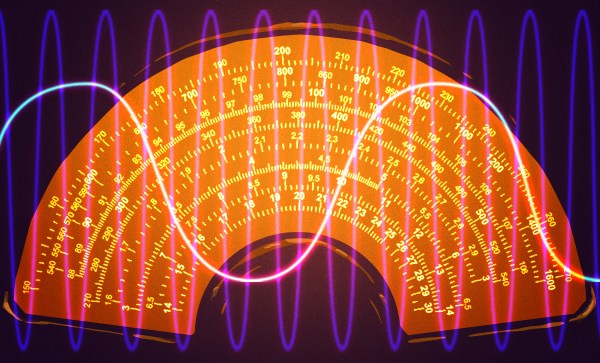
An abiding memory for a teen fascinated by electronics and radio in the 1970s and 1980s is the proliferation of propaganda stations that covered the shortwave spectrum. Some of them were slightly surreal such as Albania’s Radio Tirana which would proudly inform 1980s Western Europe that every village in the country now possessed a telephone, but most stations were the more mainstream ideological gladiating of Voice of America and Radio Moscow.

It’s a long-gone era as the Cold War is a distant memory and citizens East and West get their info from the Internet, but perhaps there’s an echo of those times following the invasion of the Ukraine. With most external news agencies thrown out of Russia and their websites blocked, international broadcasters are launching new shortwave services to get the news through. Owning a shortwave radio in Russia may once again be a subversive activity. Let’s build one!

Continue reading “Owning A ShortWave Radio Is Once Again A Subversive Activity”

An Old Typewriter Speaks To The World

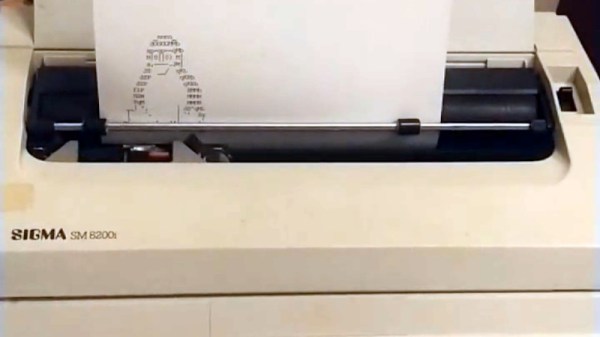
Typewriters are something which was once ubiquitous, yet which abruptly faded away and are now a rare sight. There was a period of a few years in which electric typewriters and computers existed side-by-side though, and it’s one of these which [Jonah Brüchert] has experimented with connecting to a computer for use as a printer or terminal.

The machine in question is a SIGMA SM 8200i typewriter, which is a rebadged version of the East German Erika S3004. It has an intriguing 26-pin connector on its side which provides access to a 1200 baud serial port. It uses its own character encoding dubbed “gdrascii”, for which there is a Python library that he could port to Rust. The result is a terminal in the old style, from the days when access to a computer was through a teletype  rather than a screen. All that’s missing is a punched tape reader at its side!

We’ve featured a lot of typewriters here over the ears, but this isn’t the first that has received a terminal conversion.

Eight RS232 Ports, One Ethernet Port

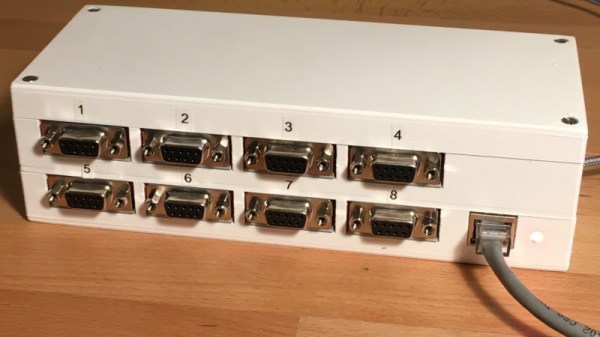
When it comes to impromptu enclosures, [Paul Wallace] is a man after our own hearts, for his serial-to-Ethernet converters allowing him to control older test equipment were housed in takeaway curry containers. Once the test equipment pile had grown it became obvious that a pile of curry containers was a bit unwieldy, even if the curry had been enjoyable, so he set about creating an all-in-one multiway serial to Ethernet box.

Reminiscent of the serial terminal access controllers that were found in dumb terminal sites back in the day, it’s a box with eight DB-9 connectors for serial ports and a single RJ45 Ethernet port. Inside is a Teensy 4.1 which packs a PHY and eight hardware serial ports, and a pile of MAX232 level converter modules. These have a small modification to wire in the CTS and RTS lines, and the whole is clothed in a custom 3D printed case.

The result is a very neat, almost commercial standard box that should save him quite a bit of space. Not everyone has eight devices to drive, so if you have just one how about using an ESP8266?

The Nine Dollar Laser Bed

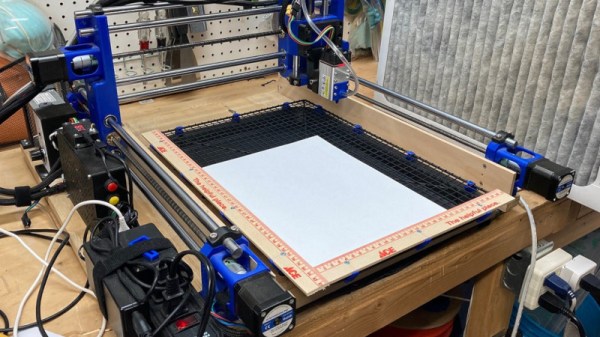
A laser cutter bed has to be robust, fireproof, and capable of adequately supporting whatever piece of work is being done on the machine. For that reason they are typically a metal honeycomb, and can be surprisingly expensive. [David Tucker] has built a MultiBot CNC machine and is using it with a laser head, and his solution to the problem of a laser bed is to turn towards the kitchen ware store.

The answer lay in an Expert Grill Jerky Rack, a wire grille with a baking tray underneath it. Perfect lasering support but for its shininess, so it was painted matte back to reduce reflections and a handy set of clips were 3D printed to secure the grille to the tray.

We like this solution as it’s both effective and cheap, though we can’t help a little worry at the prospect of any laser cutter without adequate enclosure for safety. Having been involved in the unenviable task of cleaning an encrusted hackerspace laser cutter bed, we also like the idea that it could be disposed of and replaced without guilt. Do you have any tales of laser cutter bed cleaning, or have you found a cheap substitute of your own? Let us know in the comments!