This Week In Security: Bogus CVEs, Bogus PoCs, And Maybe A Bogus Breach

It appears we have something of a problem. It’s not really a new problem, and shouldn’t be too surprising, but it did pop up again this week: bogus CVEs. Starting out in the security field? What’s the best way to jump-start a career? Getting a CVE find to your name certainly can’t hurt. And as a result, you get very junior security researchers looking for and reporting novel security vulnerabilities of sometimes dubious quality. Sometimes that process looks a lot like slinging reports against the wall to see what sticks. Things brings us to an odd bug report in the OBS Studio project.

A researcher put together a script to look for possible password exposure on Github projects, and it caught a configuration value named “password” in a .ini file, being distributed in the project source. Obvious credential leak in Git source, right? Except for the little detail that it was in the “locale” folder, and the files were named ca-es.ini, ja-jp.ini, and similar. You may be in on the joke by now, but if not, those are translation strings. It wasn’t leaked credentials, it was various translations of the word “password”. This sort of thing happens quite often, and from the viewpoint of a researcher looking at results from an automated tool, it can be challenging to spend enough time with each result to fully understand the code in question. It looks like this case includes a language barrier, making it even harder to clear up the confusion.

Things took a turn for the worse when a CVE was requested. The CVE Numbering Authority (CNA) that processed the request was MITRE, which issued CVE-2023-34585. It was a completely bogus CVE, and thankfully a more complete explanation from OBS was enough to convince the researcher of his error. That, however, brings us back to CVE-2023-36262, which was published this week. It’s yet another CVE, for the same non-issue, and even pointing at the same GitHub issue where the alleged bug is debunked. There’s multiple fails here, but the biggest disappointment is MITRE, for handing out CVEs twice for the same issue. Shout-out to [Netspooky] on Twitter for spotting this one. Continue reading “This Week In Security: Bogus CVEs, Bogus PoCs, And Maybe A Bogus Breach”

3D Audio Imaging With A Phased Array Microphone

Remember the scene from Blade Runner, where Deckard puts a photograph into a Photo Inspector? The virtual camera can pan and move around the captured scene, pulling out impossible details. It seems that [Ben Wang] discovered how to make that particular trick a reality, but with audio instead of video. The secret sauce isn’t a sophisticated microphone, but a whole bunch of really simple ones. In this case, it’s 192 of them, arranged on long PCBs working as the spokes of a wall-art wheel. Quite the conversation piece.

Continue reading “3D Audio Imaging With A Phased Array Microphone”

Quetzal-1 Satellite Goes Open Source

Back in 2020, students from Universidad Del Valle De Guatemala (UVG) pulled off a really impressive feat, designing and building a CubeSat that lasted a whopping 211 days in orbit. In addition to telemetry and radio equipment, it carried a black-and-white camera payload.

But it turns out space is hard. The first pictures were solid black or white, with the automatic exposure process failing pretty badly. A pair of good pictures were taken by waiting until the satellite was passing over Guatemala during sunrise or sunset. A hung I2C bus led to battery drain, and the team tried a system reset to clear the hung state. Sadly the craft never came back to life after the reset, likely because of one of the Lithium-Ion battery cells failed completely in the low charge state.

That was 2020, so why are we covering it now? Because the project just released a massive trove of open source design documents, the software that ran on the satellite and ground station, and all the captured telemetry from the flight. It’s the ultimate bootstrap for anyone else designing a CubeSat, and hopefully provides enough clues to avoid some of the same issues.

Even though the mission had problems, it did achieve a lot of milestones, including the first picture of Earth taken by a Central American satellite. Even coming online and making radio contact from orbit to an earthbound station is quite a feat. The team is already looking forward to Quetzal-2, so stay tuned for more!

And if you want the details on the Quetzal-1 design, and what went wrong with the electrical system, both PDF papers have been released. Seeing more open source in space is an encouraging development, and one that should continue to grow as the cost of payloads to orbit continues to fall. We’ve covered the UPSat satellite, the PyCubed framework, and even the RTL-SDR for listening to satellite radio traffic.

Cooling Paint You Can Actually Make

[NightHawkInLight] has been working on radiative sky paint. (Video, embedded below.) That’s a coating that radiates heat in the infrared spectrum at a wavelength that isn’t readily absorbed or reflected by the atmosphere. The result is a passive system that keeps materials a few degrees cooler in direct sunlight than an untreated piece in the shade. That sounds a bit like magic, but apparently the math checks out.

Continue reading “Cooling Paint You Can Actually Make”

Fujitsu Proprietary Keyboard Goes PS/2 With A Pico

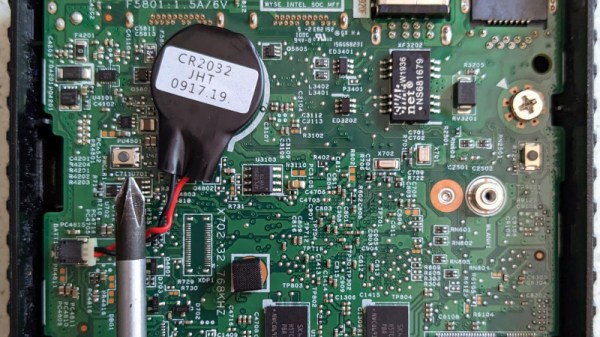
One of our favorite retro-computing YouTubers, [Clint] from LGR, found himself a very interesting Fujitsu keyboard while thrift store shopping. It was a beautiful unit, but confusing, as this keyboard comes with an 8-pin DIN connector. A 5-pin DIN plug or 6-pin Mini-DIN would be easy to work with, but what was this odd connection? Turns out the Fujitsu N860-2500-T111 came with an Olympus CV-100 Video Processor, which was designed for medical imaging, potentially among other uses. And as often happened with old specialized hardware, the keyboard used a proprietary protocol for sending keystrokes.

[Clint] put out a call for anyone that could help him build an adapter, and [Andy] from Element14 answered the call. But this problem requires more than an adapter, mainly because the Fujitsu doesn’t have key rollover. It’s one key at a time, and that just doesn’t work for the sort of things [Clint] shows off on LGR. So, the electronic guts of the keyboard were removed, to be replaced with a Raspberry Pi Pico, wired directly to the keyboard matrix.

Continue reading “Fujitsu Proprietary Keyboard Goes PS/2 With A Pico”

This Week In Security:Camaro Dragon, RowPress, And RepoJacking

Malicious flash drives have come a long ways since the old days of autorun infections. It’s not an accident that Microsoft has tightened down the attack surface available of removable media. So how exactly did a malicious flash drive lead to the compromise of a European hospital? Some sophisticated firmware on the drive? A mysterious zero day? Nope, just hidden files, and an executable using the drive name and icon. Some attacker discovered that a user trying to access a flash drive, only to be presented with what looks like the same flash drive icon, will naturally try to access it again, running an .exe in the process.

That executable runs a signed Symantec binary, included on the drive, and sideloads an OCX that hijacks the process. From there, the computer is infected, as well as any other flash drives in the machine. Part of the obfuscation technique is an odd chain of executables, executed recursively for a hundred copies. Naturally once the infection has rooted itself in a given machine, it takes commands from a C&C server, and sends certain files out to its waiting overlords. Checkpoint Research has attributed this campaign to Camaro Dragon, a name straight from the 80s that refers to a Chinese actor with an emphasis on espionage. Continue reading “This Week In Security:Camaro Dragon, RowPress, And RepoJacking”

Meshtastic For The Greater Good

Last week, my city was hit by a tornado. That’s not surprising here in Oklahoma, and thankfully this event was an F0 or possibly even an EF0 — a really weak tornado. Only a couple roofs collapsed, though probably half the houses in town are going to need roof repairs, thanks to the combination of huge hail and high winds. While it wasn’t too bad, power did go down in a few places around town, and this led to an interesting series of events.

Chat messages were coming in like this: “That was a [power] flicker, yeah. Even took down my Internet.” Followed by “Whee, [fiber Internet] got knocked out and now Starlink has too many clouds in the way.” And after ten minutes of silence, we got a bit worried to see “Time to hide under a bed. … Is cell service back?” It is a bit spooky to think about trying to help neighbors and friends after a disaster, in the midst of the communication breakdown that often follows. If he had needed help, and had no working communications, how long would it have taken for us to go check on him?
Continue reading “Meshtastic For The Greater Good”