The Rise And Fall Of The Fan Car

The advent of aerodynamic wings in motorsport was one of the most dramatic changes in the mid-20th century. Suddenly, it was possible to generate more grip at speed outside of altering suspension setups and fitting grippier tyres. However, it was just the beginning, and engineers began to look at more advanced ways of generating downforce without the drag penalty incurred by fitting wings to a racecar.

Perhaps the ultimate expression of this was the fan car. Mechanically complex and arguably dangerous, the technology offered huge downforce with minimal drag. However, the fan car’s time in the spotlight was vanishingly brief, despite the promise inherent in the idea. Let’s take a look at the basic theory behind the fan car, how they worked in practice, and why we don’t see them on racetracks today. Continue reading “The Rise And Fall Of The Fan Car”


We’re Cloning Animals From The “Frozen Zoo”; Like A Seed Bank But For Animals

Seed banks are facilities of great value to biodiversity and agriculture around the world. These facilities are used to house stocks of seeds of a wide variety, helping to maintain genetic diversity and avoid the permanent loss of various plant species. While there are some challenges, the basic requirements to run a simple seed bank are to keep a selection of seeds at low temperature and humidity to maximise their viable lifespan.

When it comes to animals, things become more difficult — one can’t simply plant an old seed in the ground and grow a fresh new meerkat, for example. Preservation of animal genetic material poses its own unique set of challenges — ones that the San Diego “Frozen Zoo” don’t shy away from. They’ve recently shown the viability of the program with the healthy birth of a ferret cloned from an animal that died in 1988.

Continue reading “We’re Cloning Animals From The “Frozen Zoo”; Like A Seed Bank But For Animals”

Using Phase Change Materials For Energy Storage

Renewable energy sources are becoming increasingly popular. However, such energy can be wasted if an excess is available when it’s not yet needed. A particularly relevant example is solar power; solar panels provide most of their output during the day, while often a household’s greatest energy use is at night.

One way to get around this problem is by storing excess energy so that it can be used later. The most common way this is done is with large batteries, however, it’s not the only game in town. Phase change materials are proving to be a useful tool to store excess energy and recover it later – storing energy not as electricity, but as heat. Let’s take a look at how the technology works, and some of its most useful applications. Continue reading “Using Phase Change Materials For Energy Storage”

Modified 3D Printer Makes A Great Microscope, Too

A false-color polarimetric image of sugar crystals floating in water.

Look past the melty plastic bits, and your average 3D printer is just a handy 3-axis Cartesian motion platform. This makes them useful for all kinds of things, and as [E/S Pronk] shows us, they can easily be modified into an automated polarimetric microscope!

The microscope build actually took two forms. One, a regular digital microscope any of us may be familiar with, using a C-mount microscope lens fitted to a Raspberry Pi HQ camera. The other, a polarimetric microscope, using an Allied Vision Mako G-508B POL polarimetric camera instead, with the same microscope lens. The polarimetric camera takes stunning false-color images, where the color values correspond to the polarization of the light bouncing off an object. It’s incredibly specialized hardware with a matching price tag, but [E/S Pronk] hopes to build a cheaper DIY version down the line, too.

3D printers make excellent microscopes, as they’re designed to make small precise movements and are easily controlled via G-Code. We’ve seen them used for other delicate purposes too – such as this one modified to become a soldering robot. Video after the break.

Continue reading “Modified 3D Printer Makes A Great Microscope, Too”

Should I Use Wheels Or Tracks?

When it comes to dominating offroad performance, many people’s first thought is of tracked vehicles. Bulldozers, tanks and excavators all use treads, and manage to get around in difficult terrain without breaking a sweat. Today, we’re exploring just what makes tracked vehicles so capable, as well as their weaknesses.

It’s All About Ground Pressure

The various parts of a tank’s propulsion system.

Let’s first look at how tank tracks work. There are a huge variety of designs, with differences depending on application. Different trends have been followed over time, and designs for military use in combat differ from those used for low-speed construction machines, for example. But by looking at a basic tank track design, we can understand the basic theory. On tanks, the track or tread itself is usually made up of individual steel links that are connected together with hinges, though other machines may use rubber tracks instead. The tracks are wrapped around one or more drive wheels, often cogged, which directly pull on the track. On the bottom of the vehicle are the road wheels, which ride on top of the track where it lies on the ground.  The weight of the vehicle is carried through the road wheels and passed on to the tread, spreading out the load across a broader area. Outside of this, the track system may also have one or more idler wheels used to keep the track taught, as well as return rollers to guide the track back around without touching the road wheels.

Continue reading “Should I Use Wheels Or Tracks?”

Retro Dreamcast Rhythm Game Controller Built From Scratch

Pop’n Music is a rhythm game which has had both arcade and home console releases over the years. [Charlie Cole] is a fan of the Dreamcast version, and decided to build his own controller for the game using the new hotness, the Raspberry Pi Pico.

The controller itself is built out of layers of lasercut MDF, along with an acrylic top and cork bottom to make it sit nicely on surfaces. Arcade buttons are installed to play the rhythm game, mimicking the design of the official cabinets seen in arcades. To run the controller, a Pico was pressed into service, with [Charlie] hoping to use the Pico’s PIO hardware to easily and effectively interface with the Dreamcast’s Maple bus. There were a few headaches along the way, and it didn’t quite live up to expectations, but with some clever use of dual cores, [Charlie] was able to get everything up and running.

Often, such vintage gaming hardware can be thin on the ground, so having the skills to build your own can come in handy. We’ve seen rhythm game hardware modded before too, like this repurposed DJ Hero controller. Video after the break.

DodowDIY Is A Homebrew Sleep Aid

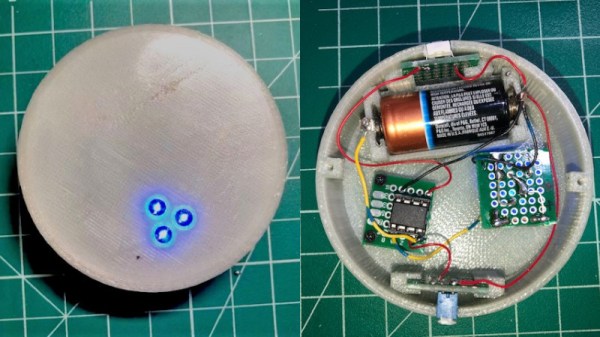
The Dodow is a consumer device that aims to help users sleep, through biofeedback. The idea is to synchronise one’s breathing with the gentle rhythm of the device’s blue LEDs, which helps slow the heartrate and enables the user to more easily drift off to sleep. Noting that the device is essentially a breathing LED and little more, [Daniel Shiffman] set about building his own from scratch.

An ATTiny85 runs the show; no high-powered microcontrollers are necessary here. It’s hooked up to three 5mm blue LEDs, which are slowly ramped up and down to create a smooth, attractive breathing animation. The LEDs are directed upward so that their glow can be seen on the ceiling, allowing the user to lay on their back when getting ready for sleep. It’s all wrapped up in a 3D printed enclosure that is easily modifiable to suit a variety of battery solutions; [Daniel] chose the DL123A for its convenient voltage and battery life in this case. The design is available on Thingiverse for those looking to spin their own.

It’s a neat example of where DIY can really shine – reproducing a somewhat-expensive gadget that is overpriced for its fundamental simplicity. Now when it comes to waking up again, consider building yourself a nifty smart alarm clock.