You’re Going To Flip Out Over This Rocket League RC Car

Rocket League is a video game famous for being wildly popular despite being virtually unplayable without several hours practice. It involves hyper fast cars playing soccer, complete with the ability to flip, jump, and rocket boost into the ball. [mrak_ripple] decided he wanted some of that action in a real RC car, and set to work.

While rocket boosts were out of scope for this build, [mrak_ripple] was pretty confident he could build a jumping, flipping RC car modelled after the Rocket League Octane vehicle. Initial experiments involved a custom 3D printed spring mechanism, but the results were underwhelming. Instead, in the true hacker spirit, a jumping mechanism was taken from an existing toy, and installed in the car instead. This was combined with a mechanism built out of a brushless motor with a flywheel added to generate a flipping moment in mid-air.

The final result is impressive, with the car flipping relatively cleanly once refined and lightened from its original design. We’d love to see a two-axis build that can front- and back-flip as well. It’s a step up in complexity from the last build we saw from [mrak_ripple], the amusing mashed potato trebuchet. Video after the break.

Continue reading “You’re Going To Flip Out Over This Rocket League RC Car”

Basics Of Remote Cellular Access: Connecting Via VPN

You’ve got a machine hooked up to the Internet via a shiny new cellular modem, which you plan to administer remotely. You do a quick check on the external IP, and try and log in from another PC. Try as you might, SSH simply won’t connect. What gives?

The reality of the modern internet is that most clients no longer get their own unique IPv4 address. There simply aren’t enough to go around anymore. Instead, most telecommunications operators use Carrier Grade Network Address Translation which allows a single external address to be shared by many customers. This can get in the way of direct connection attempts from the outside world. Even if that’s not the case, most cellular operators tend to block inbound connections by default. However, there is a way around this quandary – using a VPN. Continue reading “Basics Of Remote Cellular Access: Connecting Via VPN”

Hex Matrix Clock Does It With Six Sides

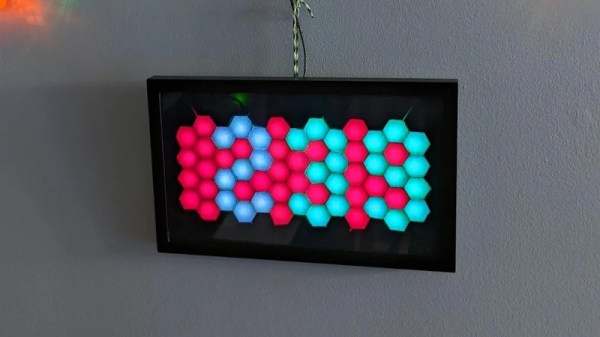
LED matrixes were once a total headache, requiring careful consideration to make the most of limited I/O pins and available microcontroller resources. These days, addressable LED strings have made it all a cinch. Thus, going a little out of the box isn’t so daunting. [w.r.simpson] did just that with this hex-matrix clock.

Relying on hexes instead of a normal Cartesian grid requires some attention to how the rows and columns are laid out, but the Instructable goes through the necessary coordinate system to address the display. The whole display was built without a 3D printer, instead relying on some basic craft skills and a picture frame as the enclosure. Strips of WS2812B LEDs were used to build the hexagonal matrix, run by a Adafruit Metro Mini 328. To give each hexagonal pixel, or hexel, a crisp outline, a shadow grid was built using black paper to stop the light bleeding between the display segments when switched on. Smoked plexiglas wasn’t available, so instead, tinted window film was used to darken the front of the display.

The result is impressive; while some glue marks from the shadow grid are visible closeup, from a distance the final product looks incredibly futuristic thanks to the hexagonal layout. We can imagine this would make a great set dressing in a futuristic film clip; we fully expect to see this concept in the background of the next Ariana Grande single. If this build isn’t enough six-sided fun to sate your appetite, consider getting into Super Hexagon too!

Sand Plotter Built With 3D Printer Parts

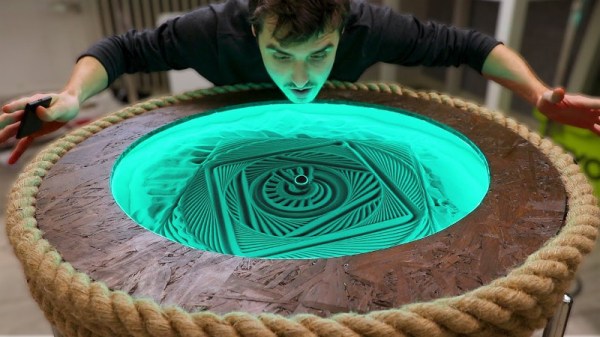
Sand plotters are beautiful machines. They can make endless patterns, over and over again, only to wipe away their own creation with each new pass. Having seen the famous Sisyphus sand sculpture online, [Simon] decided to make his own.

The build came together quickly, thanks to [Simon]’s well-stocked workshop and experience with CNC motion platforms. The frame was built out of wood, with a combination of hand-cut and lasercut parts. After fabric-wrapping the outer rim turned out poorly, rope was substituted instead for a stylish, organic look. LEDs were installed inside to light the sand for attractive effect. The metal ball is moved through the sand via a magnet attached to an XY platform mounted on the back of the table. The platform is built out of old 3D printer parts, with a Creality CR10S Pro chosen for its ultra-quiet stepper drivers. Initial attempts to make the system near-silent were hung up by the crunching sound of the ball rolling over the sand; this was fixed by instead mounting the ball on a foam pad. While the ball is now dragged instead of rolling, the effect is one of blissful quiet instead of crunching aggravation.

The final build is incredibly attractive, and something we’d love to have as a coffee table as a conversation piece. We’ve seen [Simon]’s work around here before, too – with the water-walking RC car a particular highlight. Video after the break.

Continue reading “Sand Plotter Built With 3D Printer Parts”

Smart Power Delivery For Long LED Strips

Addressable LED strips, most commonly using the WS2812B, have revolutionized the pursuit of the glowiest and flashiest of builds. No longer does a maker have to compromise on full RGB color or number of LEDs due to the limitations of their chosen microcontroller, or fuss around with multiplexing schemes. However, the long strips of bright LEDs do have an issue with voltage drop on long runs, leading to dimming and color irregularities. Thankfully, [Jan Mrázek] has come up with a useful solution in the form of the Neopixel Booster.

The device consists of a small PCB which packs a 5 volt regulator capable of putting out up to 4 amps. It’s designed with pads that match typical Neopixel strips, such that it can be neatly soldered in every 50cm or every 60 LEDs or so. Each booster PCB is fed with a set of fat power wires, at between 6-18 volts. This allows electricity to be fed to the full length of the strip at higher voltage, and thus lower current, greatly reducing resistive power losses. By having several regulators along the length of the strip, it helps guarantee that the whole length of a long run is receiving plenty of voltage and current and can light up the correct color as desired.

It’s a well thought out solution to a frustrating problem, and [Jan’s] efforts on the design front mean that a 5 meter long waterproof strip can be converted in around about an hour. We can imagine this could be manufactured into strips in future, too. If you’re wondering what to do with all those LEDs, consider making yourself a custom display.

Baby Yoda Becomes Personable Robot

Baby Yoda has been a hit character in Disney’s The Mandalorian, but does not actually exist in real life as far as we know. Instead, [Manuel Ahumada] set about building a robotic replica, complete with artificial intelligence.  (Video, embedded below.)

The first step was to build a basic robotic simulcra of Baby Yoda, which [Manuel] achieved by outfitting a toy with servos, motors and a Raspberry Pi. With everything hooked up, Baby Yoda was able to move his head and arms, and scoot around on wheels, all under the control of a Bluetooth gamepad. With that sorted, [Manuel] added brains in the form of a smartphone running Intel’s OpenBot machine learning platform. This allows Baby Yoda to track and follow people it sees on its smartphone camera, and potentially even navigate real-world spaces with future upgrades.

It’s a fun build, and we’d love to see the bot let loose at a convention to explore and make friends. We’ve covered OpenBot before, and look forward to seeing it used in more builds. Video after the break.

Continue reading “Baby Yoda Becomes Personable Robot”

Growing Opals In The Lab

Opals are unique amongst gemstones, being formed from tiny silica nanospheres arranged in precise structures that give them their characteristic shifting color when seen from different angles. [The Thought Emporium] loves a challenge, so set about growing some himself.

It’s not the hardest gemstone synthesis ever, but it’s no cakewalk either. The process requires tetraethyl orthosilicate, or TEOS, which can be difficult to find, but the rest of the chemicals required are commonly available. The initial phase involves mixing the TEOS with reactants to form nanoscale silica spheres in the range of 200-350 nanometers wide. With the spheres in solution, the mixture must then be carefully dried in such a way as to create the right structure to produce opal’s famous color effects. At this stage, industrial producers add further silica to stabilize the matrix, though [The Thought Emporium] wasn’t able to find literature that explained how to do this. Instead, he relied on resin, which while imperfect, did allow the specimens to be stabilised and shown off for the purposes of the video.

The video notes that many of the steps in this process were perfected decades ago, but remain held as trade secrets, making replication an exercise in experimentation. Nonetheless, success was had in producing recognisably opalescent specimens, and we can’t wait to see further refinement of the DIY process.

We’ve seen similar work from [The Thought Emporium] before, exploring structural color and holograms. Video after the break.

Continue reading “Growing Opals In The Lab”