Developed On Hackaday: First Feedback From Users

2013-12_Developed_on_Hackaday

Holy cr*p guys… we were amazed by the quantity of positive feedback that was left in the comments section of our last article. We have been featured by Slashdot ! We got plenty of project name suggestions, therefore we organized a poll located at the end of this post to let you decide which one is best. I also received many emails from people eager to start contributing to this offline password keeper project. If you missed the call and want to get involved, it’s still not too late. You can get in touch with me @ mathieu[at]hackaday[dot]com. So far, we have many beta testers, several software developers, one security assessor and a few firmware developers. Next step is to create a mailing list and a Hackaday forum category once the project’s name has been chosen.

Obviously, the very first post of our “Developed On Hackaday” series was to gauge your initial reactions to this ‘new’ project. Notice here the double quotes, as when someone has a new idea there usually are only two possibilities that may explain why it doesn’t exist in the market yet: either it is completely stupid or people are already working on it. In our case, it seems we are in the second category as many readers mentioned they wanted to work/were working/had worked on a similar product. As we’re selfish, we offered them to contribute to this new device.

To ensure that all of our readers are on the same page as to how the device will work we embedded a simple block diagram after the break, as well as a list of all new functionalities that we want to implement given the feedback we received. So keep reading to see what the future holds, as well as to vote on this new project’s name…

Continue reading “Developed On Hackaday: First Feedback From Users”
Meet The Teensy 3.1

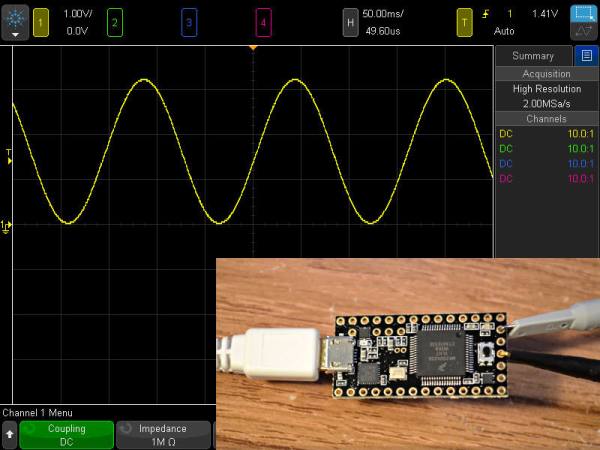
[Paul Stoffregen] just released an updated version of his Teensy 3.0, meet the oddly named Teensy 3.1. For our readers that don’t recall, the Teensy 3.0 is a 32 bit ARM Cortex-M4 based development platform supported by the Arduino IDE (using the Teensyduino add-on). The newest version has the same size, shape & pinout, is compatible with code written for the Teensy 3.0 and provides several new features as well.

The Flash has doubled, the RAM has quadrupled (from 16K to 64K) allowing much more advanced applications. The Cortex-M4 core frequency is 72MHz (48MHz on the Teensy 3.0) and the digital inputs are 5V volts compatible. Pins 3 and 4 gained CAN bus functions. The new microcontroller used even has a 12 bits Digital to Analog Converter (DAC) so you could create a simple signal generator like the one shown in the picture above. Programming is done through the USB port, which can later behave as host or slave once your application is launched. Finally, the price tag ($19.80) is in our opinion very reasonable.

Embedded below is an interview with its creator [Paul Stroffregen].

Continue reading “Meet The Teensy 3.1”

DCF77 Powered Clock Is A Work of Art

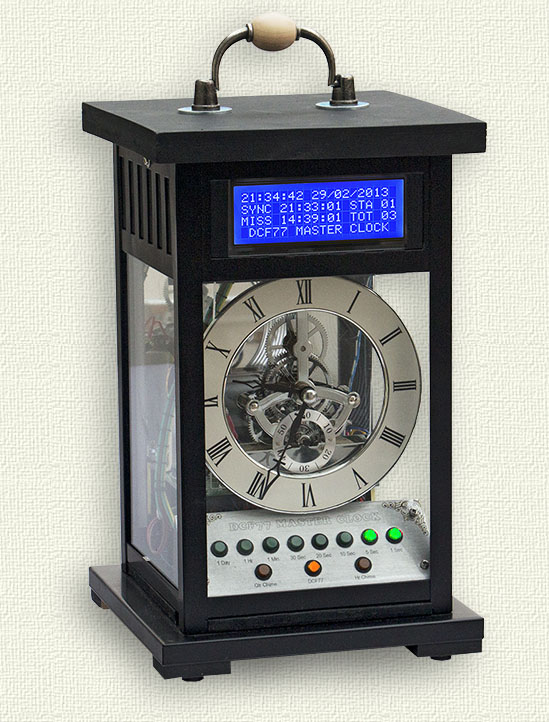
[Brett] just completed his DCF77 Master Bracket Clock, intended to be a backup to an old logic controlled clock he made. For our readers that don’t know, DCF77 is a German longwave time signal whose transmitter is located near Frankfurt (Germany). Every minute, the current date and time are sent on the 77.5kHz carrier signal.

The result, which you can see above, is made using an Ikea lantern, a skeleton clock, an ATmega328 (for Arduino compatibility), a voice recording playback IC (ISD1730), a cheap 20×4 LCD display, a DCF77 receiver module, and many LEDs. We’re pretty sure that it must have taken [Brett] quite a while to get such a nice looking clock. In case the clock loses power from the power supply, 3 AA cells provide battery backup. On the firmware side, making the platform Arduino-compatible allowed [Brett] to use its libraries so the coding was quickly done. Embedded after a break is a video of the final result.

Continue reading “DCF77 Powered Clock Is A Work of Art”

Developed On Hackaday: Let’s Build Some Hardware!

We’re pretty sure that most of you already know that a few months ago Hackaday was bought by SupplyFrame, who therefore became our new evil overlords. We do hope you’ve noticed that they’re actually quite nice, and in their divine goodness they recently gave the go-ahead on this series called Developed on Hackaday.

A new project will be made by the Hackaday staff & community and will hopefully be brought to the consumer market. For those who don’t have the time/experience to get involved in this adventure, we want to show and document what it takes to bring an idea to the marketable product stage. For the others, we would like to involve you in the design/development process as much as possible. Obviously, this project will be open source hardware/software. This time around, the hardware will mainly be developed by yours truly. You may already know me from the whistled platform (currently sold on Tindie) or from all the different projects described on my website, which makes this new adventure far from being my first rodeo.

What’s in it for the contributors? During all the steps of this project, we’ll offer many rewards as well as hand-soldered first prototypes of the device so you can start playing/testing it. Nothing is set in stone so every suggestion is welcome. Should we make a Kickstarter-like campaign to manufacture the final product, we’ll only do so once our prototype is final, our partners are chosen and all details of the production process are set and confirmed. In that case, we will just need to gather the required funds to make the device a reality. What are we going to build? Keep reading to find out.

Continue reading “Developed On Hackaday: Let’s Build Some Hardware!”

Using Ultrasonic Sensors To Measure And Log Oil Tank Levels

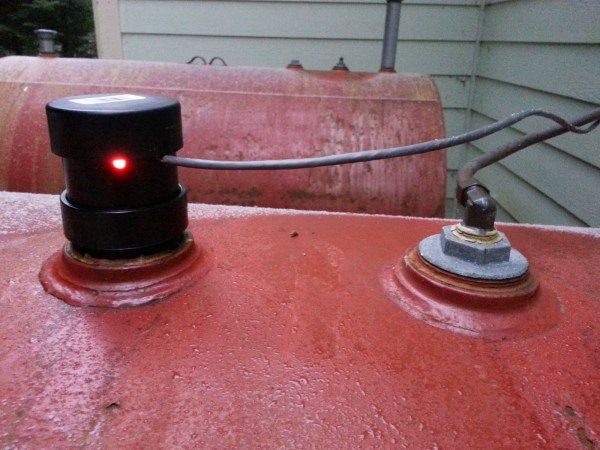
[Mike] lives in a temperate rainforest in Alaska (we figured from his website’s name) and uses a 570 gallon oil tank to supply his furnace. Until now, he had no way of knowing how much oil was left in the tank and what his daily usage was. As he didn’t find any commercial product that could do what he wanted, he designed his own solution. In his write-up, [Mike] started by listing all the different sensors he had considered to measure the oil level and finally opted for an ultrasonic sensor. In his opinion, this kind of sensor is the best compromise between cost, ease of use, range and precision for his application. The precise chosen model was the ping))) bought from our favorite auction website for around $2.5.

[Mike] built the custom enclosure that you can see in the picture above using PVC parts. Enclosed are the ultrasonic sensor, a temperature sensor and an LED indicating the power status. On the other side of the CAT5 cable can be found an Arduino compatible board with an XBee shield and a 9V battery. Using another XBee shield and its USB adapter board, [Mike] can now wirelessly access the tank oil level log from his computer.

Repairing And Adding Bluetooth Control To An Induction Cooker

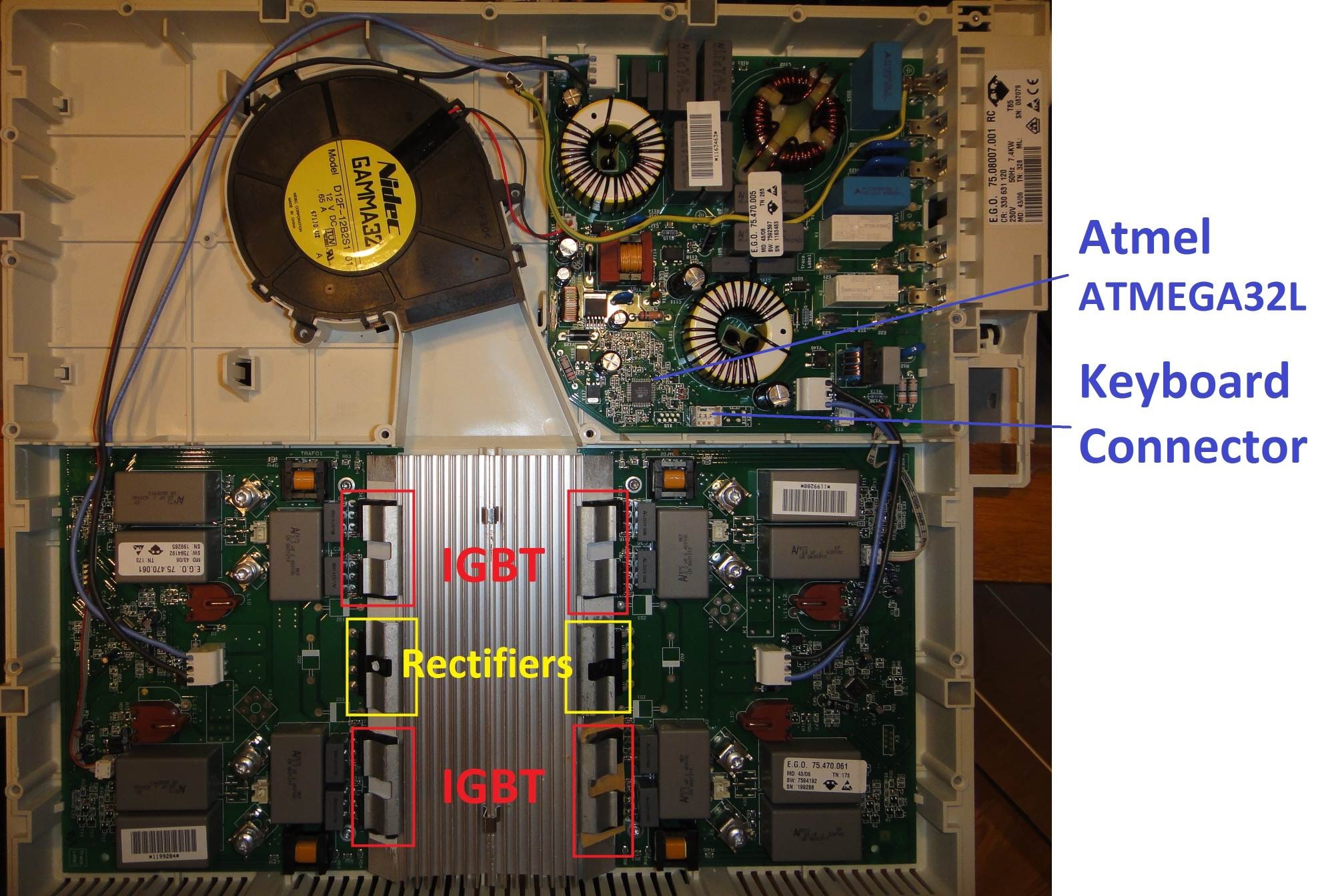
When his 6 years old induction cooker recently broke, [Johannes] decided to open it in an attempt to give it another life. Not only did he succeed, but he also added Bluetooth connectivity to the cooker. The repair part was actually pretty straight forward, as in most cases the IGBTs and rectifiers are the first components to break due to stress imposed on them. Following advice from a Swedish forum, [Johannes] just had to measure the resistance of these components to discover that the broken ones were behaving like open circuits.

He then started to reverse engineer the boards present in the cooker, more particularly the link between the ‘keyboards’ and the main microcontroller (an ATMEGA32L) in charge of commanding the power boards. With a Bus Pirate, [Johannes] had a look at the UART protocol that was used but it seems it was a bit too complex. He then opted for an IOIO and a few transistors to emulate key presses, allowing him to use his phone to control the cooker (via USB or BT). While he was at it, he even added a temperature sensor.

Adding A SIM Card To The Photon Q 4G LTE

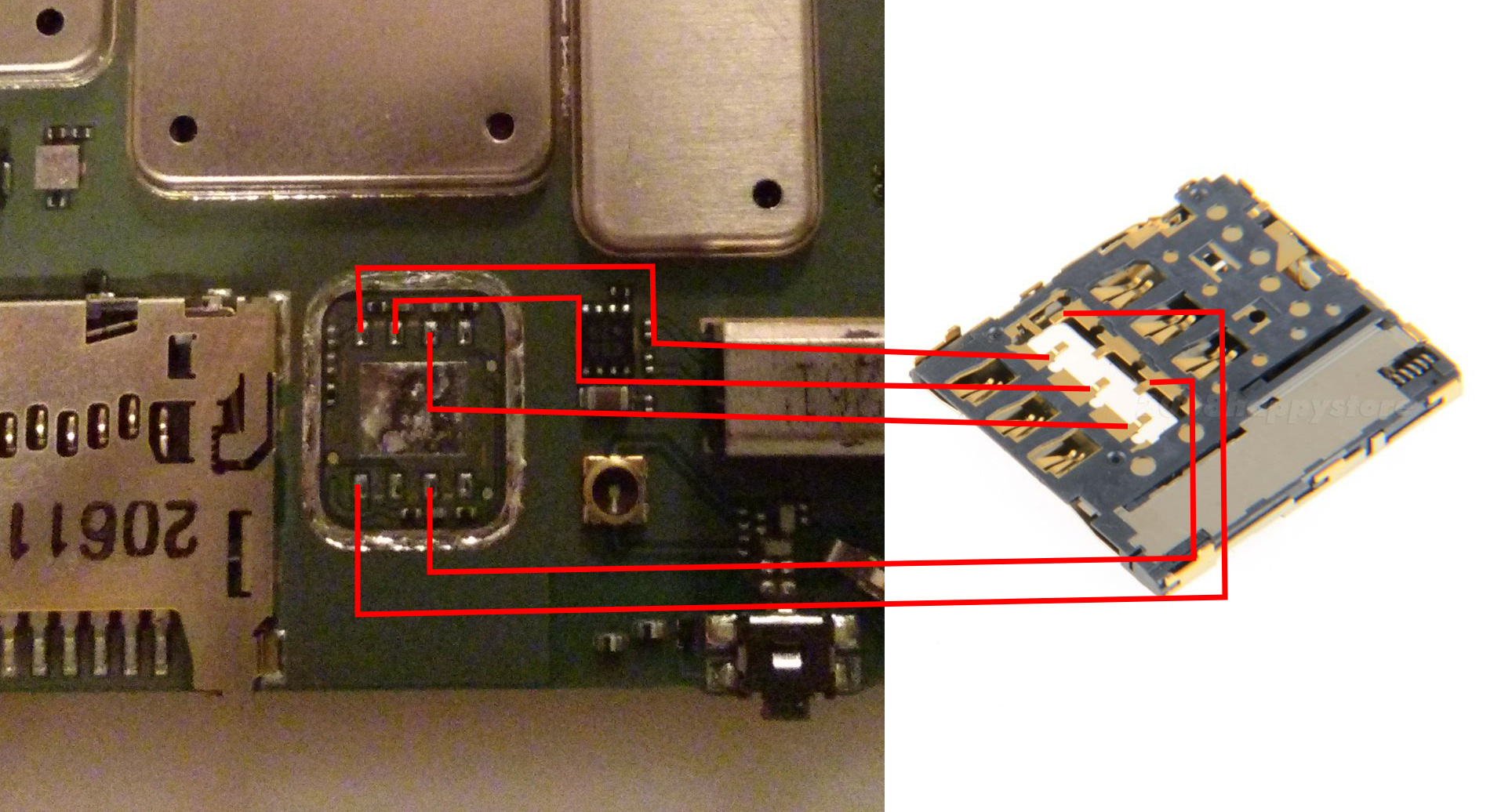
[Charles] is a big fan of phones that have physical keyboards. He thinks they are better suited for writing lengthy emails, but unfortunately his HTC Desire Z was getting old so he had to replace it. [Charles] therefore decided to import the Motorola Photon Q from the USA which exposed one major problem. The Verizon phone uses CDMA so there is nowhere to put a GSM SIM. But a bit of hacking allowed him to add a SIM card slot to it. Even though he’s not the one who originally found this hack (XDA thread here), his write-up is definitely an interesting read. To perform this modification, he needed a hot air reflow station, a soldering iron, a Dremel with the appropriate cutting wheel and several SIM card slot assemblies from the Galaxy S3 (as the first ones usually get burned during the disassembly process).

Obviously the first steps involved opening the phone, which may have taken a while. Using hot air, [Charles] removed the EMI shield covering the SIM card IC . He then extracted the latter using the same technique. Finally, he removed another EMI shield covering the contacts to which the SIM card slot should be connected. A few minutes/hours of delicate soldering and case modding later, [Charles] could use his SIM card on his brand new phone.