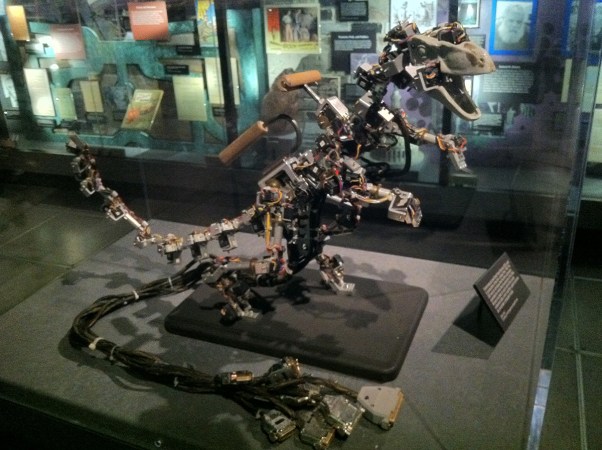
Raptor DID. Photo by Matt Mechtley.

How Jurassic Park’s Dinosaur Input Device Bridged The Stop-Motion And CGI Worlds

In a double-blast from the past, [Ian Failes]’ 2018 interview with [Phil Tippett] and others who worked on Jurassic Park is a great look at how the dinosaurs in this 1993 blockbuster movie came to be. Originally conceived as stop-motion animatronics with some motion blurring applied using a method called go-motion, a large team of puppeteers was actively working to make turning the book into a movie when [Steven Spielberg] decided to go in a different direction after seeing a computer-generated Tyrannosaurus rex test made by Industrial Light and Magic (ILM).

Naturally, this left [Phil Tippett] and his crew rather flabbergasted, leading to a range of puppeteering-related extinction jokes. Of course, it was the early 90s, with computer-generated imagery (CGI) animators being still very scarce. This led to an interesting hybrid solution where [Tippett]’s team were put in charge of the dinosaur motion using a custom gadget called the Dinosaur Input Device (DID). This effectively was like a stop-motion puppet, but tricked out with motion capture sensors.

This way the puppeteers could provide motion data for the CG dinosaur using their stop-motion skills, albeit with the computer handling a lot of interpolation. Meanwhile ILM could handle the integration and sprucing up of the final result using their existing pool of artists. As a bridge between the old and new, DIDs provided the means for both puppeteers and CGI artists to cooperate, creating the first major CGI production that holds up to today.

Even if DIDs went the way of the non-avian dinosaurs, their legacy will forever leave their dino-sized footprints on the movie industry.

Thanks to [Aaron] for the tip.


Top image: Raptor DID. Photo by Matt Mechtley.

Cost-Optimized Raspberry Pi 5 Released With 2 GB RAM And D0 Stepping

When the Raspberry Pi 5 SBC was released last year, it came in 4 and 8 GB RAM variants, which currently retail from around $80 USD and €90 for the 8 GB variant to $60 and €65 for the 4 GB variant. Now Raspberry Pi has announced the launch of a third Raspberry Pi 5 variant: a 2 GB version which also features a new stepping of the BCM2712 SoC. This would sell for about $50 USD and feature the D0 stepping that purportedly strips out a lot of the ‘dark silicon’ that is not used on the SBC.

These unused die features are likely due to the Broadcom SoCs used on Raspberry Pi SBCs being effectively recycled set-top box SoCs and similar. This means that some features that make sense in a set-top box or such do not make sense for a general-purpose SBC, but still take up die space and increase the manufacturing defect rate. The D0 stepping thus would seem to be based around an optimized die, with as only possible negative being a higher power density due to a (probably) smaller die, making active cooling even more important.

As for whether 2 GB is enough for your purposes depends on your use case, but knocking $10 off the price of an RPi 5 could be worth it for some. Perhaps more interesting is that this same D0 stepping of the SoC is likely to make it to the other RAM variants as well. We’re awaiting benchmarks to see what the practical difference is between the current C1 and new D0 steppings.

Thanks to [Mark Stevens] for the tip.

Historical Microsoft And Apple Artifacts Among First Christie’s Auction Of Living Computers Museum

Recently the Christie’s auction house released the list of items that would be going up for sale as part of the first lot of Living Computer Museum items, under the banner “Gen One: Innovations from the Paul G. Allen Collection”. One auction covers many ‘firsts’ in the history of computing,  including a range of computers like an Apple 1, and a PDP-10, as well as early Microsoft memos and code printouts. The other auctions include such items like a Gemini Spacesuit as worn by [Ed White] and a signed 1939 letter from [Albert Einstein] to [US President Roosevelt] on the discovery by the Germans of a fissionable form of uranium from which a nuclear weapon could be constructed.

We previously reported on this auction when it was first announced in June of this year. At the time many were saddened at seeing the only computer history and its related educational facilities vanish, and there were worries among those who had donated items to the museum what would happen to these now that the museum’s inventory was being put up for sale. As these donations tend to be unconditional, the museum is free to do with the item as they see fit, but ‘being sold at auction’ to probably a private collector was likely not on their mind when filling in the donation form.

As the first auctions kick off in a few days we will just have to wait and see where the museum’s inventory ends up at, but it seems likely that many of these items which were publicly viewable will now be scattered across the globe in private collections.

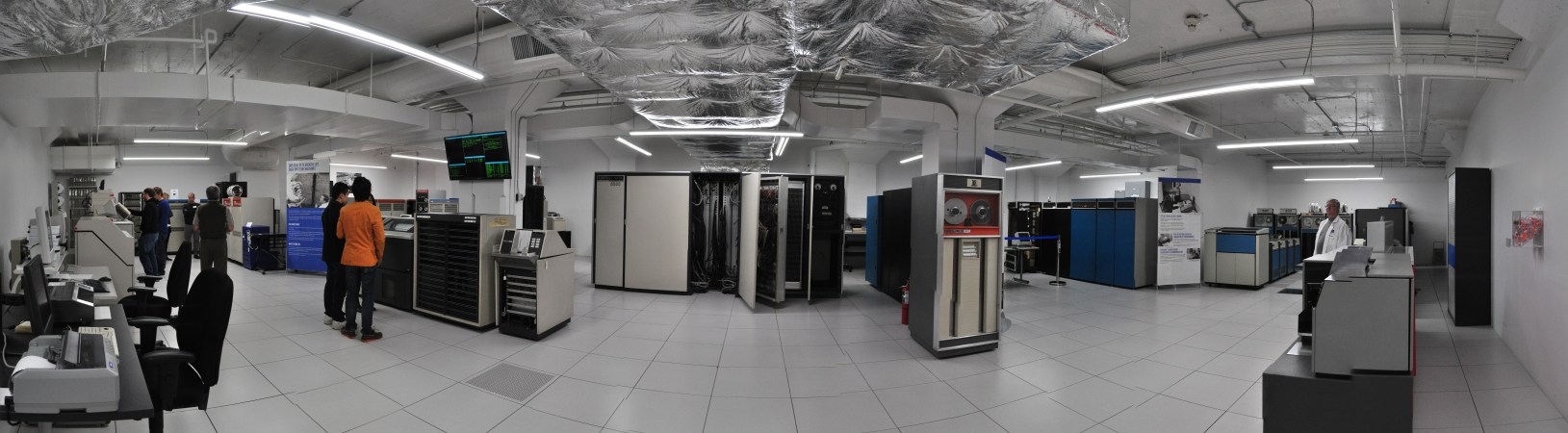
Top image: A roughly 180° panorama of the “conditioned” room of the Living Computer Museum, Seattle, Washington, USA. Taken in 2014. (Credit: Joe Mabel)

Building A Paper Tape Reader To Read Bytes

Over at the Usagi Electric farm, [David Lovett]’s custom 1-bit, vacuum tube-based computer (UEVTC for short) has been coming along well the past years, matching and exceeding the Motorola MC14500B 1-bit industrial control unit (ICU) that it is heavily inspired by. What is still missing, however, is a faster way to get data into the computer than manually toggling switches. The obvious choice is to make a (punched) paper tape reader, but how does one go about this, and what options exist here? With a few historical examples as reference and the tape reader on the impressive 1950s Bendix G-15 which [David] happens to have lounging around, [David] takes us in a new video through the spiraling complexity of what at first glance seems like a simple engineering challenge.

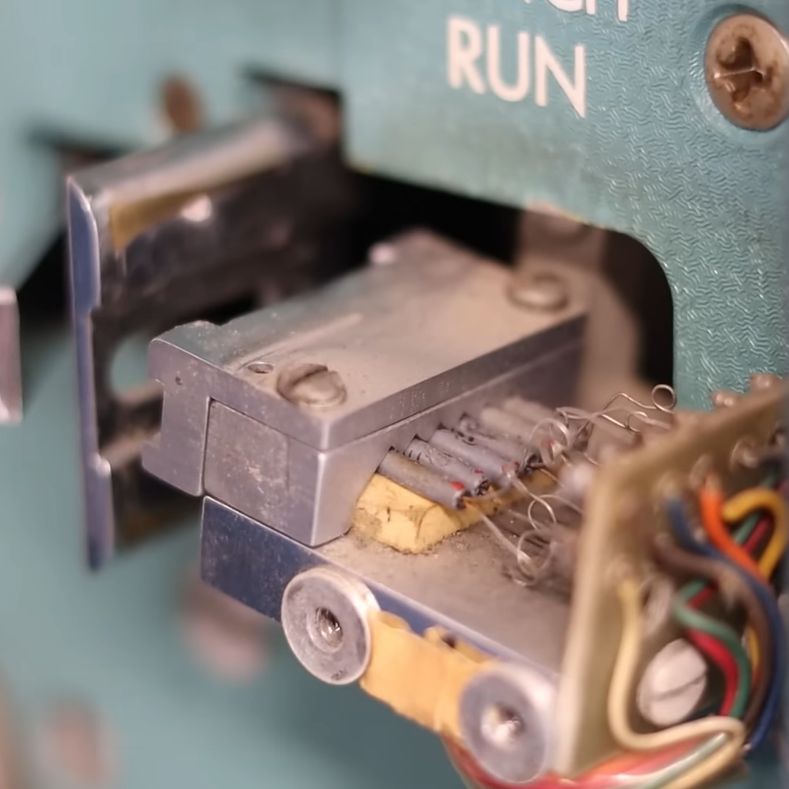
Photodiodes in the tape reader of the Bendix G-15. (Credit: David Lovett, Usagi Electric)

Punched paper tape saw significant use alongside punched paper cards and magnetic tape, and despite their low bit density, if acid-free paper (or e.g. mylar) is used, rolls of paper tape should remain readable for many decades. So how to read these perforations in the paper? This can be done mechanically, or optically, with in both case the feedrate an important consideration.

Right off the bat the idea of a mechanical reader was tossed out due to tape wear, with [David] digging into his stack of photodetector tubes. After looking at a few rather clunky approaches involving such tubes, the photodiodes in the Bendix G-15’s tape reader were instead used as inspiration for a design. These are 1.8 mm diameter photodiodes, which aren’t super common, but have the nice property that they align exactly with the holes in the paper tape.

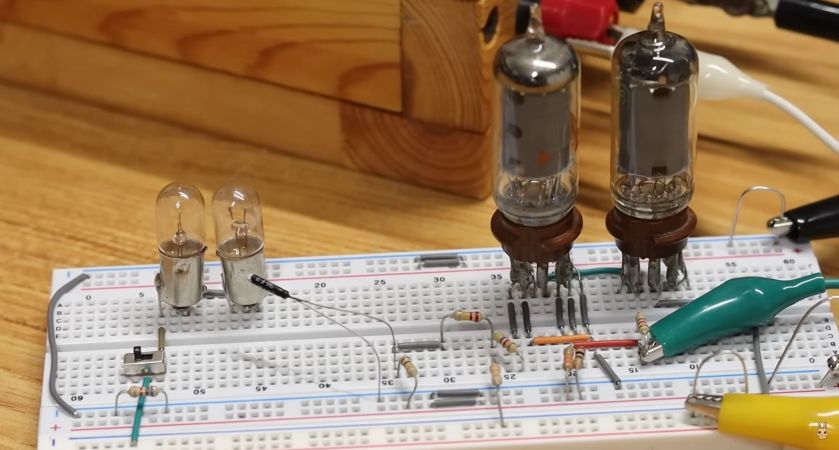
This left building a proof-of-concept on a breadboard with some incandescent bulbs and one of the photodiode to demonstrate that a valid logic signal could be produced. This turned out to be the case, clearing the construction of the actual tape reader, which will feature in upcoming videos.

Continue reading “Building A Paper Tape Reader To Read Bytes”

Reverse-Engineering The AMD Secure Processor Inside The CPU

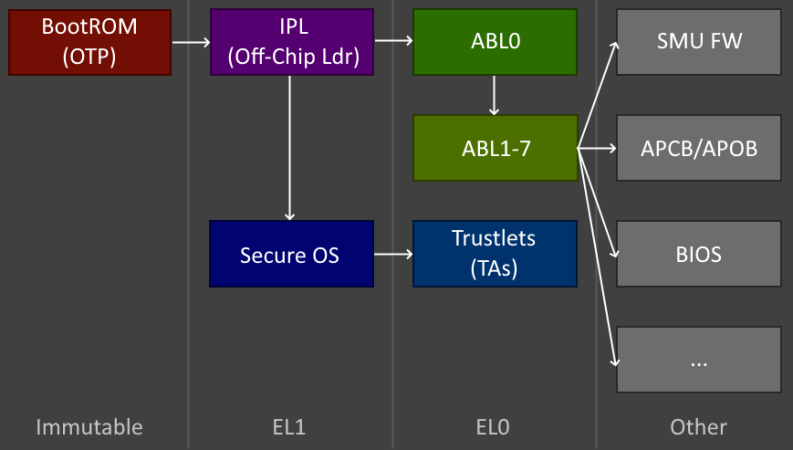
On an x86 system the BIOS is the first part of the system to become active along with the basic CPU core(s) functionality, or so things used to be until Intel introduced its Management Engine (IME) and AMD its AMD Secure Processor (AMD-SP). These are low-level, trusted execution environments, which in the case of AMD-SP involves a Cortex-A5 ARM processor that together with the Cryptographic Co-Processor (CCP) block in the CPU perform basic initialization functions that would previously have been associated with the (UEFI) BIOS like DRAM initialization, but also loading of encrypted (AGESA) firmware from external SPI Flash ROM. Only once the AMD-SP environment has run through all the initialization steps will the x86 cores be allowed to start up.

In a detailed teardown by [Specter] over at the Dayzerosec blog the AMD-SP’s elements, the used memory map  and integration into the rest of the CPU die are detailed, with a follow-up article covering the workings of the CCP. The latter is used both by the AMD-SP as well as being part of the cryptography hardware acceleration ISA offered to the OS. Where security researchers are interested in the AMD-SP (and IME) is due to the fascinating attack vectors, with the IME having been the most targeted, but AMD-SP having its own vulnerabilities, including in related modules, such as an injection attack against AMD’s Secure Encrypted Virtualization (SEV).

Although both AMD and Intel are rather proud of how these bootstrapping systems enable TPM, secure virtualization and so on, their added complexity and presence invisible to the operating system clearly come with some serious trade-offs. With neither company willing to allow a security audit, it seems it’s up to security researchers to do so forcefully.

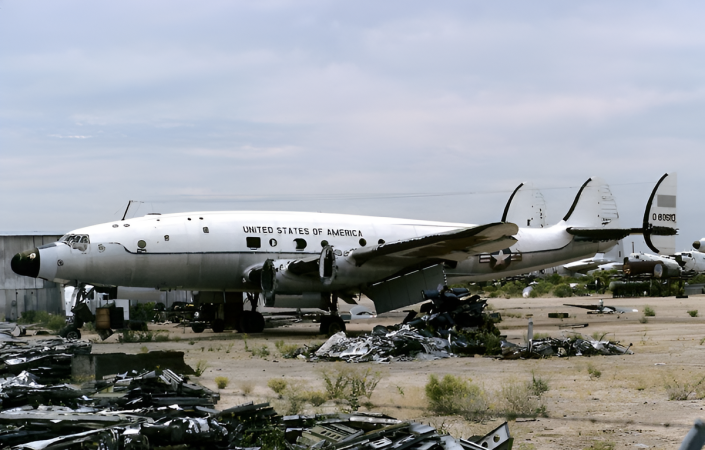
For years, the first Air Force One sat neglected and forgotten in an open field at Arizona’s Marana Regional Airport. (Credit: Dynamic Aviation)

The First Air Force One And How It Was Nearly Lost Forever

Although the designation ‘Air Force One’ is now commonly known to refer to the airplane used by the President of the United States, it wasn’t until Eisenhower that the US President would make significant use of a dedicated airplane. He would have a Lockheed VC-121A kitted out to act as his office as commander-in-chief. Called the Columbine II after the Colorado columbine flower, it served a crucial role during the Korean War and would result the coining of the ‘Air Force One’ designation following a near-disaster in 1954.

This involved a mix-up between Eastern Air Lines 8610 and Air Force 8610 (the VC-121A). After the Columbine II was replaced with a VC-121E model (Columbine III), the Columbine II was mistakenly sold to a private owner, and got pretty close to being scrapped.

In 2016, the plane made a “somewhat scary and extremely precarious” 2,000-plus-mile journey to Bridgewater, Virginia, to undergo a complete restoration. (Credit: Dynamic Aviation)

Although nobody is really sure how this mistake happened, it resulted in the private owner stripping the airplane for parts to keep other Lockheed C-121s and compatible airplanes flying. Shortly before scrapping the airplane, he received a call from the Smithsonian Institution, informing him that this particular airplane was Eisenhower’s first presidential airplane and the first ever Air Force One. This led to him instead fixing up the airplane and trying to sell it off. Ultimately the CEO of the airplane maintenance company Dynamic Aviation, [Karl D. Stoltzfus] bought the partially restored airplane after it had spent another few years baking in the unrelenting sun.

Although in a sorry state at this point, [Stoltzfus] put a team led by mechanic [Brian Miklos] to work who got the airplane in a flying condition by 2016 after a year of work, so that they could fly the airplane over to Dynamic Aviation facilities for a complete restoration. At this point the ‘nuts and bolts’ restoration is mostly complete after a lot of improvisation and manufacturing of parts for the 80 year old airplane, with restoration of the Eisenhower-era interior and exterior now in progress. This should take another few years and another $12 million or so, but would result in a fully restored and flight-worthy Columbine II, exactly as it would have looked in 1953, plus a few modern-day safety upgrades.

Although [Stoltzfus] recently passed away unexpectedly before being able to see the final result, his legacy will live on in the restored airplane, which will after so many years be able to meet up again with the Columbine III, which is on display at the National Museum of the USAF.

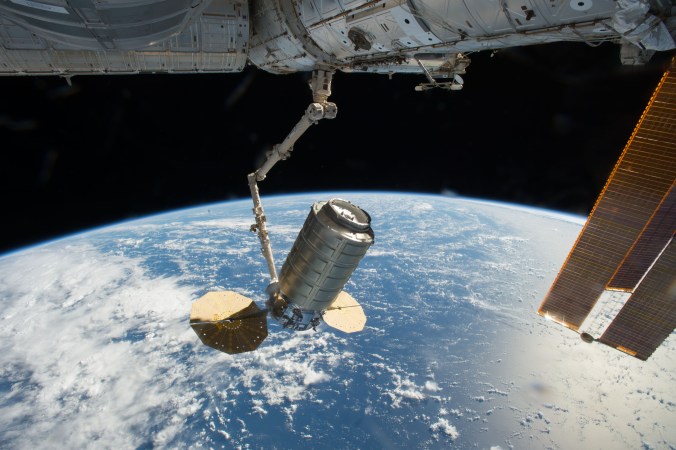
Canadarm2 captures Cygnus OA-5 S.S. Alan Poindexter in late 2016 (Credit: NASA)

Canadarm2 Scores Milestone With Catching Its 50th Spacecraft

Recently Canada’s Canadarm2 caught its 50th spacecraft in the form of a Northrop Grumman Cygnus cargo vessel since 2009. Although perhaps not the most prominent part of the International Space Station (ISS), the Canadarm2 performs a range of very essential functions on the outside of the ISS, such as moving equipment around and supporting astronauts during EVAs.

Power and Data Grapple Fixture on the ISS (Credit: NASA)

Officially called the Space Station Remote Manipulator System (SSRMS), it is part of the three-part Mobile Servicing System (MSS) that allows for the Canadarm2 and the Dextre unit to scoot around the non-Russian part of the ISS, attach to Power Data Grapple Fixtures (PDGFs) on the ISS and manipulate anything that has a compatible Grapple Fixture on it.

Originally the MSS was not designed to catch spacecraft when it was installed in 2001 by Space Shuttle Endeavour during STS-100, but with the US moving away from the Space Shuttle to a range of unmanned supply craft which aren’t all capable of autonomous docking, this became a necessity, with the Japanese HTV (with grapple fixture) becoming the first craft to be caught this way in 2009. Since the Canadarm2 was originally designed to manipulate ISS modules this wasn’t such a major shift, and the MSS is soon planned to also started building new space stations when the first Axiom Orbital Segment is launched by 2026. This would become the Axiom Station.

With the Axiom Station planned to have its own Canadarm-like system, this will likely mean that Canadarm2 and the rest of the MSS will be decommissioned with the rest of the ISS by 2031.

Top image: Canadarm2 captures Cygnus OA-5 S.S. Alan Poindexter in late 2016 (Credit: NASA)