An Insulin Injection That Lasts For Days: A New Hope For Diabetics

A major challenge for people who have a form of diabetes is the need to regulate the glucose levels in their body. Normally this is where the body’s insulin-producing cells would respond to glucose with a matching amount of insulin, but in absence of this response it is up to the patient to manually inject insulin. Yet recent research offers the hope that these daily injections might be replaced with weekly injections, using insulin-binding substances that provide a glucose-response rather like the natural one. One such approach was tested by Juan Zhang and colleagues, with the results detailed in Nature Biomedical Engineering.

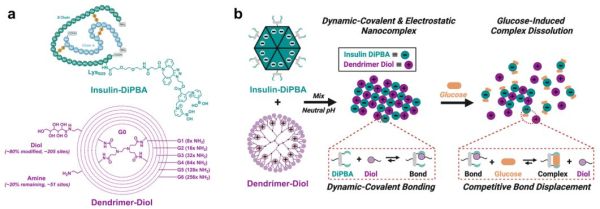
In this study, the researchers injected a group of diabetic (type 1) mice and minipigs with the formulation, consisting out of gluconic acid-modified recombinant human insulin bound to a glucose-responsive phenylboronic acid-diol complex. The phenylboronic acid element binds more easily to glucose, which results in the insulin being released, with no significant hypoglycemia observed in this small non-human test group. A major advantage of this mechanism is that it is fully self-regulating through the amount of glucose present in the blood.

This study is similar to work by Sijie Xian and colleagues published in Advanced Materials (ChemRxiv preprint) where a similar complex of glucose-sensitive, bound insulin complex was studied, albeit in vitro. With non-human animal testing showing good results for this method, human trials may not be far off, which could mean the end to daily glucose and insulin management for millions in the US alone.

(Top image: Chemical structures of the insulin-DiPBA complex and its functioning. Credit: Sijie Xian et al., 2023)

China’s Nuclear-Powered Containership: A Fluke Or The Future Of Shipping?

Since China State Shipbuilding Corporation (CSSC) unveiled its KUN-24AP containership at the Marintec China Expo in Shanghai in early December of 2023, the internet has been abuzz about it. Not just because it’s the world’s largest container ship at a massive 24,000 TEU, but primarily because of the power source that will power this behemoth: a molten salt reactor of Chinese design that is said to use a thorium fuel cycle. Not only would this provide the immense amount of electrical power needed to propel the ship, it would eliminate harmful emissions and allow the ship to travel much faster than other containerships.

Meanwhile the Norwegian classification society, DNV, has already issued an approval-in-principle to CSSC Jiangnan Shipbuilding shipyard, which would be a clear sign that we may see the first of this kind of ship being launched. Although the shipping industry is currently struggling with falling demand and too many conventionally-powered ships that it had built when demand surged in 2020, this kind of new container ship might be just the game changer it needs to meet today’s economic reality.

That said, although a lot about the KUN-24AP is not public information, we can glean some information about the molten salt reactor design that will be used, along with how this fits into the whole picture of nuclear marine propulsion.

Continue reading “China’s Nuclear-Powered Containership: A Fluke Or The Future Of Shipping?”

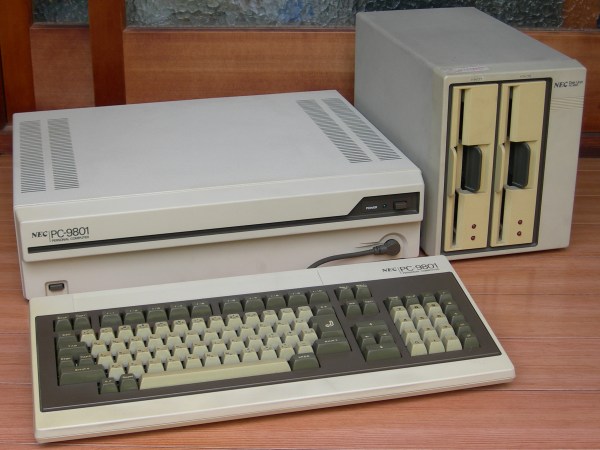
PC-9801 system. (Credit: MH0301 - Own work, CC BY-SA 4.0)

The Strange World Of Japan’s PC-98 Computer Ecosystem

Despite the popularity of the IBM PC in the West during the 1980s, it had shortcomings that prevented it from flourishing in the Japanese market, most of all support for the Japanese language. This led to a sort of parallel universe in which NEC’s PC-9800 series (‘PC-98’) was the dominant personal computer, including its NEC µPD7220 display controller with its 4096-color palette. These computer systems led to a graphics style that persists to today, along with a whole ecosystem of games and applications that never left the PC-98. In an article by [Biz Davis] this software ecosystem, its art style and their lasting impact is explored.

Screenshots from X-Girl, a PC-98 game from 1994.

Although the NEC PC-9800 series of computers was primarily focused on Japanese businesses with its release in the early 1980s, it found itself adopted for educational and hobby purposes as well. During the 1980s and early 1990s they faced little opposition from IBM PCs and clones, despite them all being x86-based systems running DOS. It wasn’t until the early 1990s that mostly US companies began to explicitly design computers to work for the Japanese market, leading to a gradual decline of the PC-9800 series PCs in the market.

Despite the last PC-98 system having been released in 2000 – with the last systems running some flavor of Windows – these systems and the software for them isn’t just a unique time capsule of this part of Japan’s history, but continues to see new software releases to this day. If you wish to experience this software for yourself, a number of open source PC-9800 emulators are available, including the nyan-tastic Neko Project II.

Top image: PC-9801 system. (Credit: MH0301 – Own work, CC BY-SA 4.0)

Promethean Matches: The Ancestor To Modern Matches

The history of making fire at will is a long and storied one, stretching back to the days when we’d rub wooden sticks together, or use flint and steel to ignite tinder. An easier, albeit vastly more expensive and dangerous alternative came in the 19th century when chemists discovered auto-ignition using a potassium chlorate mixture and sulfuric acid. This method was refined and later patented by Samuel Jones in 1828 as the ‘promethean match’ after the God of Fire, Prometheus, which is the topic of a recent [NurdRage] chemistry video.

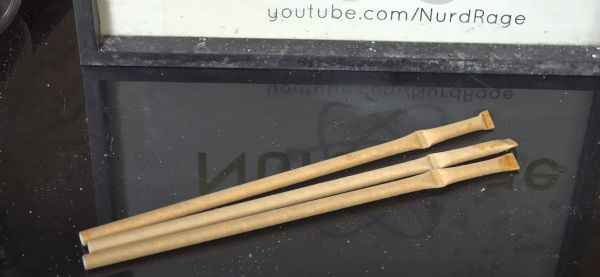
Crush, don't strike: the fiery conflagration of a promethean match. (Credit: NurdRage)
Crush, don’t strike: the fiery conflagration of a promethean match. (Credit: NurdRage)

Using practically the same recipe of potassium chlorate and sugar as in the 19th century, [NurdRage] uses paper straws to contain this powder. Glue is used to section the paper straw into two compartments and seal in the components, with the smaller compartment used for a glass capsule containing sulfuric acid. This vial was produced from the tip of a glass pipette, using a hot flame to first seal the tip, then detach and seal the other end of the tip, resulting in the sulfuric acid capsule, ready to be added to the second compartment.

The moment this glass capsule is crushed, the sulfuric acid will soak into the paper, reaching the large compartment with the potassium chlorate and sugar mixture, causing a strongly exothermic reaction that ignites the paper. Yet as simple as this sounds, [NurdRage] found the three matches he made to be rather fickle, with one igniting beautifully after crushing the capsule with pliers, while one did nothing and the remaining match decided to violently explode rather than burn.

Considering the immense manual labor involved in making these matches, they never were very popular, and were quickly replaced by strike-anywhere matches, followed by safety matches, none of which require you to carry fragile glass capsules containing sulfuric acid with you. As a chemistry experiment, it is however a total blast that will set any boring chemistry class on fire.

Continue reading “Promethean Matches: The Ancestor To Modern Matches”

Absorbing Traffic Noise With Bricks Using Helmholtz Resonators

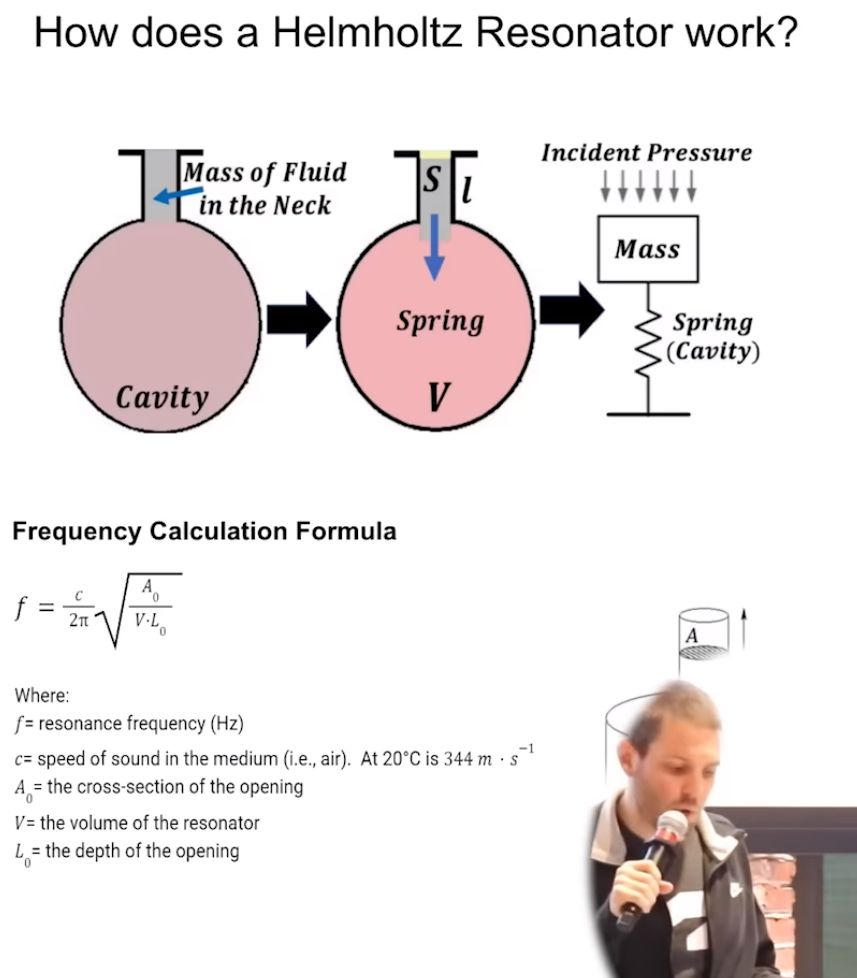
One inevitable aspect of cities and urban life in general is that it is noisy, with traffic being one of the main sources of noise pollution. Finding a way to attenuate especially the low-frequency noise of road traffic was the subject of [Joe Krcma]’s Masters Thesis, the results of which he gave a talk on at the Portland Maker Meetup Club after graduating from University College London. The chosen solution in his thesis are Helmholtz resonators, which are a kind of acoustic spring. Using a carefully selected opening into the cavity, frequencies can be filtered out, and extinguished inside the cavity.

Basic functionality and formula used to determine the dimensions of a Helmholtz Resonator.

As examples of existing uses of Helmholtz resonators in London, he points at the Queen Elizabeth Hall music venue, as well as the newly opened Queen Elizabeth Line and Paddington Station. For indoor applications there are a number of commercial offerings, but could this be applied to outdoor ceramics as well, to render urban environments into something approaching an oasis of peace and quiet?

For the research, [Joe]’s group developed a number of Helmholtz resonator designs and manufacturing methods, with [Joe] focusing on clay fired versions. For manufacturing, 3D printing of the clay was attempted, which didn’t work out too well. This was followed by slip casting, which allowed for the casting of regular rectangular bricks.

But after issues with making casting hollow bricks work, as well as the cracking of the bricks during firing in the kiln, the work of another student in the group inspired [Joe] to try a different approach. The result was a very uniquely shaped ‘brick’ that, when assembled into a wall, forms three Helmholtz resonators: inside it, as well as two within the space with other bricks. During trials, the bricks showed similar sound-deadening performance as  foam and wood. He also made the shape available on Thingiverse, if you want to try printing or casting it yourself.

Continue reading “Absorbing Traffic Noise With Bricks Using Helmholtz Resonators”

UK’s JET Tokamak Retires After 40 Years And 105,842 Pulses

The UK’s most famous fusion reactor – the Joint European Torus (JET) tokamak – saw its first plasma on June 25th of 1983. Its final plasma pulse was generated on December 18th of 2023, for a total of 105,842 pulses over forty-and-a-half years and countless experiments.

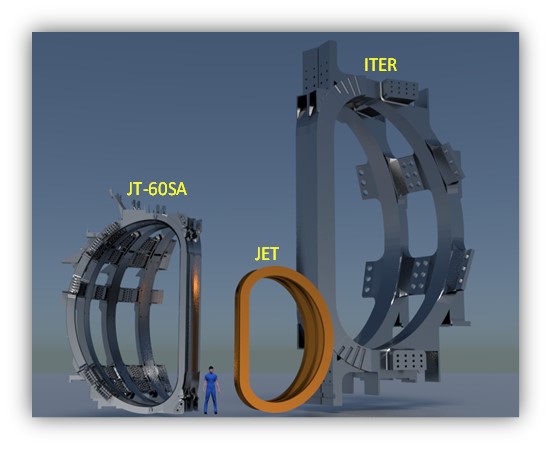
Comparison of toroidal field (TF) coils from JET, JT-60SA and ITER (Credit: QST)

Originally designed in the 1970s by Euratom members, JET formed the core of Europe’s fusion research program, allowing many of the aspects of tokamak systems to be explored, including deuterium-tritium fusion. Its final day of experiments involved an inverted plasma shape prior to targeting electrons at the tokamak’s inner wall, to study the impact of such damage.

Although JET has received a number of upgrades over the decades, the MAST Upgrade and upcoming STEP fusion reactors at the Culham Centre for Fusion Energy (CCFE) are now headed where JET’s design cannot go. Current advanced tokamak reactors like Japan’s JT-60SA are increasingly using super-conducting coils with  often plasma volumes far beyond JET’s, with the focus shifting from plasma research to net energy production.

This means that unless JET somehow gets repurposed/upgraded and recommissioned, this is the final goodbye to one of the world’s most famous and influential fusion reactors.

(Top image: Internal view of the JET tokamak superimposed with an image of plasma flows)

Teardown Of FGM-148 Javelin Missile’s Guidance Computer

You know it’s a good teardown when [Michel] starts off by saying to not ask him where exactly he got the guidance section of an FGM-148 Javelin from. This shoulder-launched anti-tank guided missile (ATGM) is a true marvel of engineering that has shown its chops during recent world events. As a fire-and-forget type guided missile it is designed to use the internal IR tracker to maintain a constant lock on the target, using its guidance system to stay exactly on track.

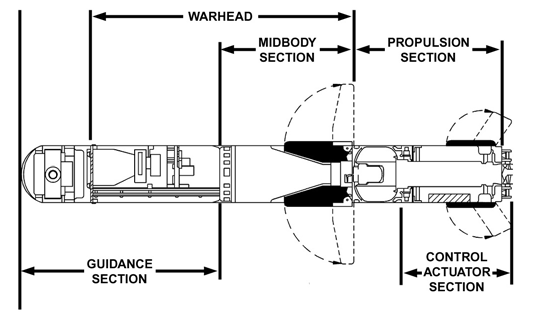
FGM-148 Javelin schematic overview. (Source: U.S. Army, FM 3-22.37)

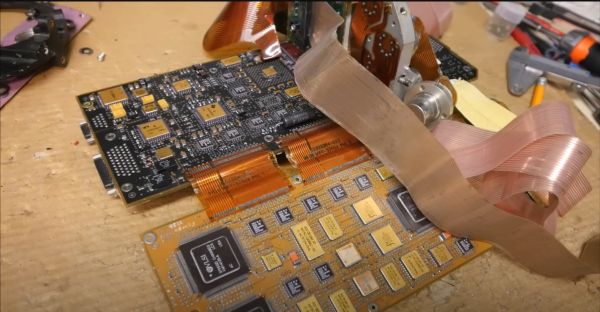
Initially designed in 1989 and introduced into service in 1996, it has all the ceramic-and-gold styling which one would expect from a military avionics package from the era. Tasked with processing the information from the IR sensor, and continuously adjusting the fins to keep it on course, the two sandwiched, 3 mm thick PCBs that form the main section of the guidance computer are complemented by what looks like a milled aluminium section which holds a sensor and a number of opamps, all retained within the carbon-fiber shell of the missile.

In the video [Michel] looks at the main components, finding datasheets for many commercially available parts, with the date codes on the parts confirming that it’s a late 80s to early 90s version, using presumably a TMS34010 as the main CPU on the DSP board for its additional graphics-related instructions. Even though current production FGM-148s are likely to use far more modern parts, this is a fun look at what was high-end military gear in the late 1980s and early 1990s.

Continue reading “Teardown Of FGM-148 Javelin Missile’s Guidance Computer”