Wireless CNC Pendant Implemented With ESP-NOW

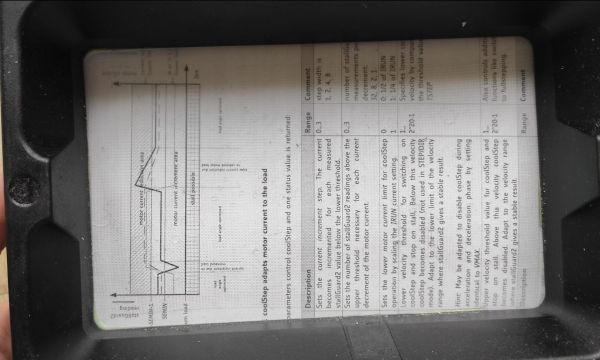
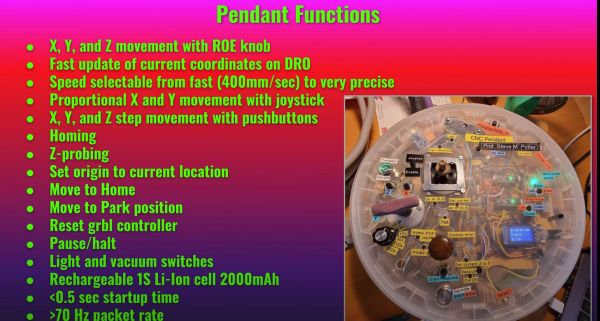
As a fervent fan of twiddly and twirly widgets and tactile buttons in a device’s user interface, [Steve M Potter] created a remote control (pendant) for his CNC machine, which he explains in a recent video that’s also linked down below. In addition to all the tactile goodness, what is perhaps most interesting about this controller is that it uses Espressif’s ESP-NOW protocol. This still uses the same 2.4 GHz as WiFi would, but uses a system more akin to the pairing of a wireless mouse or keyboard.

Advantages of ESP-NOW include the lower power usage, longer range, no requirement for a router and WiFi SSID & password. As far as latency goes, [Steve] measured a round-trip latency of 2.4 ms, which is fast enough for this purpose. Since it does control a potentially dangerous machine, all transmissions are acknowledged and re-transmitted at higher power if needed.

The lower power usage means that the pendant will last a lot longer on a single charge from the 18650 Li-ion cell, while ESP-NOW’s fixed address pairing saves time when turning the pendant on. Meanwhile, on the CNC side, another ESP32 acts as the receiving end for commands, although theoretically an ESP8266 could be used as well, if size or power was a concern there.

As for the transparent enclosure? It’s to make it easier to show it off to interested folk, apparently.

Continue reading “Wireless CNC Pendant Implemented With ESP-NOW”

The Dawn Of Synthetic Milk: When Milk Becomes More Like Beer

What would we do without milk in modern day society? Although lactation originally evolved as a way to provide a newborn mammal with nutrients and the other essentials during the first weeks of their life, milk has for thousands of years now been a staple food in human cultures. Whether from cows, camels, sheep or other mammals, each year humans consume many liters of this mythical substance, with our galaxy’s name – the Milky Way –  coming courtesy of Greek mythology and a spilled milk incident.

A major issue with mammalian milk, however, is that it is only produced by females for a certain time after giving birth, which requires for example a dairy cow to constantly go through pregnancies, which is both cumbersome and not very animal-friendly. Simultaneously, the newborn offspring cannot drink this milk, but must be provided with an alternative. For these reasons synthetic milk is becoming an increasingly more popular animal- and environmentally-friendly alternative.

For years now, companies such as US-based Perfect Day are producing milk that’s for all intents and purposes identical to cow milk, with the added advantage of being free of lactose and other problematic additions. The best part of this all? It’s all done with existing fermentation techniques.

Continue reading “The Dawn Of Synthetic Milk: When Milk Becomes More Like Beer”

Bypass Defective STDP9320 Video Controller On Wacom Cintiq Companion 2

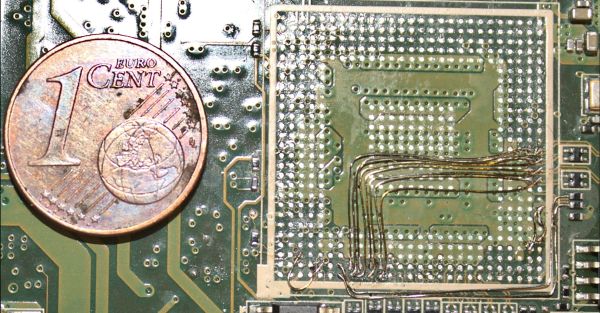
Some products seem to have a part of two that’s pretty much guaranteed to end up dying on you. In the case of the 2015-vintage Wacom Cintiq Companion 2, this turns out to be the so-called Athena chip, which switches the display input between the HDMI port and internal display controller. This allows for use in both standalone mode (tablet), as well as companion mode, where it acts as a drawing tablet for a connected PC. When confronted with such a faulty device, [neutrino] found and applied a simple fix: bypassing the Athena chip altogether.

This fix is recommended by the Repair Preservation Group’s wiki page on the topic, noting that this will permanently disable its use as an external display without additional repairs to recreate the functionality of the removed chip. This STDP9320 (PDF) part by ST Microelectronics is described as a ‘Premium high resolution multimedia monitor controller with 3D video’ and contains a wide range of video scalers, a HDMI receiver, DisplayPort (including embedded DP) support. With this fix, the Cintiq Companion 2’s Intel CPU’s graphics core is directly connected to the display’s eDP input, along with a range of voltages and enable pins.

What the exact reason is for the STDP9320 dying after a few years with what appears to be some kind of internal power failure or short, but this bypass fix at least restores standalone functionality. Sourcing a replacement for this obsolete IC seems possible, but a big gamble. Sadly, it would seem that this Wacom device will no longer be a companion for much longer.

Continuous Printing On LCD Resin Printer: No More Wasted Time On Peeling? Is It Possible?

Anyone who has done any amount of 3D printing with SLA printers is probably well aware of the peeling step with each layer. This involves the newly printed layer being pulled away from the FEP film that is attached to the bottom of the resin vat. Due to the forces involved, the retraction speed of the build plate on the Z-axis has to be carefully tuned to not have something terrible happen, like the object being pulled off the build plate. Ultimately this is what limits SLA print speed, yet [Jan Mrázek] postulates that replacing the FEP with an oxygen-rich layer can help here.

The principle is relatively simple: the presence of oxygen inhibits the curing of resin, which is why for fast curing of resin parts you want to do so in a low oxygen environment, such as when submerged in water. Commercial printers by Carbon use a patented method called “continuous liquid interface production” (CLIP), with resin printers by other companies using a variety of other (also patented) methods that reduce or remove the need for peeling. Theoretically by using an oxygen-permeating layer instead of the FEP film, even a consumer grade SLA printer can skip the peeling step.

The initial attempt by [Jan] to create an oxygen-permeating silicone film to replace the FEP film worked great for about 10 layers, until it seems the oxygen available to the resin ran out and the peeling force became too much. Next attempts involved trying to create an oxygen replenishment mechanism, but unfortunately without much success so far.

Regardless of these setbacks, it’s an interesting research direction that could make cheap consumer-level SLA printers that much more efficient.

(Thumbnail image: the silicone sheet prior to attaching. Heading image: the silicone sheet attached to a resin vat. Both images by [Jan Mrázek])

HP 33120A Repair: Shutting Down The Eye Of Sauron

When a friend of [Tom Verbeure] came into possession of two HP 33120A 15 MHz function/arbitrary waveform generators, he could not resist giving them a try. Although not exactly high-end units, the HP 33120A makes for a pretty nice unit for a home lab. During the first test run, however, [Tom] discovered that one of the units had a dead output, which made it rather useless. Undeterred, [Tom] set to work diagnosing it, helped by the repair manual and full schematics.

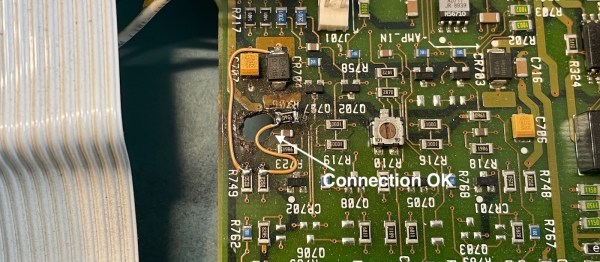
While the cause was quickly tracked down to the general area around an exploded MLCC, fixing the fried Zener diode that may have initiated the short on the -15V rail revealed an unpleasant surprise. To [Tom]’s horror, he saw a portal to Hell itself open when part of the PCB caught on fire due to an internal short. After making sure to capture a video of this event, he then proceeded to use a thermal camera to track down the hot spot and uses a drill to remove the short.

While one can argue with the use of a drill to remove shorts on inner layers of a PCB, ultimately the fix was effective. A look on the schematic and comparison with the functioning 33120A unit later, all it took was two bodge wires to restore functionality. After this event, [Tom]’s friend gave him the repaired unit as thanks, and definitely not because [Tom] had begun to refer to it as ‘his precious’.

LEDCard: The Pocketable Ring Light

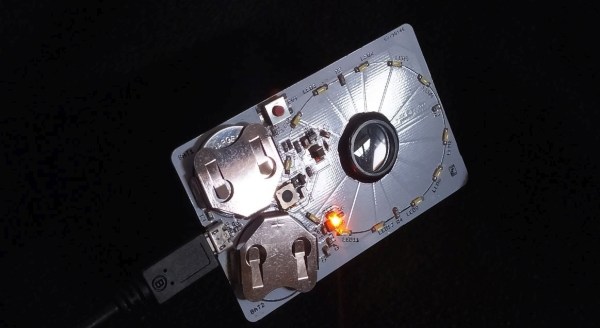
How many times have you found yourself fumbling about with lighting while trying to get a clear up-close shot of an object? Although smartphones come with pretty nice cameras these days, properly lighting an object and taking impressive macro shots isn’t exactly their strong suit. This is where [MisterHW]’s LEDCard is a very welcome companion. Not only does it provide a credit card sized ring light, it also allows for a molded acrylic lens to be inserted for high-quality macro shots.

The project in its current iteration consists out of a single PCB with rechargeable Li-ion coin cells (LIR2430) and a USB-powered charge controller. After charging the LEDCard (or inserting freshly charged Li-ion coin cells), a single button press will light up the SMD LEDs via the LM3410 LED driver IC. Press the ON button gently (half-press) for medium brightness and fully for full intensity. Finally, pressing the TEST button with the LEDs lit performs a battery level test that turns the LEDs off if the battery is ok. If they stay lit, it’s time to recharge the LEDCard.

As [MisterHW] points out, the LEDCard being compact enough to carry around with you wherever you go makes it suitable as an emergency flashlight as well. It’s also not the final iteration of the design. Future (incremental) improvements include a diffuser for the ring light and more. Even so, in its current state LEDCard is already a proven design.

A DIY Pulse Tube Cryocooler In The Quest For Home-Made Liquid Nitrogen

What if you have a need for liquid nitrogen, but you do not wish to simply order it from a local supplier? In that case you can build your very own pulse tube cryocooler, as [Hyperspace Pirate] is in the process of doing over at YouTube. You can catch part 1 using a linear motor and part 2 using a reciprocating piston-based version also after the break. Although still very much a work-in-progress, the second version of the cryocooler managed to reduce the temperature to a chilly -75°C.

The pulse tube cryocooler is one of many types of systems used for creating a cooling effect. Commercially available refrigerators and freezers tend to use Rankine cycle coolers due to their low cost and effectiveness at (relatively) warmer temperatures. For cryogenic temperatures, Stirling engines are commonly used, although they find some use in refrigeration as well. All three share common elements, but they differ in their efficiency over a larger temperature range.

In this video series, the viewer is taken through the physics behind these coolers and the bottlenecks which prevent them from simply cooling down to zero Kelvin. Despite the deceptive simplicity of pulse tube cryocoolers — with just a single piston, a regenerator mesh, and some tubing — making them work well is an exercise in patience. We’re definitely looking forward to the future videos in this series as it develops.

Continue reading “A DIY Pulse Tube Cryocooler In The Quest For Home-Made Liquid Nitrogen”