The Confusing World Of Wood Preservation Treatments

Wood is an amazing material to use around the house, both for its green credentials and the way it looks and feels. That said, as a natural product there are a lot of microorganisms and insects around that would love to take a few good nibbles out of said wood, no matter whether it’s used for fencing, garden furniture or something else. For fencing in particular wood treatments are therefore applied that seek to deter or actively inhibit these organisms, but as the UK bloke over at the [Rag ‘n’ Bone Brown] YouTube channel found out last year, merely slapping on a coating of wood preserver may actually make things worse.

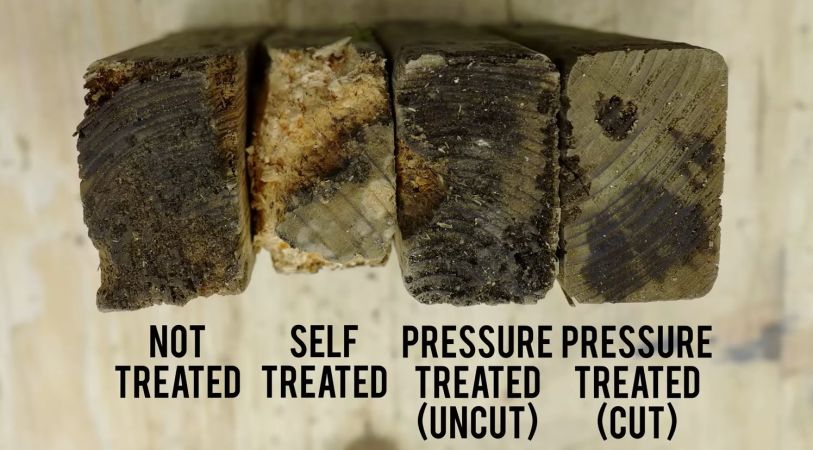
For the experiment three tests were set up, each with an untreated, self-treated and two pressure treated (tanalized) sections. Of the pressure treated wood one had a fresh cut on the exposed side, with each of the three tests focusing on a different scenario.

After three years of these wood cuts having been exposed to being either partially buried in soil, laid on the long side or tossed in a bucket, all while soaking up the splendid wonders of British weather, the results were rather surprising and somewhat confusing. The self-treated wood actually fared worse than the untreated wood, while the pressure treated wood did much better, but as a comment by [davidwx9285] on the video notes, there are many questions regarding how well the pressure treatment is performed.

While the self-treatment gets you generally only a surface coating of the – usually copper-based – compound, the vacuum pressure treatment’s effectiveness depends on how deep the preservative has penetrated, which renders some treated wood unsuitable for being buried in the ground. Along with these factors the video correctly identifies the issue of grain density, which is why hardwoods resist decay much better than e.g. pine. Ultimately it’s quite clear that ‘simply put on a wood preserver’ isn’t quite the magical bullet that it may have seemed to some.

Continue reading “The Confusing World Of Wood Preservation Treatments”

Illustration of a Gemini B reentry vehicle separating from the Manned Orbiting Laboratory (MOL). (Source: US Air Force)

The Advanced Project Gemini Concepts That Could Have Been

Looking back on the trajectory leading to Project Apollo and the resulting Moon missions, one can be forgiven for thinking that this was a strict and well-defined plan that was being executed, especially considering the absolute time crunch. The reality is that much of this trajectory was in flux, with the earlier Project Gemini seeing developments towards supplying manned space stations and even its own Moon missions. [Spaceflight Histories] recently examined some of these Advanced Gemini concepts that never came to pass.

In retrospect, some of these seem like an obvious evolution of the program. Given both NASA and the US Air Force’s interest in space stations at the time, the fact that a up-sized “Big Gemini” was proposed as a resupply craft makes sense. Not to be confused with the Gemini B, which was a version of the spacecraft that featured an attached laboratory module. Other concepts, like the paraglider landing feature, were found to be too complex and failure prone.

The circumlunar, lunar landing and Apollo rescue concepts were decidedly more ambitious and included a range of alternatives to the Project Apollo missions, which were anything but certain especially after the Apollo 1 disaster. Although little of Advanced Gemini made it even into a prototype stage, it’s still a fascinating glimpse at an alternate reality.

Continue reading “The Advanced Project Gemini Concepts That Could Have Been”

Why Super Mario 64 Wastes So Much Memory

The Nintendo 64 was an amazing video game console, and alongside consoles like the Sony PlayStation, helped herald in the era of 3D games. That said, it was new hardware, with new development tools, and thus creating those early N64 games was a daunting task. In an in-depth review of Super Mario 64’s code, [Kaze Emanuar] goes over the curious and wasteful memory usage, mostly due to unused memory map sections, unoptimized math look-up tables, and greedy asset loading.

The game as delivered in the Japanese and North-American markets also seems to have been a debug build, with unneeded code everywhere. That said, within the context of the three-year development cycle, it’s not bad at all — with twenty months spent by seven programmers on actual development for a system whose hardware and tooling were still being finalized, with few examples available of how to do aspects like level management, a virtual camera, etc. Over the years [Kaze] has probably spent more time combing over SM64‘s code than the original developers, as evidenced by his other videos.

As noted in the video, later N64 games like Legend of Zelda: Ocarina of Time are massively more optimized and streamlined, as lessons were learned and tooling improved. For the SM64 developers, however, they had a gargantuan 4 MB of fast RDRAM to work with, so optimization and memory management likely got kicked down to the bottom on the priority list. Considering the absolute smash hit that SM64 became, it seems that these priorities were indeed correct.

Continue reading “Why Super Mario 64 Wastes So Much Memory”

Tefifon: Germany’s Tape-Shaped Record Format

A Tefifon cartridge installed for playback. (Credit: Our Own Devices, YouTube)

Recently the [Our Own Devices] YouTube channel took a gander at the Tefifon audio format. This was an audio format that competed with shellac and vinyl records from the 1930s to the 1960s, when the company behind it went under. Some people may already know Tefifon as [Matt] from Techmoan has covered it multiple times, starting with a similar machine about ten years ago, all the way up to the Stereo Tefifon machine, which was the last gasp for the format.

There’s a lot to be said for the Tefifon concept, as it fixes many of the issues of shellac and vinyl records, including the limited run length and having the fragile grooves exposed to damage and dust. By having the grooves instead on a flexible band that got spooled inside a cartridge, they were protected, with up to four hours of music or eight hours of spoken content, i.e. audio books.

Although the plastic material used for Tefifon bands suffered from many of the same issues as the similar Dictabelt audio recording system, such as relatively rapid wear and degradation (stiffening) of the plastic, it was mostly the lack of interest from the audio labels that killed the format. With the big labels and thus big artists heavily invested in records, the Tefifon never really got any hits and saw little use outside of West Germany throughout the 1950s and 1960s before its last factories were shuttered.

Continue reading “Tefifon: Germany’s Tape-Shaped Record Format”

PVDF: The Specialized Filament For Chemical And Moisture Resistance

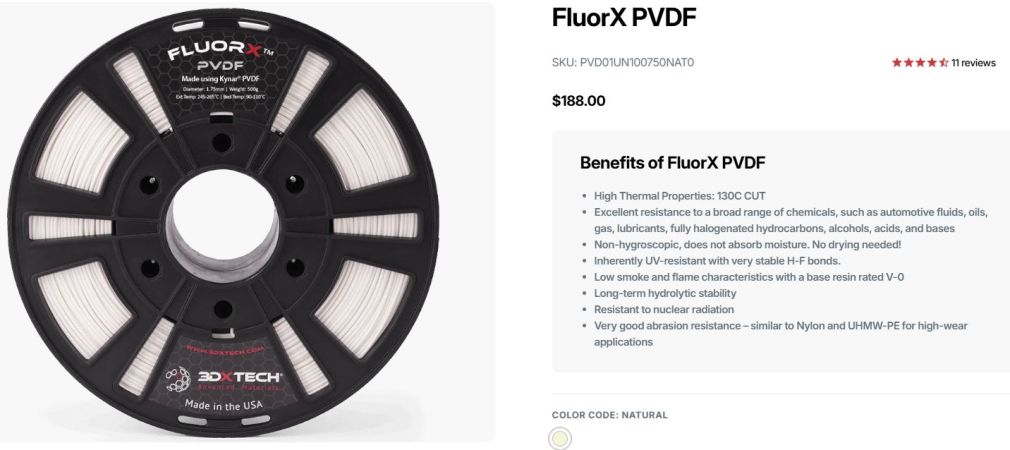
There’s a dizzying number of specialist 3D printing materials out there, some of which do try to offer an alternative to PLA, PA6, ABS, etc., while others are happy to stay in their own niche. Polyvinylidene fluoride (PVDF) is one of these materials, with the [My Tech Fun] YouTube channel recently getting sent a spool of PVDF for testing, which retails for a cool $188.

Some of the build plate carnage observed after printing with PVDF. (Credit: My Tech Fun, YouTube)

Reading the specifications and datasheet for the filament over at the manufacturer’s website it’s pretty clear what the selling points are for this material are. For the chemists in the audience the addition of fluoride is probably a dead giveaway, as fluoride bonds in a material tend to be very stable. Hence PVDF ((C2H2F2)n) sees use in applications where strong resistance to aggressive chemicals as well as hydrolysis are a requirement, not to mention no hygroscopic inclinations, somewhat like PTFE and kin.

In the video’s mechanical testing it was therefore unsurprising that other than abrasion resistance it’s overall worse and more brittle than PA6 (nylon). It was also found that printing this material with two different FDM printers with the required bed temperature of 110°C was somewhat rough, with some warping and a wrecked engineering build plate in the Bambu Lab printer due to what appears to be an interaction with the usual glue stick material. Once you get the print settings dialed in it’s not too complicated, but it’s definitely not a filament for casual use.

Continue reading “PVDF: The Specialized Filament For Chemical And Moisture Resistance”

JuiceBox Rescue: Freeing Tethered EV Chargers From Corporate Overlords

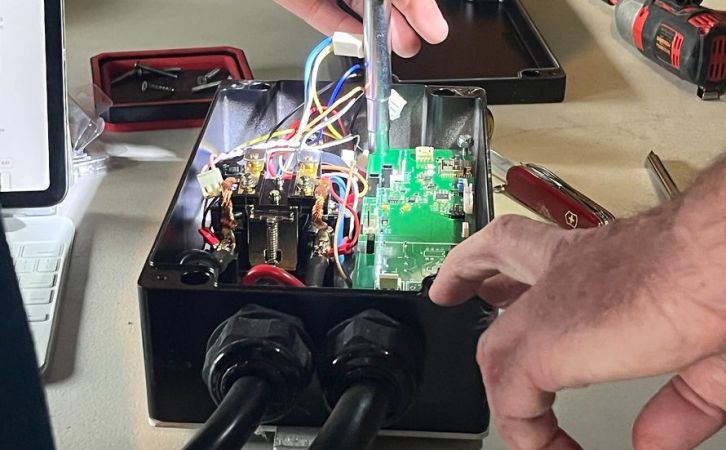
The JuiceBox charger in its natural environment. (Credit: Nathan Matias)

Having a charger installed at home for your electric car is very convenient, not only for the obvious home charging, but also for having scheduling and other features built-in. Sadly, like with so many devices today, these tend to be tethered to a remote service managed by the manufacturer. In the case of the JuiceBox charger that [Nathan Matias] and many of his neighbors bought into years ago, back then it and the associated JuiceNet service was still part of a quirky startup. After the startup got snapped up by a large company, things got so bad that [Nathan] and others saw themselves required to find a way to untether their EV chargers.

The drama began back in October of last year, when the North American branch of the parent company – Enel X Way – announced that it’d shutdown operations. After backlash, the online functionality was kept alive while a buyer was sought.  That’s when [Nathan] and other JuiceBox owners got an email informing them that the online service would be shutdown, severely crippling their EV chargers.

Ultimately both a software and hardware solution was developed, the former being the JuicePass Proxy project which keeps the original hardware and associated app working. The other solution is a complete brain transplant, created by the folk over at OpenEVSE, which enables interoperability with e.g. Home Assistant through standard protocols like MQTT.

Stories like these make one wonder how much of this online functionality is actually required, and how much of it just a way for manufacturers to get consumers to install a terminal in their homes for online subscription services.

Google Will Require Developer Verification Even For Sideloading

Do you like writing software for Android, perhaps even sideload the occasional APK onto your Android device? In that case some big changes are heading your way, with Google announcing that they will soon require developer verification for all applications installed on certified Android devices – meaning basically every mainstream device. Those of us who have distributed Android apps via the Google app store will have noticed this change already, with developer verification in the form of sending in a scan of your government ID now mandatory, along with providing your contact information.

What this latest change thus effectively seems to imply is that workarounds like sideloading or using alternative app stores, like F-Droid, will no longer suffice to escape these verification demands. According to the Google blog post, these changes will be trialed starting in October of 2025, with developer verification becoming ‘available’ to all developers in March of 2026, followed by Google-blessed Android devices in Brazil, Indonesia, Thailand and Singapore becoming the first to require this verification starting in September of 2026.

Google expects that this system will be rolled out globally starting in 2027, meaning that every Google-blessed Android device will maintain a whitelist of ‘verified developers’, not unlike the locked-down Apple mobile ecosystem. Although Google’s claim is that this is for ‘security’, it does not prevent the regular practice of scammers buying up existing – verified – developer accounts, nor does it harden Android against unscrupulous apps. More likely is that this will wipe out Android as an actual alternative to Apple’s mobile OS offerings, especially for the hobbyist and open source developer.