Fubarino Contest: Morse Code Christmas Baubles

fubarion-contest-christmas-morse-code

Fubarino Contest entries are starting to roll in at a faster rate. If you’re working on one you only have a few hours left! Submissions are due before 12:00am Pacific Time! This bit of inspiration is a two-fer. Both entries decided to use Morse Code to spell out the Hackaday URL.

First up, [Tariq] is getting into electronic design because his friend’s 8-year-old son [Yago] is really interested in Math and Science. The device he was working on is a little portable Morse Code message flasher (don’t miss part 2). The idea is that [Yago] can carry it around and pretend it’s a spy device containing a secret message. It might as well be since your average Joe probably wouldn’t notice the irregular flashing and if they did they wouldn’t be able to decode it without some help. The device is built around an ATtiny85. Normally it displays a Christmas greeting for [Yago]. But at the end of the cycle, or at power-up, it flashes the Hackaday URL at an extreme rate. Can anyone actually decode this without putting it on a logic analyzer?

The second offering is in the form of a blinky Christmas tree. [Jim] built the Arduino-compatible ornament for the holidays. It does a great job of flashing a bunch of different patterns, and it wasn’t too much work for him to make it flash the URL.


This is an entry in the Fubarino Contest. Submit your entry before 12/19/13 for a chance at one of the 20 Fubarino SD boards which Microchip has put up as prizes!

Retrotechtacular: Films Used To Be Recorded On Film

retrotechtacular-movie-film-photo-finishing

We’re sure that this title makes some readers itch because there are still a number of well-respected directors who insist on shooting with film rather than digital, but the subject of this week’s Retrotechtacular shows a portion of the movie industry that has surely been relegated to life-support in the past few decades. Photo finishing, once the stronghold of chemical processes used by all to develop their photographs, has become virtually non-existent. This is the story of how film and photo finishing drove cinema for much of its life.

The reels seen above are negative and positive film. The negative film goes in the camera and captures the images. After developing and fixing the negative film, the process is repeated. Light shines through the fixed negative in order to expose a fresh reel of film. That film is finished and fixed to create the reel which can be used in a projector. This simple process is covered near the beginning of the clip found below. The 1940 presentation moves on to discuss the in-depth chemistry techniques used in the process. But you’re really in for a treat starting about half-way through when the old manual methods are shown, which have been replaced by the “modern laboratory”. We love those huge analog dials! The video concludes by showing the true industrialization of the film developing process.

We’re running out of Retrotechtacular topics. If you know of something that might be worth a feature please send in a tip!

Continue reading “Retrotechtacular: Films Used To Be Recorded On Film”

Fubarino Contest: Game Boy Printer

fubarino-contest-gameboy-printer

[Dave] has a Game Boy Printer and loves the Mario-themed Easter egg that prints while holding the feed button during power-up. When he heard that Microchip gave us some Fubarino boards for our Easter Egg Contest, this hardware immediately came to mind and he set out to add a Hackaday Easter egg to the printer.

To tinker with the hardware, [Dave] built on the work of [Furrtek]—featured here a few years ago—which simplified the process of printing directly from an Arduino board. Connecting the TX and RX lines of the Arduino triggers the new Easter egg. He demonstrates printing both of the hidden messages in the video below.

Continue reading “Fubarino Contest: Game Boy Printer”

Fubarino Contest: Battery Capacity Tester

fubarino-contest-battery-capacity-tester

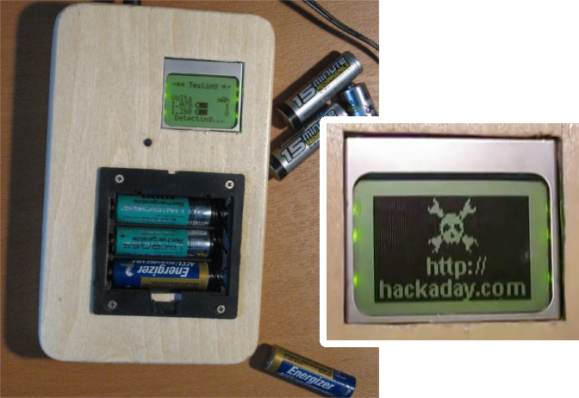
Here’s a project that we sadly let slip through the cracks a couple of years ago. Luckily [Brian] dusted it off and added an Easter Egg to the firmware in order to include it in the Fubarino Contest. The device is a rechargeable battery capacity tester. It discharges NiMH or NiCad batteries through a load resistor at about 1 Watt. [Brian] includes a discussion in his write-up about the hardware’s inability to work with 14500 Li-Ion cells. He includes enough info for you to figure out how to make changes to the circuit if you want to enable this option.

There is a MOSFET for switching each of the three battery positions. The ATmega168 takes readings from the cells once per second. It displays status information on a Nokia 5510 cellphone screen. This is where he chose to inject the Hackaday URL. When a cell’s discharge is complete, the image above scrolls onto the screen and remains there for a short time. See for yourself after the break.

Continue reading “Fubarino Contest: Battery Capacity Tester”

Machine Learning Used To Create An HIV Vaccine

hiv-vaccine-microspheres

When we think of machine learning it’s usually in the context of robotics—giving an algorithm a large set of input data in order to train it for a certain task like navigation or understanding your handwriting. But it turns out you can also train a nasty virus to go to sleep and never wake up again. That’s exactly what the Immunity Project has been doing. They believe that they have a viable HIV vaccine and are trying to raise about $25 million to begin human testing.

The vaccine hacks the Human Immunodeficiency Virus itself, forcing it to mutate into a dormant form that will not attack its human carrier. It sounds so simple, but a lot of existing knowledge and procedures, as well as new technology, went into getting this far. Last week we spoke with [Reid Rubsamen, M.D.] about the process, which began by collecting blood samples from a wide range of “Controllers“. Controllers are people who carry HIV but manage to suppress the virus’s progression to AIDS. How do you find these people? That’s another story which Scientific American covered (PDF); the short answer is that thanks to the work of [Bruce D. Walker, M.D.] there was already a database of Controllers available.

The information accumulated by [Walker] then underwent a data crunching exercise. The data set was so enormous that a novel approach was adopted. For the laymen this is described as a spam filter: using computers to look at large sets of email to develop a complex process for sifting real messages out of the noise. The task at hand is to look at the genotype of a Controller and compare it with the epitope— a short chain of proteins—in the virus they carry. The power of machine learning managed to whittle down all the data to a list of the  first six epitopes that have the desired dormant-mutation property. The vaccine consists of a cocktail of these epitopes. It does, however, require some clever delivery tactics to reach the parts of the world where it’s most needed. The vaccine must not require refrigeration nor any special skills to administer.

The vaccine’s production uses existing methods to synthesize the amino acid peptides, which are the epitopes themselves. The packaging, however, is a new concept. [Dr. Rubsamen’s] company, Flow Parma, Inc., is using microspheres to encapsulate the vaccine, which render it shelf-stable and allow it to be administered through a nasal spray. Learn more about the technology behind the production of microspheres from this white paper (PDF).

If the vaccine (which will be produced without profit) passes clinical trials, it could see mass distribution as early as 2017.

The $25M we mentioned earlier is a tall hill to climb, but think of the reward if the vaccine is successful. You can donate directly to help reach this goal. If you’re planning on giving gift cards this year, you can purchase them for many different retailers through Gyft, who is donating 100% of December proceeds to the project.


Hackaday Links: December 15, 2013

hackaday-links-chain

Want to get a hold of a gaming controller attachment for iOS at a rock bottom price? [Dark GOD] learned that Amazon is closing out the Gameloft DUO Gamer hardware for $6 because the hardware is no longer supported by the operating system. He shows how to make it work using a Cydia app. [Thanks ProMan]

[Frank Zhao] had a cheap HDMI switch which had problems with a sagging power rail. His solution was to hack in a USB port to inject some power.

This security hack uses an Arduino with LCD screen to display a QR code. Scan it with an Android device and you no longer need keys! Here’s the code repo and a demo video.

It’s interesting to see how many places the WS28xx pixels are popping up. Here’s a crowdfunding campaign that uses a matrix of the pixels as a portable gaming display. Look somewhat familiar? We’ve seen [Retro Brad’s] earlier hardware (made to play Super Pixel Bros.) that used an LED module instead. This is probably a lot easier to drive since it uses serial data instead of multiplexing.

Next is some robot building inspiration. [IronJungle] has been hard at work building a rover that uses compass bearings for navigation.

We liked seeing a drop-in replacment uC for Ikea Dioder projects, but if you need more power under the hood, take command of those colored lights with a Raspberry Pi.

Those lucky enough to have access to a laser cutter will find this Inkscape extension for living hinges useful.

Finally, POTUS threw down the gauntlet, encouraging everyone to learn how to program by pointing them toward the Hour of Code program. We’ve long thought that everyone should have some level of coding education. Do you agree with us? Of course, getting something like this into schools is a monumental challenge, so it’s nice to see extra-curricular offerings. We also believe that Hackerspaces are among the best driving forces for getting kids a tech education. [via Adafruit]

Battlebots In The Sky

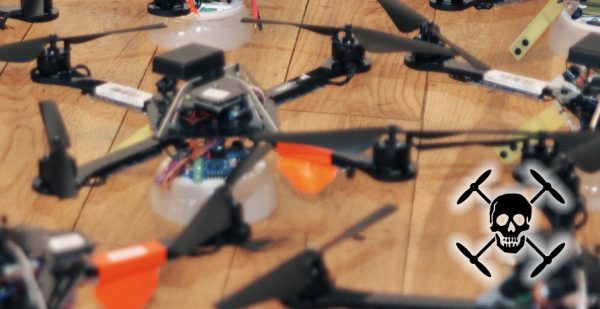
Here’s one of those ideas that makes us wonder: “Why didn’t we come up with that?” The LVL1 in Louisville, Kentucky is hosting an event they call the Quadcopter Ultimate Aerial Combat Competition (QUACC). Kudos to them on coming up with a very professional name for the event. At risk of drawing cease-and-desist orders from the defunct TV program, we’ll always think of this as Battlebots in the Sky. (Lawyers: please don’t make us take that down… it’s an homage to the awesomeness that was at least the first few seasons of the show).

So why are we publicizing local events on Hackaday? It’s not the event, but the idea that’s spectacularly worth sharing! You’ve got to check out their contest rules as well as the Q&A list. Registration is closed, but the lucky ones who claimed a spot for the low price of $40 will be issued a regulation quadcopter today. They have a week to play around with it, testing out different ideas for disabling their enemy. A match ends when either one competitor defeats the other, or when a competitor’s battery runs dry. A new battery is the issued to the winner for use in the next round.

We’d love to hear your ideas for weaponizing (or adding countermeasures to) these delicate, lightweight aircraft. Aerosol accelerant and a BBQ igniter? How about shielding and a type of EMP, or some other system that will disrupt controller commands of your opponent? Obviously if you launch a similar competition at your hackerspace we want to hear about it!

[Thanks Gerrit]