Update: Semi-automatic Pick And Place Goes Fully-Automatic

automated-pick-and-place

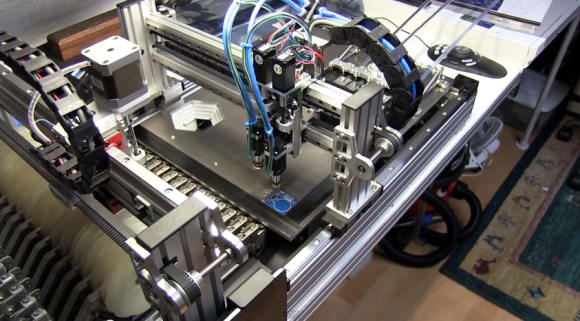
Way back in April we looked at an impressive Pick and Place machine project which wasn’t actually up and running yet. Well it looks like [Brian Dorey] has really put the pedal to the metal with this fall, posting nine project updates since September.

The previous system was working just fine but required quite a bit of user intervention to do the actual placing. So the first modifications toward the new goal centered around motorizing the gantry. There’s a lot of information on this, as well as the vacuum tweezer heads that were designed for the system. But for us it was exciting to read about the vibrating chip feeder. This uses the vibrating motor from an Xbox controller to jiggle the ICs from their tube packaging to a staging jig off the side of the build table. You can see a video of this after the break along with a demo of the entire machine at work.

[Brian] seems to favor the Xbox parts as he also used an Xbox live camera along with OpenCV to detect the parts and ensure they are lined up correctly. For the best results possible the parts need to be illuminated properly which is why he also built a rather interesting light ring using 144 red LEDs.

Continue reading “Update: Semi-automatic Pick And Place Goes Fully-Automatic”
Video Gaming To Fix Eye Ailments

video-gaming-fixes-crossed-eyes

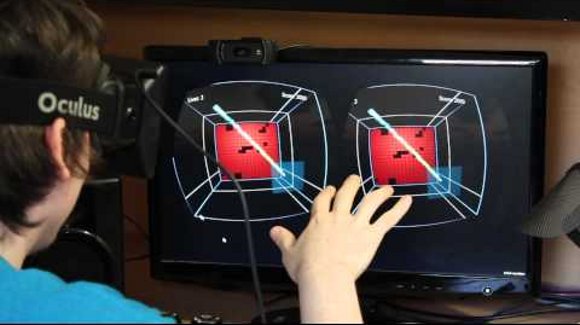
Let’s face it, most of the time we’re hacking for no other reason than sheer enjoyment. So we love to see hacks come about that can really make a difference in people’s lives. This time around it’s a video game designed to exercise your eyes. [James Blaha] has an eye condition called Strabismus which is commonly known as crossed-eye. The issue is that the muscles for each eye don’t coordinate with each other in the way they need to in order to produce three-dimensional vision.

Recent research (linked in the reference section of [James’] post) suggests that special exercises may be able to train the eyes to work correctly. He’s been working on developing a video game to promote this type of training. As you can see above, the user (patient?) wears an Oculus Rift headset which makes it possible to show each eye slightly different images, while using a Leap Motion controller for VR interaction. If designed correctly, and paired with the addictive qualities of games, this my be just what the doctor ordered. You know what they say, practice makes perfect!

Continue reading “Video Gaming To Fix Eye Ailments”

Sniffing Out LG Smart TV Tracking Protocol

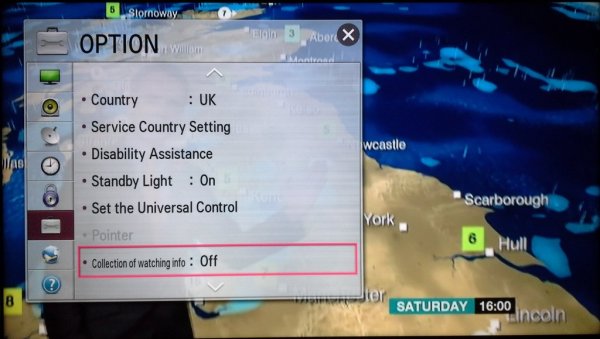
[DoctorBeet] noticed the advertisements on the landing screen of his new LG smart television and started wondering about tracking. His curiosity got the better of him when he came across a promotional video aimed at advertisers that boasts about the information gathered from people who use these TVs. He decided to sniff the web traffic. If what he discovered is accurate, there is an invasive amount of data being collect by this hardware. To make matters worse, his testing showed that even if the user switches the “Collection of watching info” menu item to off it doesn’t stop the data from being phoned home.

The findings start off rather innocuous, with the channel name and a unique ID being transmitted every time you change the station. Based on when the server receives the packets a description of your schedule and preferred content can be put together. This appears to be sent as plain data without any type of encryption or obfuscation.

Things get a lot more interesting when he discovers that filenames from a USB drive connected to the television are being broadcast as well. The server address they’re being sent to is a dead link — which makes us think this is some type of debugging step that was left in the production firmware — but it is still a rather sizable blunder when it comes to personal privacy. If you have one of these televisions [DoctorBeet] has a preliminary list of URLs to block with your router in order to help safeguard your privacy.

[Thanks Radcom]

Building A Crystal Clear Whiteboard

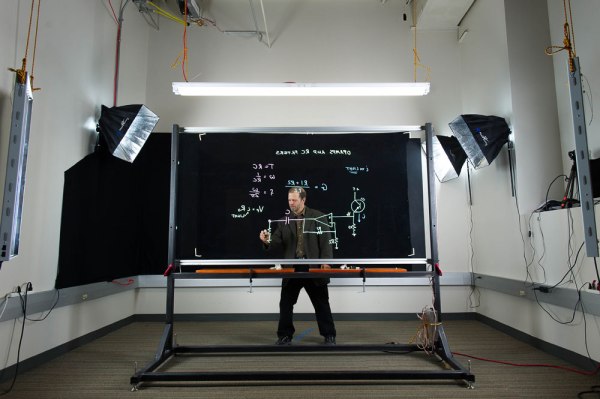
[Michael Peshkin] teaches mechanical engineering at Northwestern University. He likes to use diagrams to illustrate his point, but he also likes to face his students when doing so. His solution was to develop this clear whiteboard which ends up unlocking a lot more than just some hand-drawn schematics.

It’s a bit hard to see what he’s written on the board in the image above but squint and see if you can figure out what’s wrong with this style of teaching? Everything he’s writing is backwards. That’s not actually a problem in this case as [Michael] uses flip teaching. He records and posts all of his lectures online. Classroom time is then used for question and answer on the lecture subjects. In order to get the text to read the correct way he just bounces the camera off of a mirror.

The board itself is a huge sheet of tempered glass attached to the metal frame using bolts through holes in the pane. This leave the edges free. He added extruded rail to the top and bottom to embed strips of LEDs. They light the inside of the glass, and excite the fluorescent dry erase marker ink making it much more visible. [Michael] didn’t stop with the board, he  also rigged up a lighting system that gives him a lot of options, and uses a monitor for dealing with digital overlays. He can put up a diagram on the computer, watching the monitor to see where his marker is making annotations. All this happens in real-time which means no post production! See a demo of these features after the break.

This could all be done without the glass at all, but that would make it quite a bit more difficult for the person doing the writing.

Continue reading “Building A Crystal Clear Whiteboard”

Using DMA To Drive WS2812 LED Pixels

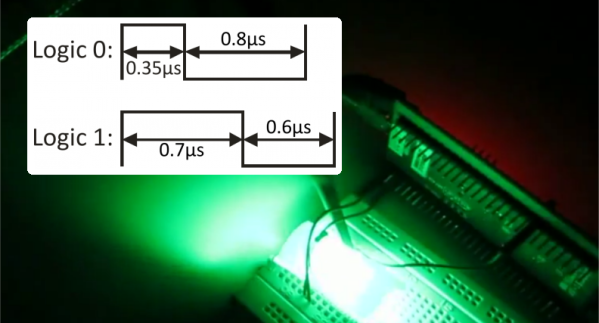
It’s pretty well known by now that the LED pixel hardware which is starting to be commonplace, both WS2811 and WS2812, needs pretty strict timing in order to address them. There are libraries out there which mean almost no work on your part, but that’s no fun. [Elia] started looking into what it takes to drive the hardware, trying out a few 8-bit micros before moving to 32-bit with the help of an STM32VL Discovery Board. The move to a beefier processor brings a lot of speed, but why bit bang everything? He came up with a way to use the PWM and DMA features of the chip to drive the LEDs.

DMA is the Direct Memory Access unit that allows you to change the values being sent to the pixel without interrupting the processor. This is done by pre-loading the data at a memory location. This buffer is automatically read by the DMA unit — its values are used to set the PWM timer compare trigger in order to send out logic values show in the diagram above.

If you do want to delve further into this topic here’s a collection of techniques for driving the WS2811.

Continue reading “Using DMA To Drive WS2812 LED Pixels”

Tricky Repair Of Power Driver For CNC Machine

tricky-power-driver-repair

Designing and building something from scratch is one thing. But repairing fried electronics is a much different type of dark art. This video from [Mike’s Electric Stuff] is from more than a year ago, but we didn’t think you’d mind since what he accomplishes in it is so impressive. He’s got a burnt out pick and place hybrid power module which isn’t going to fix itself.

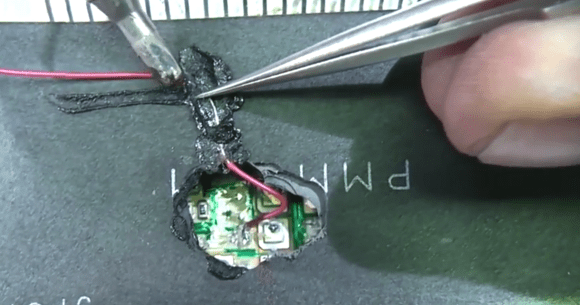
The power module construction includes a part that has chip-on-board-style MOSFETs and the circuitry that goes with them enclosed in a black plastic housing. It’s kind of like a submodule was encapsulated using the same plastic as integrated circuits. After cracking it open it appears the bonding wire has burnt away. [Mike] connects a jumper wire to one of the board traces in order to use an external MOSFET. This is much easier said than done since the module substrate is ceramic designed to dissipate heat. We’re amused by his technique of melting the jumper into the plastic housing to protect it from the heat sink that goes over the package. In the end he gets his CNC running again. This may not be the best long-term fix but he just needed to continue running until a proper replacement part arrives.

Oh, one more thing: the Metcal vacuum desolderer he uses in the video… do want!

Continue reading “Tricky Repair Of Power Driver For CNC Machine”

Fail Of The Week: Commute-Shortening Electric Scooter

fotw-electric-scooter

Please don’t judge [Alan] on his choice of vests. This project is from 1999 when it was common to see people rockin’ these threads. Anyone who has ever spent time on the University of Minnesota campus in Minneapolis, Minnesota will know that parking is at a premium. [Alan] had a 12-15 minute walk from his parking garage to his office and was considering a cheaper parking location that would balloon that to 20-25 minutes. But engineers don’t see problems, they see project ideas. He started work on a tiny electric scooter that could slim down his commute. Obviously he did find some success, but it was interspersed with failures that make his scooter the Fail of the Week.

Continue reading “Fail Of The Week: Commute-Shortening Electric Scooter”