Custom Microcontroller Using Only A Dremel

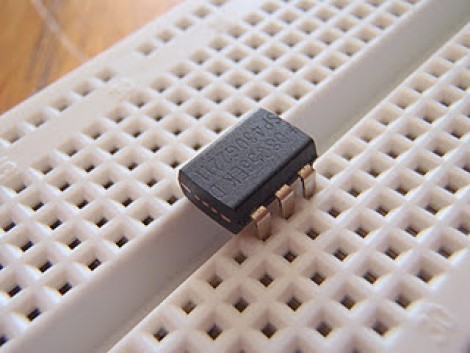
Check out this 6-pin MSP430 microcontroller. What’s that you say? TI doesn’t make a 6-pin MSP430? True, Texas Instruments doesn’t make one, so [Greg] grabbed his Demel and a cutoff wheel, and chopped up a larger uC to arrive at this package.

It may sound a bit crazy at first, but when you think about it there’s nothing really all that special about this. The plastic package on DIP components these days is mostly empty. The silicon die which does the computing is quite small in comparison, and usually mounted in the very center of the part. [Greg] simply cut off eight of the unneeded pins (four from each end).

Well, it might be a stretch to call them unneeded since he cut the ground and voltage pins. He gets around this issue by taking advantage of the same properties of the I/O pins used in this barebones RFID tag. You can inject power through the I/O and we’d bet you could easily use this chopped-up MSP430G2211 as an RFID tag if you wanted to.

[Thanks Ian]
Bending A Printer Control Board To Output POV Messages

Confronted with the issue of finding a use for his mounting pile of junk electronics, [Rue] set out to build a persistence of vision device using a hardware state machine. We have a suspicion that his original link may go down if there’s too much traffic so here’s a cached link just in case.

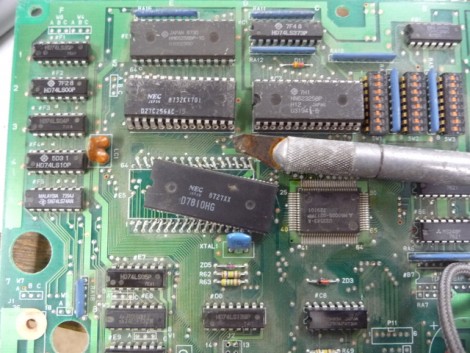
Any board that is MSC-51 or MCS-48 based would have worked for his purposes. This is because the addressing scheme of the hardware makes it an easy hack. The image above shows him cutting off the processor from this board. It was chosen because of a 74HC373; it was a mistake at first but since it’s pin compatible with the 74HC374 that he needed a simple swap did the trick. From there a clock source was added, and the address information necessary to display the message was burned into an EEPROM.

Step twelve of his writeup shows a Morse Code message created by attaching the board to a broomstick and twirling it around in an arc. We took  just a minute to decode the message and believe it’s a shout-out to Hackaday. Nice, thanks for reading [Rue]!

Raspberry Pi Runs XBMC; Reliably Decodes 1080p

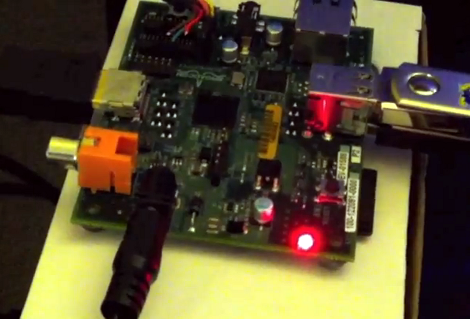
This is the Raspberry Pi board, an ARM based GNU-Linux computer. We’ve heard a little bit about it, but it recently garnered our attention when the machine was shown running XBMC at 1080p. That’s a lot of decoding to be done with the small package, and it’s taken care of at the hardware level.

Regular readers will know we’re fans of the XBMC project and have been looking for a small form factor that can be stuck on the back of a television. We had hoped it would be the BeagleBaord but that never really came to fruition. But this really looks like it has potential, and with a price tag of $35 (that’s for the larger 256MB RAM option) it’s a no-brainer.

Now there’s still a lot of rumors out there. We came across one thread that speculated the device will not decode video formats other than h.264 very well since it uses hardware decoding for that codec only. We’ll reserve judgement until there’s more reliable info. But you can dig through this forum thread where the XMBC dev who’s been working with the hardware is participating in the discussion.

Don’t forget to peek at the demo clip after the break too.

Continue reading “Raspberry Pi Runs XBMC; Reliably Decodes 1080p”

Investigating The Generative Properties Of A Stepper Motor

You probably know that if you spin a motor (mechanically) it generates electricity on what would normally be the inputs. This can be a problem when you shut off a spinning motor and is the reason that protection diodes are built into motor driver circuits. But [Dino] isn’t interested in driving a motor, he wanted to see what he could do with the electricity generated by spinning a stepper motor.

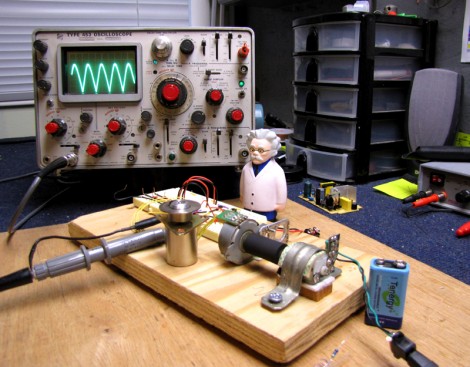
He built the test rig that you see above for this purpose. In the foreground a 12V DC motor is held in place with an electrical conduit clamp. This connects to the stepper motor being tested using a segment of rubber tube. The DC motor provides a reliable input for his experiments, but could be replaced in the future by a propeller to make it wind powered, or by a water wheel. Check out the video after the break to see what kind of juice [Dino] gets out of it, and how it can be used for powering LEDs, recharging batteries, or driving a motor.

Continue reading “Investigating The Generative Properties Of A Stepper Motor”

Espresso Upgrade Gives You More Data With Your Caffeine

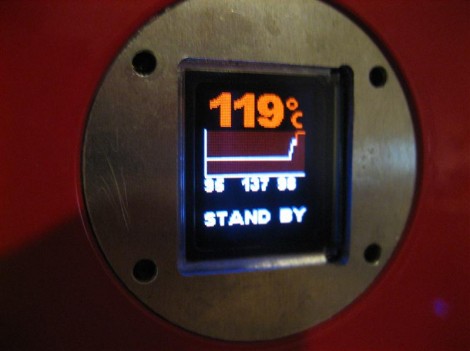
Whether you take it as a single shot or a double, a great Barista want’s to know the details on what’s happening with the espresso machine. [Tobi] was happily generating the morning cup when he realized that the needle-thermometer on his machine wasn’t working any longer. Instead of shelling out a lot of money for a direct replacement, he built his own display and controller for this espresso machine (translated).

He had a few goals with this hack. Obviously he needed to replace the temperature meter, but he also wanted a colorful display and some timing options. He was able to get his hands on a nice little OLED display that would fit in the vacated opening and it only cost a few bucks. He’s got his own mini-mill which came in handy when fabricating a board to host the ATmega16 which drives add-on, but he also used it to make a bracket for the screen replacement.

Now his machine is fixed, looks a bit more modern, and it has more features which are shown off in the video after the break. If you’re looking to add some custom circuitry to your coffee ritual you may also take some inspiration from this similar espresso machine hack. Continue reading “Espresso Upgrade Gives You More Data With Your Caffeine”

Matrix Backpack Was A Fun Design Project

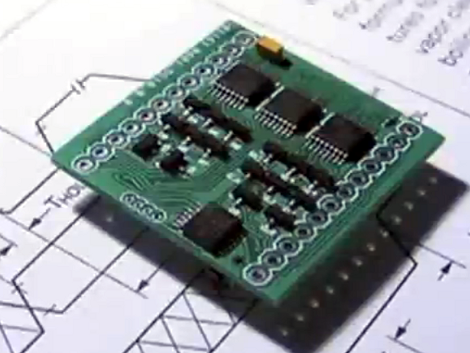
[Greg] is really working on a small scale with his LED Matrix backpack PCB. It’s a toy that he designed as an activity. He constrained himself to a board which would exactly match the outline of an 8×8 bicolor LED matrix package.

What you see here is the side of the PCB which will be facing the underside of the LED dot matrix module. Let’s call this the top of the board. The underside has a CR2032 battery holder which provides enough juice to run the display. Since the matrix is bi-color there’s a slew of pins to drive. [Greg] uses three shift registers for the high side, and sixteen N-channel MOSFETS for the low side. He’s chosen an MSP430G2201 microcontroller which has a nice sleep mode for power conservation. It has no problem driving tri-color animations as seen the clip after the break, but also has an unpopulated clock crystal footprint if you wanted to use it as a timepiece.

Despite the small footprints and cramped board [Greg] still hand soldered all of the components. He even posted a time-lapse of the process in the page linked at the top.

Continue reading “Matrix Backpack Was A Fun Design Project”

Reviewing The Numbers From One Month Of Solar Harvesting

[Mathieu] just finished analyzing the numbers from a month of solar energy harvesting. You may remember that he was curious to see what kind of energy can be collected from small solar cells used indoors. He built several copies of a test platform which collected data between December 16th and January 16th.

First of all, it’s not shocking to find out that rooms with no sunlight produced negligible energy during that time. When you think about it, if they had been gathering a statistically significant amount wouldn’t that mean the lighting used in those rooms was incredibly inefficient? In other words, there’s no way you need to be making that much light.

But he did find that proper positioning in rooms that catch sunlight during the day can result in usable energy for small loads. He established that a 0.5 Watt panel harvested just a bit more than half of what a 1 Watt panel did. But perhaps the most useful discovery was that it’s quite a bit more efficient to have a charging circuit store energy in a battery rather than directly powering a fixed load.

It will take us a few more viewings to really decide what we can take away from the experiment for our own projects. But we appreciate [Mathieu’s] quest for knowledge and his decision to put this information out there so that others can learn from it.