Arduino Weather-station To Internet Bridge

Here’s a project that looks to eliminate the PC necessary for pushing weather station data to the Internet. When you think about it, getting data from your own weather sensing hardware to a site like Weather Underground doesn’t require very much processing at all. The largest chunk of the puzzle is a window to the Internet, and that can be easily accomplished with a microcontroller rather than an always-on computer.

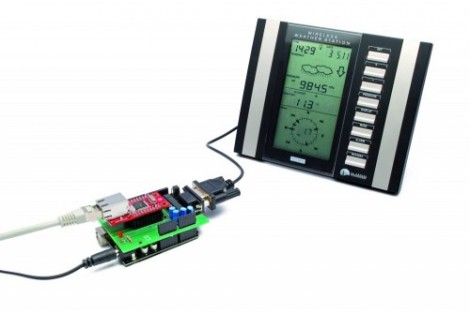
In this case, [Boris Landoni] is using an Arduino along with an RS232 shield and an Ethernet shield. The weather station, a La Crosse WS23xx series, already has an RS232 serial port for grabbing the data. The shield is necessary to step the voltage down to levels that will play nicely with Arduino. It also gives you a D-Sub connector for easy hook up. From there he hit up the documentation for Weather Undeground API, writing code to build the necessary string which is pushed over the Ethernet connection at regular intervals.

If your weather station only offers a USB port you’re not out of luck. Using an embedded platform with USB host functionality you can achieve the same results as we see here.

Pros And Cons Of Replacing Tool Batteries With Lithium Polymer

[HammyDude] was tired of buying replacement batteries for his power tools. He had some Lithium Polymer batteries on hand and decided to take one of his dead drills and swap out the dead power pack.

The orange battery pack you see above has a deans connector on it for use with RC vehicles. By opening up the drill housing, [HammyDude] was able to add the mating deans connector. Now the replacement easily plugs into the drill, and it even fits inside the handle body.

This battery is made up of several cells, and an inexpensive charger is capable of topping off each individually for a balanced charge. In the video after the break [HammyDude] points out that the Makita charger applies voltage to all of the cells in series. It’s incapable of balance charging so when one cell dies the battery is toast. We’ve encountered this problem with Makita tools before.

One drawback to take note of in the end of the video: this replacement doesn’t have any low voltage cut-off. Running this battery pack down too low will permanently damage it. There must be a simple circuit that could be added as a safety measure. If you know of one, drop us a tip.

Continue reading “Pros And Cons Of Replacing Tool Batteries With Lithium Polymer”

G-35 Circuit Board Porn

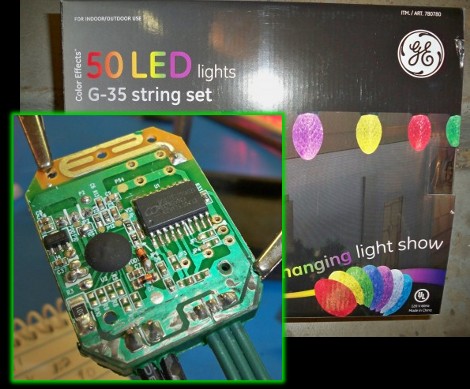
[Todd Harrison] took a slew of pictures in his quest to loose all the secrets of the G-35 Christmas Lights. These are a string of 50 plastic bulbs which house individually addressable RGB LEDs. We’ve seen a ton of projects that use them, starting about a year ago with the original reverse engineering and most recently used to make a 7×7 LED matrix. But most of the time the original control board is immediately ditched for a replacement. It’s become so common that you can now buy a drop-in board, no hacking needed. We enjoy the hard look that [Todd] took at the electronics.

The stock controller uses a single layer, single sided board. There’s a resin-blob chip, but also an SOP-20 microcontroller. Since [Todd’s] using several strings of lights on his house, he wondered if it would be possible to improve on the controller in order to synchronize the strands. His investigation showed that the board was designed to host a crystal oscillator but it is unpopulated. Unfortunately you can’t just add those parts to improve the timing of the chip (firmware changes would also be requires). He found that there’s a spot for a push-button. Quickly shorting the pads cycles through the effects, shorting them for a longer time turns off the string of lights. There is wireless control, but it seems that the only functionality it provides is the same as the unpopulated switch.

We enjoyed the close-up circuit board photos, and we like the spacing jig he used to attach the lights to his fascia boards. We’ve embedded a lengthy video about his exploits after the break. Continue reading “G-35 Circuit Board Porn”

Lamp Fading And Remote Control For The Lazy

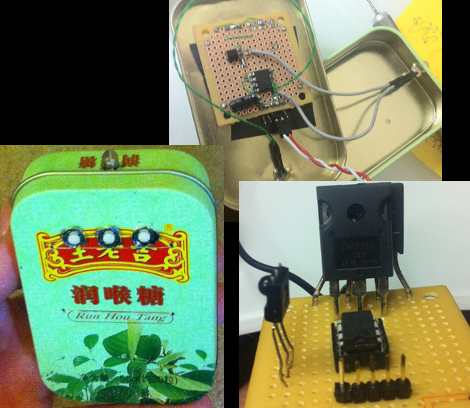
[Dmitry Grinberg] has to walk all the way across his bedroom to switch the lamp on and off. The drudgery of this finally became too much, so he built a remote control and added dimming for good measure. Above you can see the circuitry for the remote and the receiver, as well as the finished remote housed in what he calls a ‘Chinese Altoids tin’.

After the break you’ll find [Dmitry’s] demo video. The remote control is quite responsive, and the dimming has great resolution. That’s thanks to a power N-channel MOSFET which switches the AC with the help of a full wave rectifier. The PIC 12F617 that controls the MOSFET is powered separately, and [Dmitry] mentions that you must use a transformer and not a switch-mode power supply to avoid a fire. We’d like to know more about this, so leave a comment if you are able to explain further.

The remote and receiver communicate via Infrared. The protocol is operating with 38 kHz signals using an easily sourced receiver tuned to that frequency. [Dmitry] shares all the details about the encoding scheme that he uses. Recreating this communications pairing is a great way to test your understanding of this technique. But if you need a refresher, here’s a tutorial to push you in the right direction. Continue reading “Lamp Fading And Remote Control For The Lazy”

Adding Sound And Light To Your Radio Controlled Vehicles

[Nicholas] wanted to add some flair to his RC car. In addition to the headlights that you see above, there’s brake lights, and a horn that plays “Dixie” like the General Lee in the Dukes of Hazard. All of this is triggered by the wireless controller, but he figured out a way to monitor the servo signals in order to add the additional features.

The hack is driven by a Propeller chip. [Nicholas] patches into the servo lines by adding a servo-in and servo-out header to his prototyping shield. With that in place he’s able to tap into the voltage and ground pins to power the microcontroller. By attaching a 4k7 resistor to the control line, he can listen in on the servo signals using the Propeller.

This RC car has a throttle servo. So when the throttle is opened all the way up the Propeller chip flashes some white LEDs in the headlights, and uses an LM386 audio amplifier to play a tune. When the throttle is pulled all the way back the brake lights are activated. Don’t miss the test footage of this which is embedded after the break.

Continue reading “Adding Sound And Light To Your Radio Controlled Vehicles”

ANT+ Networks Using An MSP430 Chip And Android Phone

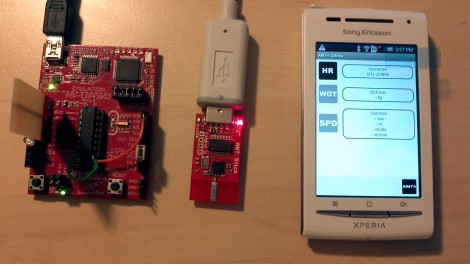
[Jbremnant] wanted to try his hand with ANT+ wireless networks. This protocol is designed for light-weight and low-power consumer electronics, like heart rate chest straps and bicycle computers (Garmin brand devices for example). There are already libraries out there for Arduino, but [Jbremnant] found that most of them were written as slave-only code. He set out to use an MSP430 to drive a fully functioning ANT network including a computer and an Android phone.

The TI Launchpad is used as the master node in the network. [Jbremnant] chose the smaller of the two MSP430 processors that came with the dev platform. After starting down this road he realized that chip didn’t have a hardware UART needed to communicate with the SparkFun ANT board (based on the nRF24AP1 radio chip). Rolling with the punches, he used a software UART he had previously worked with. Now he’s able to transmit test data from the Launchpad. It is picked up by both a USB dongle on his computer and the Android phone seen above. Check out his demo video after the break.

Continue reading “ANT+ Networks Using An MSP430 Chip And Android Phone”

LED Sconces Spice Up Dorm Room Parties

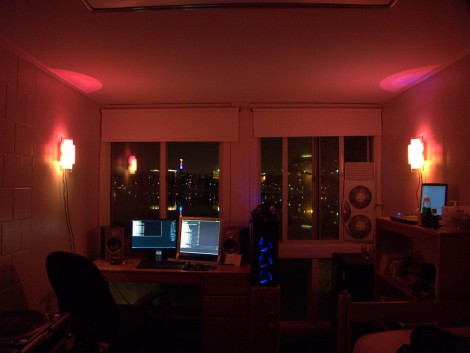
This dorm room is ready to entertain, thanks in part to the LED wall sconces that [Joseph] hacked together. Inside each fixture you’ll find three 3-Watt LED modules. For proper heat dissipation he mounted them on sheet metal which he cut out, including some fingers for additional surface area. The shape for the heat sink was chosen to fit behind the diffuser of the sconce, which is an incandescent light fixture with the socket removed.

[Joseph] designed his own control boards for the base station and LED modules. They communicate with each other via RS485, which lets him run CAT-5 cable to each, but the lights do require external power as well. The controller itself is a USB dongle which takes the serial commands from a computer and pushes them out over the RS485 protocol. In the video after the break you can get a good look at the hardware and the overall performance of the system.

Continue reading “LED Sconces Spice Up Dorm Room Parties”