Adding RS232 To A Multimeter The Hard Way

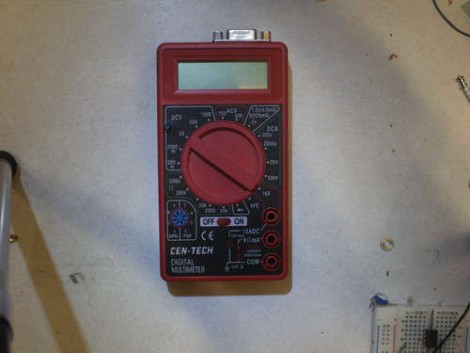
You might want to store information from a multimeter to be graphed over time. This comes with pretty much all of the high-end professional models. But if you buy a super cheap meter you can bet this isn’t an option. [Jazzzzzz] has found a way to pull the data from a $4 meter via RS232. It’s not impossible, but we definitely think he’s doing it the hard way. That’s because he’s not just tapping into a dormant feature. He’s actually adding a microcontroller to sample the data and push it via the RS232 protocol.

On the bright side, this is easier than building a multimeter from scratch. The sampling circuits are still being used, with a PIC 16F688 intercepting the signals as they enter the stock microcontroller. The signal he was after comes into the chip on just one pin, but to get the readings right on the PIC he had to use an OpAmp. That’s only part of the puzzle as he also needed a way to tell what the selector switch was set at. In the end, adding a potentiometer and reading its value let him calculate the position.

[Thanks Karl]
Ghostly Images Appear Thanks To Projections On Fog

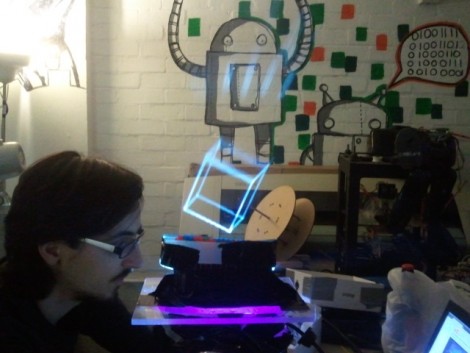
This wire-frame cube appears to be floating in mid-air because it actually is. This is a project which [Tom] calls a Laminar Flow Fog Screen. He built a device that puts out a faint amount of fog, which the intense light from a projector is able to illuminate. The real trick here is to get a uniformed fog wall, which is where the laminar part comes in. Laminar Flow is a phenomenon where fluids flow in a perfectly parallel stream, not allowing errant portions to introduce turbulence. This is a favorite trick with water.

[Tom’s] fog screen starts off with a PC fan to move the air. This airflow is smoothed and guided by a combination of a sponge, and multiple drinking straws. This apparatus is responsible for establishing the laminar flow, as the air picks up fog from an ultrasonic fogger along the way.

The only real problem here is that you want the projector shooting off into infinity. Otherwise, the projection goes right through the fog and displays on the wall, ruining the effect. Outdoor applications are great for this, as long as there’s no air movement to mess with your carefully established fog screen.

You can find a short test clip embedded after the break but there are other videos at the link above.

Continue reading “Ghostly Images Appear Thanks To Projections On Fog”

Steampunk Wings: Bigger, Heavier, And Steampunkier

This pair of backpack-mounted wings was conceived after seeing the Angel/Archangel character in the movie X-Men: The Last Stand. They measure 14’6″ inches across, but they fold up so that the wearer can actually get around in them. The mechanism is built from MDF, using several layers of gears cut from the material as well as pieces that act as the skeleton for the appendages. This makes them look and work well, but adds a lot of weight as the project comes in at about 25 pounds.

The steampunk wings we saw a few days back were partly inspired by this set. But this pair is more true to the Steampunk concept, relying on pneumatics instead of electricity for motion. A pair of pneumatic rams originally made to cushion the closing of screen doors let the wearer automatically extend the unit. As you can see in the video after the break, this happens quickly and gracefully. They do have to be folded back up by hand, and we’d bet you need a second person to assist with this, but we could be wrong.

Continue reading “Steampunk Wings: Bigger, Heavier, And Steampunkier”

LUFA Open Source USB Stack Now For NXP ARM Processors

Looks like the Lightweight USB Framework for AVRs (LUFA) has just been ported for ARM microcontrollers. NXP recently released a package for their LPC Cortex M3 family of ARM controllers. You won’t find a reference to LUFA on their nxpUSBlib description page (which we think is kind of sad), but if you grab a copy of the beta code the Version.h header file shows that it is indeed a port of the project. This is further backed up by the LUFA creator, [Dean Camera], who consulted with the NXP team doing the work.

The package provides an open-source USB stack that you can use in your projects as a USB host or USB device. We’re advocates of open source packages like this one as it makes it much easier for hobbyists to get help using the tools, and it allows the community to give back through bug fixes and feature additions.

We’ve highlighted a few LUFA projects, like this keyboard remapper and this AVR programmer. We’re looking to seeing the first set of NXP LUFA projects roll through!

[Thanks Johnny]

IPad 2 Gets A Home In Hacked IDJ Live Console

[DJ FileSpnR] did a number on this IDJ Live hardware to make room for an integrated iPad. Those that have seen the hardware before may not even recognize it. In stock condition the controller has two turn-table actuators with cross-fader control in between them. The iPad perches on top like a book, making it a fairly bulky setup.

In its hacked format, the device is much more mobile. The physical turntables have been removed, and the center console was moved to one side. This leaves just enough room to fit the iPad 2 (the original iPad is probably too thick for this to work). A cresent of the original turn table bezel has been retained to clamp the iPad in place, and to protect the dock connector at the same time. Now the touchscreen serves as turntable control, with physical sliders to the right which mange the cross-fading.

Check out the video after the break where the DJ explains his alterations and demonstrates the finished project.

Continue reading “IPad 2 Gets A Home In Hacked IDJ Live Console”

Thailand Residents Use Hacks To Make The Best Of A Horrible Situation

Thailand is dealing with horrible flooding right now. Despite the hardship, people still need to get around and go on with life so many have come up with clever hacks to make this disaster more manageable. [Jan] wrote in to let us know about this collection of flood-related hacks which he’s put together. They are wide-ranging, and many brought a smile to our faces, starting this the plastic-bag enclosed cars (not pictured).

We pulled out three of them to highlight above. On the top left is a canine life vest fashioned out of empty drinking bottles mounted on some type of harness. We hope the pets can stay out of the flood waters but this is a nice precaution. Speaking of precautions, the rubber-ducky to the right of that image is an electrical hazard detector. Float it in the water and an alarm and LED will go off if AC current is detected.  Finally, the image on the bottom shows a bridge constructed in front of a shopping center by turning carts on their backs and lining the pathway with wooden pallets.

There are several floating and amphibious vehicle hacks in the collection. So far we haven’t seen any drill-powered trolling motors though.

LED Strip And UC Add Some Flash To Your Tail Lights

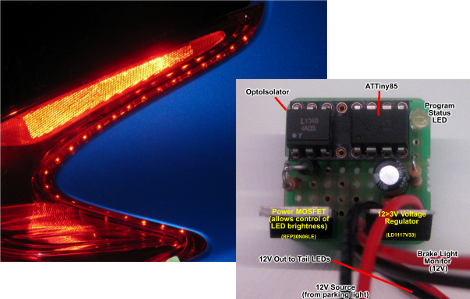
[Dave] spiced up his new 2012 Nissan Juke with a little tail-light amendment. You can see that outlining the rim of the light enclosure is a series of dots. This is an LED strip that he added to augment the brake lights. It’s glued in place, and features side emitting LEDs so that the light will be focused behind the car.

To control the strip he’s using an ATtiny85 microcontroller. It’s the chip on the right, and an optoisolator next to it protects it from the 12V vehicle power which drives the strip (via a MOSFET), and acts as a trigger when the brake pedal is pressed. He wrote a few effects into the firmware. When the lights are turned on, the strip fades up to 75% over about eight seconds. When the brake pedal is pressed they go to 100%. Check out the video after the break (it seems a little weird to us, as the video runs 18 seconds but the audio keeps going… YMMV).

We’ve seen a couple of tail light concepts that flash the brake lights when you stomp on the pedal. Unfortunately the Juke (and all other cars as far as we know) don’t have functionality built-in to sense when you’ve really given the brake a sudden jolt. It makes us wonder if this info could be gleaned from the CANbus? Continue reading “LED Strip And UC Add Some Flash To Your Tail Lights”