Range Finder Musical Toy

parallax_arduino_ping_organ

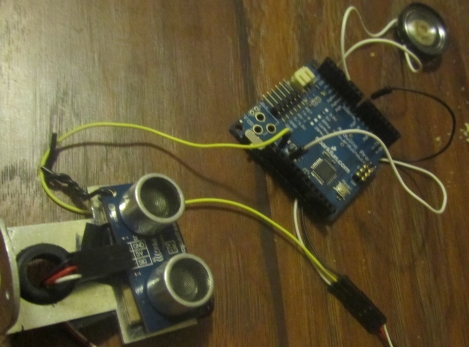
Instructables user [sketchsk3tch] was looking to make a fun toy for his kids using things he had around the house and came up with the Ping Organ. The organ is played by standing in front of the Parallax Ping range sensor, and moving around any which way you please. He interfaced the range sensor with an Arduino, scavenging a small speaker from an old toy for audio output.

The code for the project is fairly straightforward, borrowing most of it from the demo software that shipped with the Ping and the Arduino. He made a few small tweaks in order to get the organ to play frequencies of actual notes, as well as to allow for some flexibility when calculating the specific note to play.

While not the most complex project we have ever featured, [sketchsk3tch] reports that his kids love to spend time flailing around wildly in front of the organ, which is exactly what he intended.
Video of the organ being tested after the break.
Continue reading “Range Finder Musical Toy”

LaunchPad MIDI Synth

launchpad_midi_synth

[NatureTM] sent in a writeup for the MIDI synthesizer he recently built using a TI LaunchPad. The construction is pretty simple overall, consisting of little more than the MSP430, a handful of resistors, and an optoiosolater. Of course, a MIDI controller is required, but he already had that on hand.

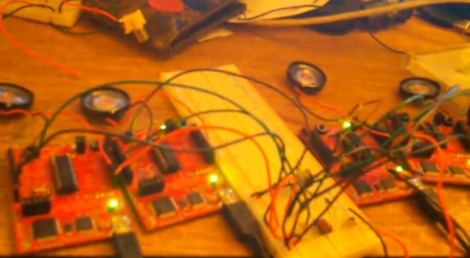
Once the MIDI data is read from the optoisolator, his code takes care of the rest, adjusting the square wave sound generator to get the proper note. He does mention that since the synthesizer is monophonic, special care is taken to ensure that simultaneous notes are processed properly. You can route all of the sound into a single speaker, but he used the optoisolator to send the sound data to multiple LaunchPads instead, resulting in a fun little MIDI quintet.

He provides code and plenty of video on his site, but keep reading for a sneak peek of his synth in action.

Continue reading “LaunchPad MIDI Synth”

NES Game Pad Guided Robotic Arm

nes_robotic_arm

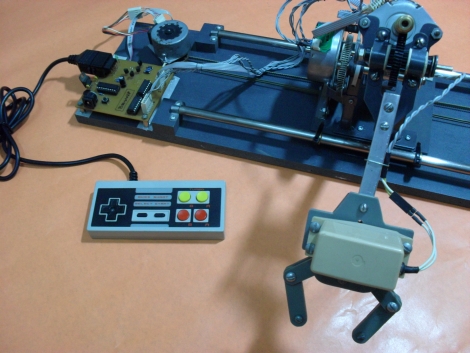
Instructables user [Bruno] sent in his most recent creation, a robotic arm controlled using an old NES game pad. He scavenged the majority of his parts from a pair of old HP printers, including motors pulleys, belts and more. In fact, most of the metal and plastic components that he used come from the old printer chassis as well. He has included copies of the templates he used when manufacturing both the plastic and metal components, which should come in handy should anyone try to replicate his work.

[Bruno] also included all of the source code for the robotic arm and mentions that the project required two PICs due to pinout requirements. He ultimately decided to use two cheaper models over a single more expensive unit that would have supplied all of the pins he needed. His cost conscious build is impressive and undoubtedly demonstrates just how many old components can be reused in new projects if you really put some thought into it. Great job with this build, keep up the good work!

Be sure to keep reading to see some video of the arm in action.

Continue reading “NES Game Pad Guided Robotic Arm”

DIY PIC Development Board And Web Server

websd

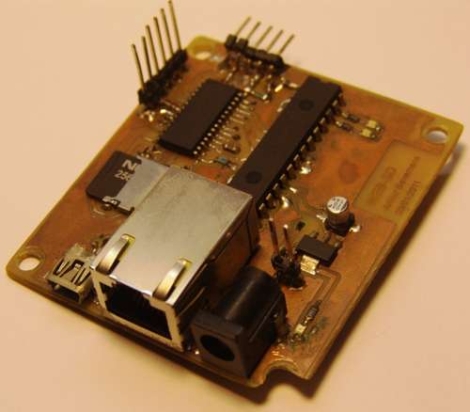
Inspired by a project featured here on Hack-a-Day, [arthurb] bought himself a PIC 24F and started experimenting once he learned the ins and outs of programming the chip. Using a breadboard and a nest of wires was fine for his first few projects, but as he advanced, he began to feel the need for a full-fledged development board. With a list of required features in mind he got to work, constructing a well thought out board as well as a handful of expansion boards that can be used for various other projects. His main development board includes Ethernet connectivity for use with his web server software, the ability to utilize an SD card for storage, and a USB port for programming. His expansion boards include a temperature sensor, a numeric touchpad, as well as a video output module. Overall it is a pretty impressive build, considering he had never programmed a PIC before starting this project. All of his boards are thoroughly documented, and he has included plenty of source code in hopes of helping other individuals just starting out in PIC programming.

You can see his web server in action here, but keep in mind that it is running off a PIC, so please be courteous in your usage.

bradley_smoker_clone

PID Controlled Bradley Smoker Clone

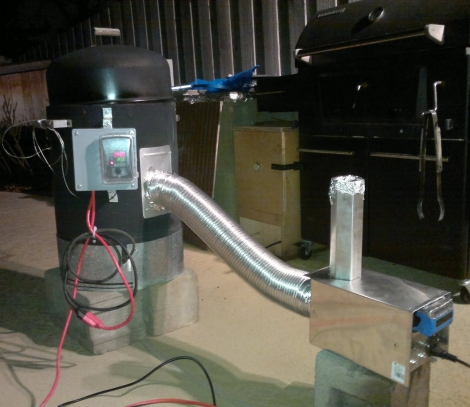
Bradley smokers are coveted for their ease of use, as they require very little interaction from the user once the hopper is loaded with wood pucks and the machine is powered on. The more robust models are quite pricey, so [Maukka] decided to build his own version of a Bradley smoker as an add on to his existing unit. He fabricated a smoke generator out of aluminum, including all of the components you would normally find in an automated smoker. Once the hopper is loaded with wood pucks, the smoker runs autonomously, shuffling new pucks onto the heating element, presumably at timed intervals. The main barrel of the smoker has a separate PIC-controlled heating element installed, and is connected to the smoke generator by an aluminum duct. This configuration allows [Maukka] to cold smoke items such as fish, nuts, and cheeses using the smoke generator by itself, while also permitting the smoking of meats at far higher temperatures when the main heating element is used. This is truly a fantastic build, and the cold smoker component is something I would love to have as an addition to my Weber bullet.

Be sure to explore his blog a bit to catch all of the build details, as they are separated into various posts.

[ThanksĀ Hali Batsuiba]

RFID Triggered Presentation Box

blasphemous_bible_box

[Lace] needed to build a “box project” for his college art class and figured he could spice things up a bit by adding some electronic components to the mix. His project, dubbed the ‘Blasphemous Bible Box‘ consists of a bible opened up the section of the book of Revelations that discusses the mark of the beast in an old cigar box. The box is normally locked, but has been programmed to unhook an internal latch when he passes the RFID chip embedded in his hand over it. The effect could have been achieved using a simpler circuit, but the enclosed Arduino seems to do the job decently enough. [Lace] has not mentioned if he has considered revising the box any, but a spring-loaded external latch secured with a magnetic lock would make for a nice effect if version 2 was ever built. Adding a servo to slowly open the box as well as including a speaker blaring Carmina Burana – O Fortuna upon opening would be pretty cool as well (hint, hint). We have video of the box in action after the break.

Continue reading “RFID Triggered Presentation Box”

spaghetti_thermic_lance

Thermic Lance Made From Spaghetti

[Frogz] sent in a video he found of a thermic lance constructed from spaghetti. If you are not familiar, thermic lances are typically comprised of an iron tube filled with iron rods, which are then burned using highly pressurized oxygen. This lance however, was built by tightly wrapping a bundle of spaghetti in aluminum foil and attaching it to an oxygen tank. While thermic lances are commonly used in heavy construction where thick steel needs to be cut, [latexiron] and his friends use theirs to cut apart a chair. While we don’t necessarily condone drunken destruction of innocent patio furniture, we can’t help but watch this video again and again in amazement of the incredibly novel use of everyday pasta. You too can join in the drunken revelry after the jump. If food-based cutting torches are your thing, be sure to check out this bacon lance as well.

Continue reading “Thermic Lance Made From Spaghetti”