An Opensource Arduino Guitar Pedal

If you’re a guitarist, or know a guitarist, you probably know just how many guitar effects there are out there — but what if you could design your own effects?

[J Rodriguez] has just released his opensource Arduino guitar pedal shield, dubbed the pedalSHIELD. He designed it as a platform to learn about digital signal processing, effects, and synthesizers — without needing an in-depth knowledge of electronics or programming. It allows you to design your own effects in C/C++, or download from his own library online. Some of the downloadable presets include an octave pedal, reverb pedals, delay pedals, and even distortion pedals!

The pedal features three programmable potentiometers, two main switches, and the foot pedal switch. The shield plugs directly into an Arduino Due, and you can find all the schematics here and the parts list here. It was completely designed in KiCad which is an open source electronics CAD design suite.

Take a listen after the break to hear the pedal in action!
Continue reading “An Opensource Arduino Guitar Pedal”

Full-size Lego Car Can Hit 30km/h!

[Steve Sammartino] is a Melbourne entrepreneur, and he had an idea: could it be possible to design and make a functional full-size Lego car?

He sent out a single tweet to try to crowd fund the project:

Anyone interested in investing $500-$1000 in a project which is awesome & a world first tweet me. Need about 20 participants…

Not one, not two, but forty Australians pledged money to start this crazy idea dubbed the #SuperAwesomeMicroProject. With the money raised, [Steve] and [Raul Oaida] purchased over 500,000 Lego pieces and began the build in Romania, where [Raul] lives.

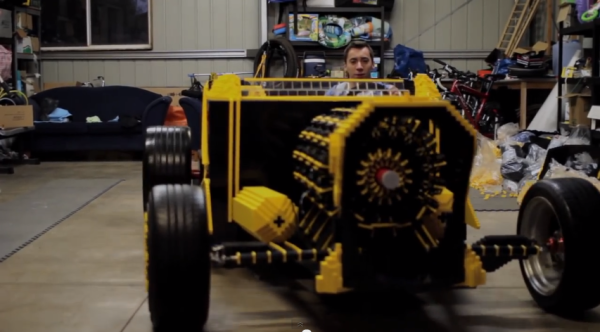
Now before you get too excited, the car is not “fully” made out of Lego. It features real tires and some select load bearing elements. That being said, the entire engine is made completely out of Lego. It features four orbital engines utilizing a total of 256 pistons. The top speed they tested it to was about 20-30km/h — it might go faster, but they didn’t want to risk a catastrophic failure.

Since its completion (it took nearly 18 months to build), it’s been shipped back to a secret location in Melbourne, but the team has made an excellent video showcasing the project. Stick around after the break to see your childhood dreams come to life.

Continue reading “Full-size Lego Car Can Hit 30km/h!”

DIY Laser Cutter

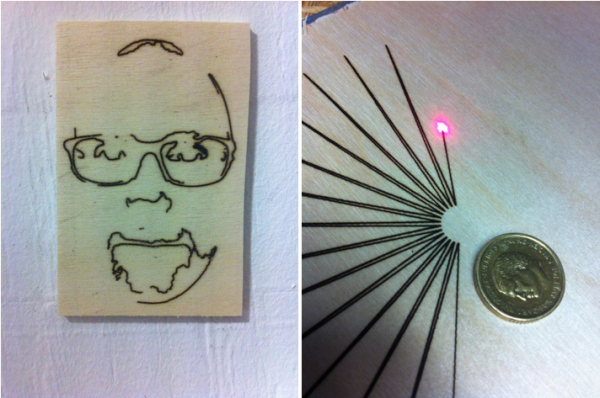
[Jens] decided he wanted to try building his own laser cutter to see just how much you can actually cut with a fairly low power 300mW laser diode.

He was inspired by a similar project from earlier this year, and chose to use the same LPC-826 laser diode, which you can find online for about $10-30. The cutter itself is has a wooden frame and uses drawer slides on both axes. Threaded M6 rods and NEMA17 stepper motors provide the actuation, and the whole thing is controlled by an Arduino Nano with Easy Driver stepper motor drivers.

So what can it cut? In his experiments he was able to cut through adhesive plastics (sticker paper), EVA foam, and black paper. He was also able to engrave wood and ABS plastic, although the plastic didn’t play too nicely with the laser. He also found it useful for laser cutting stencils, which he then used to create rusty art using hydrochloric acid and hydrogen peroxide.

Considering how cheap you could make one of these, it’s not a bad tool to have. Stick around after the break to see it laser cut a shark!

Continue reading “DIY Laser Cutter”

Addressable RGB LED Coffee Table

WP_20131219_004

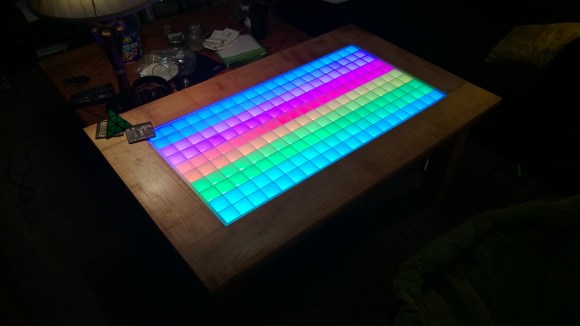
[Alexander] has just put the finishing touches on his Addressable RGB LED Coffee Table and it looks amazing!

Making use of his local hackerspace, Sector67 in Madison, Wisconsin, he learned how to use woodworking equipment to build the table out of nice curly maple wood sheet.

Next up he purchased two 4’x8′ pieces of 2.8mm bamboo plywood — even had to rent a U-Haul just to get it back to the space. Talk about dedication to a project! Having never used a laser cutter before either, [Alexander] was quickly fed up with the crappy laser interface software, so instead, he hand wrote the shapes as SVGs in notepad and then converted them to DXFs. That sounds like a rather slow way to do it, but he thinks it ended up being quicker since it’s all straight lines. Two hours of laser time later, and he had a series of slotted strips to create the grid for the LEDs.

To really light up his project, he’s using nice big 12mm RGB LEDs that he’s ordered off of eBay — they came in four strands of 50 which made it super easy to wire. A beefy 5V 12A PSU provides the juice, and an Arduino takes care of the addressing. He’s even hidden the main power cord through one of the legs!

It’s a gorgeous build, and an impressive project for being a first-timer on most of the equipment used. See for yourself in the short video after the break.

Continue reading “Addressable RGB LED Coffee Table”

A Balancing, Walking Cube Named Cubli

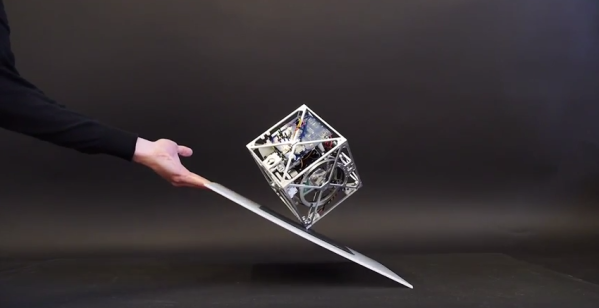
Meet Cubli! Cubli is a 15 x 15 x 15cm robotic cube that can roll around and balance on its corners using a series of gyroscopes.

The project has been going strong since February 2011 at the Institute for Dynamic Systems and Control in Zurich, where it is starting to get quite impressive. We first shared Cubli earlier this year, when it was just a wee 2-dimensional and corded 3-dimensional prototype.

Since then, it has become a fully enclosed wireless cube capable of jumping up on its end, balancing, and controlled falling — it can walk and roll! To do this, it has three large reaction wheels on each axis which can impart their angular velocity on the entire cube when the braked, allowing it to move in any direction.

According to the video after the break, the team is just building the cube “because they can”, however other researchers are interested in the technologies applications in self-assembling robots, and even planetary exploration.

Continue reading “A Balancing, Walking Cube Named Cubli”

A Weird Kind Of Printer

printer

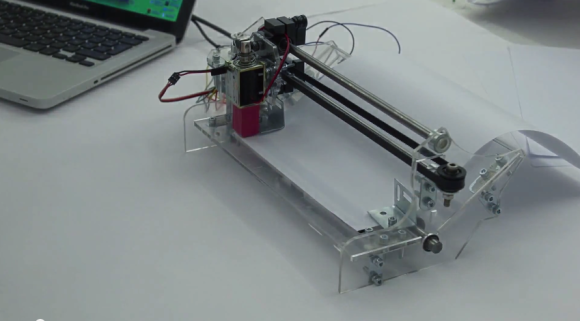
[Benjamin] is just putting the finishing touches on his home-made, paper-stabbing, needle-printer!?

From a distance, it looks like the bare bones of a regular inkjet printer, but it’s not. Instead of an ink-head it features a needle — It’s kind of like a dot-matrix (hole-matrix?) printer. He’s using it for silk-screening masks, which we have to admit, must be pretty handy — it certainly makes soldering SMT’s less scary! It could also be used for embossing or even braille printing.

The frame of the printer is laser cut out of clear plastic, and two Nema 17 steppers drive the X & Y axes. A simple solenoid actuator provides the needle-stabby action. He’s controlling the whole thing using an Arduino, and sending the data to it using a call-and-response protocol to avoid any data losses. It was built for just shy of $200, which was his original goal for the project.

Check it out after the break!

Continue reading “A Weird Kind Of Printer”

From CT Scans To 3D Prints

[the_digital_dentist] had a CT Scan done back in 2007 for treatment using orthodontics. Some how, he managed to get a copy of the CT Scan data from the lab, and has been playing around with it lately.

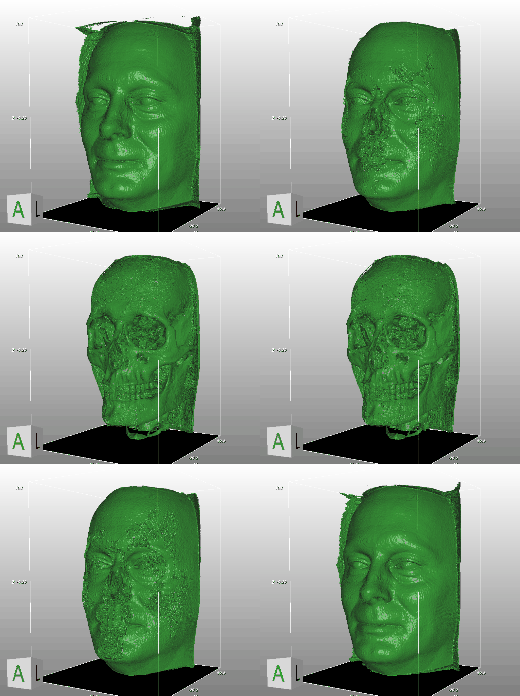
Since he has a 3D printer, the obvious end goal was to print his face using some of the data extracted from the CT Scan. This required a lot of manipulation to get it to the finished model you see above. He used an open source software called DeVIDE to process the data and export the STL. Not much information on this is given on his site, but in our research we managed to find another video documenting the process in DeVIDE on extracting the STL model from DICOM CT scan data.

5eachUnfortunately, the STL is far from being ready to print after being extracted; there is a lot of extraneous data that needs to be cleaned up. He used mesh editing software to help blow away the unnecessary details. We don’t know for sure what software [the_digital_dentist] used, but MeshLab is a good one.

After that, it was just a matter of printing the STL file. But the really cool thing about using data from CT scans is the amount of detail it captures… Stick around after the break to see an animated GIF demonstrating this.

Anyone want to print a copy of their own skull? It’d look great with a plating of Adamantanium…