Chandra X-ray Observatory Threatened By Budget Cuts

Launched aboard the Space Shuttle Columbia in July of 1999, the Chandra X-ray Observatory is the most capable space telescope of its kind. As of this writing, the spacecraft is in good health and is returning valuable scientific data. It’s currently in an orbit that extends at its highest point to nearly one-third the distance to the Moon, which gives it an ideal vantage point from which to make its observations, and won’t reenter the Earth’s atmosphere for hundreds if not thousands of years.

Yet despite this rosy report card, Chandra’s future is anything but certain. Faced with the impossible task of funding all of its scientific missions with the relative pittance they’re allocated from the federal government, NASA has signaled its intent to wind down the space telescope’s operations over the next several years. According to their latest budget request, the agency wants to slash the program’s $41 million budget nearly in half for 2026. Funding would remain stable at that point for the next two years, but in 2029, the money set aside for Chandra would be dropped to just $5.2 million.

Drastically reducing Chandra’s budget by the end of the decade wouldn’t be so unexpected if its successor was due to come online in a similar time frame. Indeed, it would almost be expected. But despite being considered a high scientific priority, the x-ray observatory intended to replace Chandra isn’t even off the drawing board yet. The 2019 concept study report for what NASA is currently calling the Lynx X-ray Observatory estimates a launch date in the mid-2030s at the absolute earliest, pointing out that several of the key components of the proposed telescope still need several years of development before they’ll reach the necessary Technology Readiness Level (TRL) for such a high profile mission.

With its replacement for this uniquely capable space telescope decades away even by the most optimistic of estimates, the  potential early retirement of the Chandra X-ray Observatory has many researchers concerned about the gap it will leave in our ability to study the cosmos.

Continue reading “Chandra X-ray Observatory Threatened By Budget Cuts”

Hackaday Europe Is Almost Here, Last Call For Tickets

By the time this post hits the front page, we’ll be just a few days away from the kickoff of Hackaday Europe 2024!

For those of you joining us in Berlin this weekend, we’ve got an incredible amount of content planned for you. Things get rolling on Friday with a pre-event meetup. But Saturday is when things really kick into high gear. Before the day’s out, we’ll have played host to nearly a dozen speakers and — literally — more workshops than we could fit into the schedule. Two workshops will be “floating” events that will happen once enough interested parties have congregated in one place. We’ll keep things going until well past midnight, which leads directly into Sunday. We want to get a few sessions of lightning talks packed in, so start coming up with your talk ideas now.

The Vectorscope will be making its European debut.

In addition, there will be food, music, camaraderie, badge hacking, and the general technolust surrounding a Hackaday event. In our humble and totally unbiased opinion, we put on some of the best and most unique hardware hacking meetups in the world — if you like reading Hackaday, you’ll love living it for a couple of days.

As of this writing, we still have a very few tickets for Hackaday Europe 2024 available. Want one? Head over to the Eventbrite page. But you better hurry. We’re talking a literal handful here, so don’t be surprised if they’ve dried up by the time you read this.

The workshops have all sold out, but as usual, we’ll be running a waiting list right up until the last minute: should anyone have to drop out of a workshop (which happens more than you might think), their spot will go to the person next in line. If you’d like to get on the list, email prize@hackaday.com with your name, ticket number, and the workshop you’re hoping to sneak into, and we’ll see what we can do.

But don’t let the workshops stop you. There’s still plenty to see, do, and experience. See you there!

Double-Checking NASA’s Eclipse Estimate At Home

If you were lucky enough to be near the path of totality, and didn’t have your view obscured by clouds, yesterday’s eclipse provided some very memorable views. But you know what’s even better than making memories? Having cold hard data to back it up.

Hackaday contributor [Bob Baddeley] was in Madison, Wisconsin for the big event, which NASA’s Eclipse Explorer website predicted would see about 87% coverage. Watching the eclipse through the appropriate gear at the local hackerspace was fun, but the real nerding out happened when he got home and could pull the data from his solar system.

A graph of the system’s generated power shows a very clear dip during the duration of the eclipse, which let him determine exactly when the occlusion started, peaked, and ended.

Continue reading “Double-Checking NASA’s Eclipse Estimate At Home”

Hackaday Links Column Banner

Hackaday Links: April 7, 2024

Folks with a bit of knowledge about network security commonly use virtual private networks (VPNs) when out and about. Whether you’re connecting to public WiFi or somebody passes you a questionable Ethernet cable at a hacker con, it’s nice to have a secure endpoint to tunnel all of your traffic. As a secondary bonus, connecting through a VPN can obscure your physical location. It’s that second feature that has a bunch of people jumping on the VPN bandwagon as they try to dodge the recent porn age checks that have gone into effect in a number of states. According to a recent article in PopSci, one particular VPN provider saw a 275% jump in demand on the same day that PornHub cut off access to users in Texas. While the debate over underage users accessing adult content is far outside of our wheelhouse, anything that gets more users connecting to the Internet via encrypted means is arguably a net positive.

If you wanted somebody from the Geek Squad to set up that VPN so you can get back on PornHub to work securely from the local coffee shop, you might be out of luck. Reports have been coming in that Best Buy’s mobile nerd division is seeing sweeping layoffs. Geeks were told to stay home on Tuesday and await a call from corporate, at which point many got the surprising news that they no longer had a job. The /r/GeekSquad subreddit has been a rallying point for staff who got the axe, with the user [jaym026] posting what we assume is an AI-generated inspirational speech from Optimus Prime. Of course, it sucks for anyone to lose their job, especially with the way things are these days. Still, we’re willing to bet almost none of those affected will look back on the day they were let go from an increasingly irrelevant brick-and-mortar electronics store as a low point in their professional careers.

Continue reading “Hackaday Links: April 7, 2024”

How To Properly Patch Your Iowa-Class Battleship

There’s a saying among recreational mariners that the word “boat” is actually an acronym for “bring out another thousand”, as it seems you can’t operate one for long without committing to expensive maintenance and repairs. But this axiom isn’t limited to just civilian pleasure craft, it also holds true for large and complex vessels — although the bill generally has a few more zeros at the end.

Consider the USS New Jersey (BB-62), an Iowa-class battleship that first served in the Second World War and is now operated as a museum ship. Its recent dry docking for routine repair work has been extensively documented on YouTube by curator [Ryan Szimanski], and in the latest video, he covers one of the most important tasks crews have to attend to while the ship is out of the water: inspecting and repairing the hundreds of patches that line the hull.

These patches aren’t to repair damage, but instead cover up the various water inlets and outlets required by onboard systems. When New Jersey was finally decommissioned in 1991, it was hauled out of the water and plates were welded over all of these access points to prevent any potential leaks. But as the Navy wanted to preserve the ship so it could potentially be reactivated if necessary, care was taken to make the process reversible.

Continue reading “How To Properly Patch Your Iowa-Class Battleship”

Kid’s Ride Gets Boosted Battery, ESP32 Control

That irresistible urge to rescue an interesting piece of hardware from the trash is something that pretty much every Hackaday reader will have felt at one time or another. Sometimes it’s something that you could put to work immediately, like an old computer or some scrap piece of material that’s just the right size. But other times, you find something on the side of the road that ends up being the impetus for a whole new project.

For [David Bertet], finding a beat up kid’s Jeep Wrangler on the curb was the first step towards a journey that ends with PowerJeep: an open source project that we wager could end up saving similar vehicles from the landfill. The basic idea is simple enough — strip out the vehicle’s original 12 volt power supply and replace it with 18 V provided by easily swappable tool batteries. But as is often the case, it’s the details and the documentation that sets this project apart.

Continue reading “Kid’s Ride Gets Boosted Battery, ESP32 Control”

ESP32 Provides Distraction-Free Writing Experience

Writing out a few thousand words is easy. Getting them in the proper order, now that’s another story entirely. Sometimes you’ll find yourself staring at a blank page, struggling to sieve coherent thoughts from the screaming maelstrom swirling around in your head, for far longer than you’d care to admit. Or so we’ve heard, anyway.

Unfortunately, there’s no cure for writer’s block. But many people find that limiting outside distractions helps to keep the mental gears turning, which is why [Un Kyu Lee] has been working on a series of specialized writing devices. The latest version of the Micro Journal, powered by the ESP32, goes a long way towards achieving his goals of an instant-on electronic notebook.

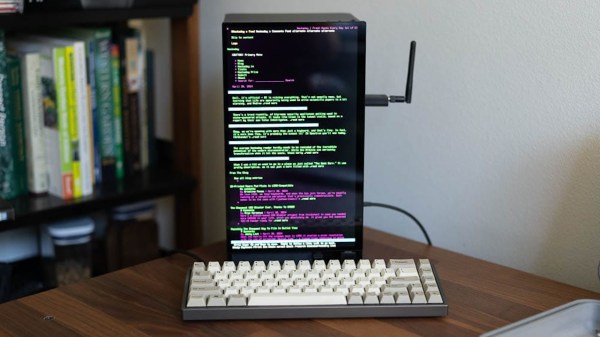
The writing experience on the Micro Journal is unencumbered by the normal distractions you’d have on a computer or mobile device, as the device literally can’t do anything but take user input and save it as a text file. We suppose you could achieve similar results with a pen and a piece of paper…but where’s the fun in that? These devices are more widely known as writerdecks, which is an extension of the popular cyberdeck concept of hyper-personalized computers.

This newest Micro Journal, which is the fourth iteration of the concept for anyone keeping score, packs a handwired 30% ortholinear keyboard, a 2.8″ ILI9341 240×320 LCD (with SD card slot), ESP32 dev board, and an 18650 battery with associated charging board into a minimalist 3D printed enclosure.

Unable to find any suitable firmware to run on the device, [Un Kyu Lee] has developed his own open source text editor to run on the WiFi-enabled microcontroller. While the distraction-free nature of the Micro Journal naturally means the text editor itself is pretty spartan in terms of features, it does  allow syncing files with Google Drive — making it exceptionally easy to access your distilled brilliance from the comfort of your primary computing device.

While the earlier versions of the Micro Journal were impressive in their own way, we really love the stripped down nature of this ESP32 version. It reminds us a bit of the keezyboost40 and the EdgeProMX, both of which were entered into the 2022 Cyberdeck Contest.

Continue reading “ESP32 Provides Distraction-Free Writing Experience”