Vibrating Braille Display Is Portable

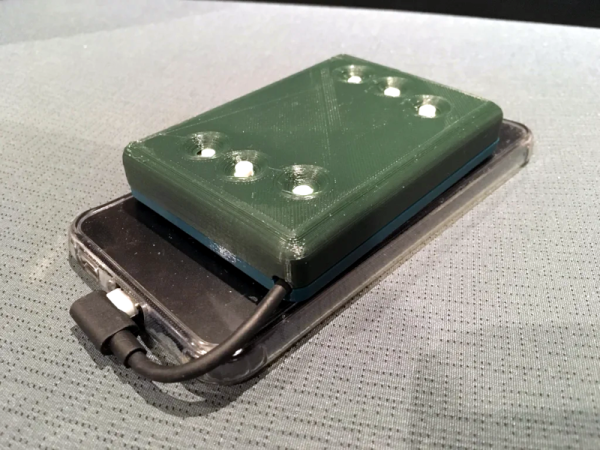
Smartphones are an integral part of life, but what if you can’t see the screen? There is text-to-speech available, but that’s not always handy and can be slow. It also doesn’t help users who can’t hear or see. Refreshable braille devices are also available, but they are expensive and not very convenient to use. [Bmajorspin] proposed a different method and built a prototype braille device that worked directly with a cell phone. The post admits that as the device stands today, it isn’t a practical alternative, but it does work and is ripe for future development to make it more practical.

The device saves costs and increases reliability by using six vibration motors to represent the six dots of a braille cell. However, this leads to an important issue. The motor can’t directly mount to the case because you have to feel each one vibrating individually. A spring mounting system ensures that each motor only vibrates the tactile actuator it is supposed to. However, the system isn’t perfect, and fast output is difficult to read due to the spread of vibrations.
Continue reading “Vibrating Braille Display Is Portable”

The Alien Energy Crisis Solved

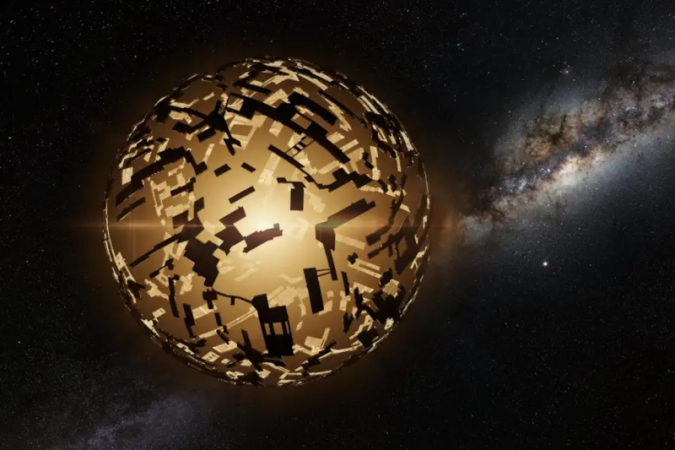
Since the dawn of the industrial revolution, humans have been searching for more energy. Especially lately, there has been a huge interest in wind, solar, geothermal, and other ways to capture and harness power. However, we have a huge power plant just eight light minutes away: our sun. Oh sure, we toy with solar power, but the amount of sunlight hitting the Earth or even Earth orbit is a tiny fraction of Sol’s total output. But what if you could capture nearly all of the sun’s output? Scientists think that maybe — just maybe — they’ve detected 60 new extraterrestrial civilizations doing just that. At least, that’s what it could be.

[Freeman Dyson] popularized the idea of a Dyson sphere, an artificial sphere surrounding a sun to capture the maximum amount of energy, back in 1960. However, the idea is older and usually credited to [Olaf Stapledon]’s 1937 novel Star Maker. While most people think the sphere would be solid, [Dyson] himself thought it would be a swarm of disjointed collectors owing to the difficulty in creating a solid shell of the required size.

Both SETI and Fermilab have searched for what is thought to be telltale infrared radiation that scientists think would emanate from a star surrounded by spheres or swarms. Several have been located, but there is no conclusive evidence.

The new 60 were identified by analyzing data from the Gaia satellite. Again, the evidence is not conclusive, but small and dim stars that are very bright in infrared can’t be explained by conventional explanations. One way to explain at least some of the stars would be if about 16% of the star was obscured by something like a swarm of Dyson sphere collectors.

There are, of course, more jejune explanations possible. For example, the star might happen to be in front of some more distant IR source. Still, it is tantalizing to think there may be more than 60 high-tech civilizations out there either waiting to meet us or, perhaps, waiting to eat us, depending on how paranoid you are.

Power Resistance Isn’t Futile

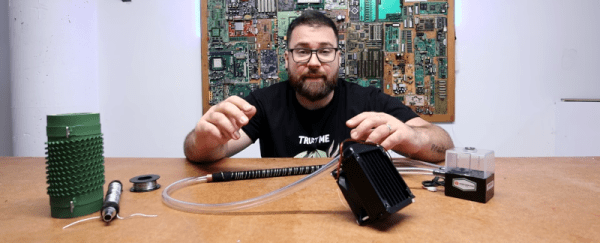
As [Electronoobs] points out, everything has resistance. So, how hard can it be to make a high-power resistor? In the video below, he examines a commercial power resistor and how to make your own using nichrome wire.

Sure, in theory, you can use a long piece of wire, but normally, you want to minimize the amount of space occupied. This leads to winding the wire around some substrate. If you just wind the wire, though, you get an inductor. This can cause nasty voltage spikes when there is a change in current through the resistor. You can get “noninductive” wire wound resistors that use either two opposing windings or alternate the turn direction on each turn. This causes the magnetic fields to tend to cancel out, reducing the overall inductance.

Nichrome wire has more resistance per millimeter and can dissipate more power. Modern digital meters can measure the resistance of a wire if you account for the test leads. To make a substrate, [Electronoobs] got creative since he anticipated generating a lot of heat. The final product even uses water cooling.

Why do you want a big resistor? Maybe you need a dummy load, or you want to drain some batteries. If you want to recycle nichrome wire, it is much more common than you might expect.

Continue reading “Power Resistance Isn’t Futile”

GitHub Hosts Ham Radio

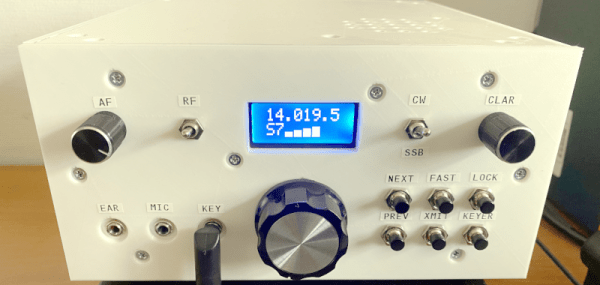
[Alex R2AUK] has been busy creating version two of a homebrew all-band ham radio transceiver. The unit has a number of features you don’t always see in homebrew radios. It covers the 80, 40, 30, 20, 17, 15, 12, and 10 meter bands. The receiver is a single-IF design with AGC. The transmitter provides up to 10W for CW and 5W for single sideband operations. There’s a built-in keyer, too. A lot of the documentation is in Russian (including the video below, which is part of a playlist). But translation tools are everywhere, so if you don’t speak Russian, you can still probably figure it out.

The VFO for both transmit and receive is an Si5351. The transmit chain is straightforward. The receiver reuses many of the same filters.

Continue reading “GitHub Hosts Ham Radio”

GPS At Any Speed

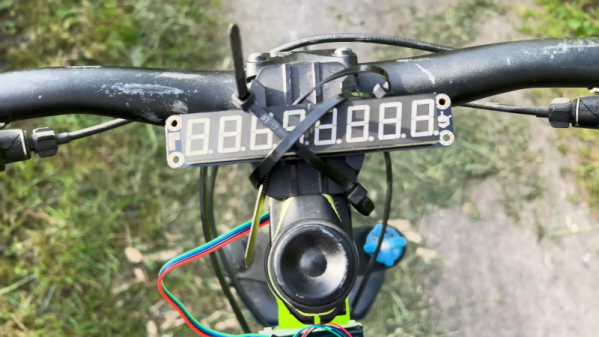
[Mellow_Labs] was asked to create a GPS speedometer. It seems simple, but of course, the devil is in the details. You can see the process and the result in the video below.

We have to admit that he does things step-by-step. The first step was to test the GPS module’s interface. Then, he tried computing the speed from it and putting the result on a display. However, testing in the field showed that the display was not suitable for outdoor use.

That prompted another version with an OLED screen. Picking the right components is critical. It struck us that you probably need a fast update rate from the GPS, too, but that doesn’t seem to be a problem. Continue reading “GPS At Any Speed”

CP/M On An Eight Line Display

How many lines do you need on a CP/M terminal? More is usually better, of course, but the MicroOffice RoadRunner managed with an 8-row, 80-column LCD screen. That may sound anemic, but in 1983, it was high-tech, as was the RoadRunner, and [Tech Time Traveller] tells us about them in a recent video you can see below.

The intro to the video shows some really strange old laptops before it gets to the RoadRunner. The machine used a Z80 work-alike CPU and a form of CP/M with some organizer functions. The machine didn’t have floppies or other disk storage, but did have four cartridge slots that could hold more memory, a spreadsheet, BASIC, or a text editor. The memory cartridges were static RAM with battery backup, so they retained data when you pulled them from the slot. Assuming the battery didn’t die.

Inside a RoadRunner cartridge.

Unfortunately, this particular machine suffered some shipping damage. In addition to the cartridges, it also had a removable battery and modem. At around the eight-minute mark, the case comes off, and inside are — surprise — more internal cartridges.

While MicroOffice isn’t a household name today, it was founded by a former Exxon executive and tapped a CEO and investor from Timex. It was funded by the likes of Olivetti. The computer rolled out in late 1983 and lived until Telxon bought MicroOffice in 1985.

Attempts to run Zork were not fruitful. There really wasn’t enough memory, and file transfer was a bit wonky. If you want a modern Z80 laptop, we know of one with 16 cores. As clunky as the RoadRunner looks, it still beats the old suitcase computers.

Continue reading “CP/M On An Eight Line Display”

Emulate A KIM-1 With A Commodore 64

When you think about virtualization, you usually think about making some CPU pretend to be another CPU. However, there are sometimes advantages to making a computer pretend to be the same computer.

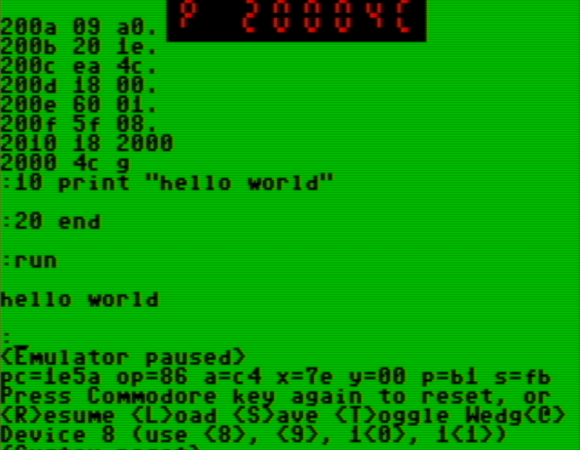
That’s the case with [oldvcr]’s KIMplement, which emulates a KIM-1 with a 6502 using a Commodore 64, which also uses a 6502.The reason this makes sense is that you have total control over an emulated CPU. If a program, for example, writes to a critical memory location or tries to take over the screen or keyboard, you can easily make the emulator do something more appropriate. Things like breakpoints and single stepping also become trivial.

The virtual machine at the heart of it is 6o6 (6502 on 6502), and it seems to perform well. By virtualizing, you can easily protect the system from programs that try to, for example, take over an interrupt vector. This is similar to how x86 protected mode can run old real-mode code in a virtual environment and intervene for certain instructions. The emulation is good enough that the emulator can run the emulator, which then runs the emulator to actually run the real target. That’s wasteful, of course, but it does speak to the completeness of the pretend CPU.

If you want a KIM-1 (and an 1802 Elf) but only have an Arduino, you can emulate a different way. At least an emulated KIM-1 doesn’t develop bad memory chips.