Crystal Radio Kit From The 1970s

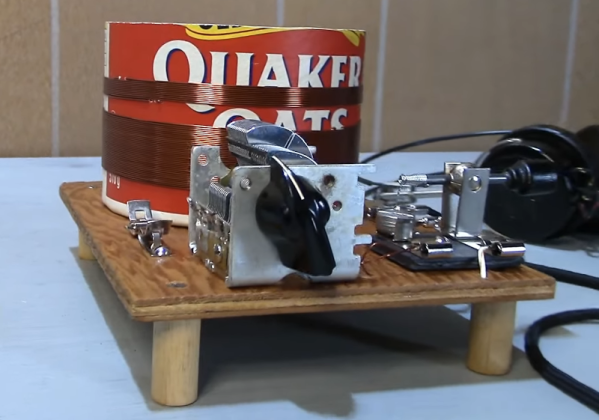
If you read the December 1970 issue of Mechanix Illustrated, you’d be treated to [Len Buckwalter]’s crystal radio build. He called out Modern Radio Labs as the supplier for parts. That company, run by [Elmer Osterhoudt], got so many inquiries that he produced a kit, the #74 crystal set. [Michael Simpson] found an unopened kit on eBay and — after a bidding war, took possession of the kit. The kit looked totally untouched. The crystal detector was still in the box, and there were period-appropriate newspaper wrappings.

The kit itself isn’t that remarkable, but it is a classic. An oatmeal box serves as a coil form. There’s a capacitor, a crystal detector, and headphones. The original cost of the parts was $7, but we imagine the eBay auction exceeded that by a large amount.

If the name [Len Buckwalter] sounds familiar, he was quite prolific in magazines like Electronics Illustrated and also wrote several books about transistors. [Michael] also shows off his innovative coil winder made from plastic cups and a coat hanger.

We’d love to find some old kits like this, although, from one way of thinking, it is almost a shame to build them after all these years. With an added audio amplifier and fiddling with the cat whisker, it sounded just fine.

If you don’t like oatmeal, you could fire up the 3D printer. While the basic circuit is simple, you can make it more complex if you like.

Continue reading “Crystal Radio Kit From The 1970s”

Hackaday Podcast Episode 267: Metal Casting, Plasma Cutting, And A Spicy 555

What were some of the best posts on Hackaday last week? Elliot Williams and Al Williams decided there were too many to choose from, but they did take a sampling of the ones that caught their attention. This week’s picks were an eclectic mix of everything from metal casting and plasma cutters to radio astronomy and space telescope budgets. In between? Some basic circuit design, 3D printing, games, dogs, and software tools. Sound confusing? It won’t be, after you listen to this week’s podcast.

Check out the links below if you want to follow along, and as always, tell us what you think about this episode in the comments!

Download an audiophile-quality oxygen-free MP3 file here.

Continue reading “Hackaday Podcast Episode 267: Metal Casting, Plasma Cutting, And A Spicy 555”

PC Watercooling Prototype Is Pumpless

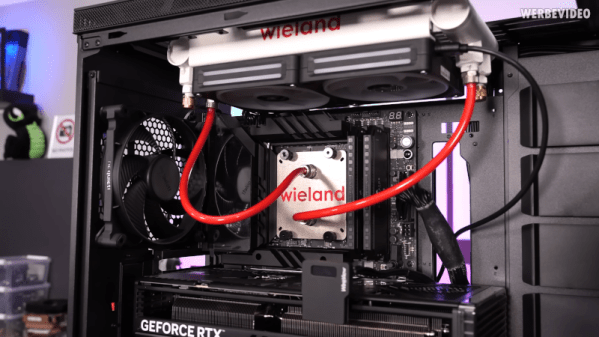
Watercooling is usually more efficient than air cooling for the same volume of equipment, and — important for many people — it is generally quieter. However, you still have water pump noises to deal with. [Der8auer] got a Wieland prototype cooler that doesn’t use a pump. Instead, it relies on the thermosiphon effect. In simple terms, the heat moves water — possibly boiling it — upwards to a radiator. Once the water is cool, it falls down back to the heat exchanger again.

It looks like any other AIO, but the block is extremely flat compared to normal coolers, which have the pump on top of the plate. As you might expect, orientation matters, and you can’t have tight bends in the hoses. The system also has to be totally airtight to function properly. The test was meant to be against a commercial AIO unit with the same number of fans. However, there was a problem, and the final test was done with a larger radiator with one of its three fans removed.

The prototype performed fine and was quiet. It didn’t do as well as the commercial cooler, but it wasn’t bad. Of course, this is a prototype. Maybe a final product will do better. Around the ten-minute mark, the IR camera came out, and it didn’t show any major unexpected hot spots.

We’ve seen water-cooled printer hotends, and pumping is a problem there. We wondered if this technology might work there. The whole thing reminded us of heat pipes without the internal wick to move cold working fluid. We’ve even seen a water-cooled calculator.

Continue reading “PC Watercooling Prototype Is Pumpless”

Computing Via (Virtual) Dominos

Back in 2012, [Matt Parker] and a team built a computer out of dominos for the Manchester Science Festival. [Andrew Taylor], part of the team that built the original,  has built a series of virtual domino puzzles to help explain how the computer worked. He also links to a video from the event, but be warned: the video contains some spoilers for the puzzles. If you are ready for spoilers, you can watch the video below.

The original computer could add two three-bit numbers and provide a four-bit result. We don’t want to give away the answers, but the inverter is quite strange. If you don’t want to puzzle it out, you can press the “reveal answer” to see [Andrew’s] solutions. Press “play” and watch the dominos fall.

Continue reading “Computing Via (Virtual) Dominos”

Early CD Player Teardown

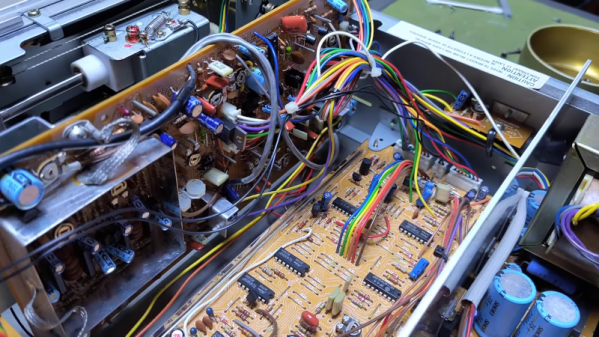
While CD players are nothing new today, they were the height of high-tech in the early 1980s. [w1ngsfly] shows us the inside of a Phase Linear 9500 player from 1983. Not only does it have many components, but it is also mechanically unusual.

The CD loads into a toaster-like slot and even pops out like a piece of toast. The tracking mechanism is quite complex, and there’s something that looks suspiciously like a dial string from an old slide rule tuner radio. Apparently, the unit was made by Kyocera and is internally similar to a Kyocera DA-01.

There’s a “head position” indicator that is actually just an LED connected to the tracking mechanism. The front panel controls look great but also allow you to control the head position exactly. As [w1ngsfly] mentions, it is almost like moving a turntable’s tonearm where you can drop it anywhere you want.

If we recall, they were about $600 to $1,000 new. If Phase Linear doesn’t ring a bell, they were well known in their day. Founded by [Bob Carver] and [Steve Johnston], the company was bought by Pioneer before the introduction and, later, by Jensen before the introduction of the 9500. [Bob] would go on to found Carver Corporation. You can find plenty of history about the company online.

We’ve seen CD players that look older. These days, CD drives are cheap and they are easy enough to control.

Continue reading “Early CD Player Teardown”

Getting Started With Radio Astronomy

There are many facets to being a radio hobbyist, but if you’ve ever had the urge to dabble in radio astronomy, check out “The Novice’s Guide to Amateur Radio Astronomy,” a presentation at the 2024 conference of the Society of Amateur Radio Astronomers. In that presentation (see the video below), [Nathan Butts] covers everything from why you should take up the hobby, how to set up a software defined radio (SDR) receiver, and how to repurpose old computers. This is just one of a series of videos recently posted from the conference — check out their channel to see them all.

Unlike optical astronomy, you can listen to the universe by radio during the day or night, rain or shine. You don’t need a dark sky, although these days, a quiet radio location might be hard to find. [Nathan] also points out that some people just want to crunch data collected by others, and that’s fun, too. There are many ways to get involved from designing hardware, writing software, or — of course — just listening.

It has never been easier to get involved. Cheap software-defined radios are perfect for this sort of work, and we all have massive computers and scores of small data-collection computers. Maybe you’ll be the next person to hear a Wow signal. If you are worried about fielding an antenna, many people repurpose satellite dishes.

Continue reading “Getting Started With Radio Astronomy”

Recycling Wires For Breadboarding

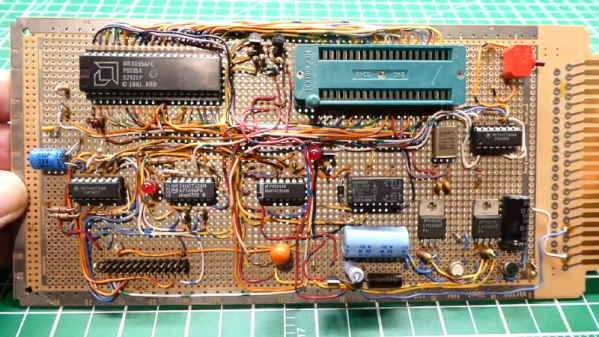
It is easy to take things for granted, but if you work with students, you realize that even something as simple as a breadboard needs explanation. [0033mer] recently shared a tip about how he wires both solderless breadboards and prototype boards on the cheap. Instead of buying special wires, he salvages riser cables often found in scrap from demolished buildings. These often have 200 or so thin solid wires inside. You take them apart, and, as he put it, if you have 15 feet of the stuff, that will last you the rest of your life. We hope you live longer than that, but still.

One advantage to doing this is you don’t feel bad about cutting the wires exactly to length which makes for neat boards. He has a tiny stripper that make it easy to remove the insulation during installation.

Continue reading “Recycling Wires For Breadboarding”