Peltier Mini Fridge For Class By Class

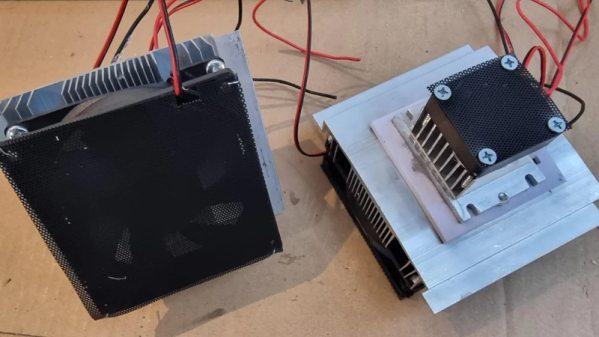
How do you keep a few sodas in your classroom cool? Well, if you are teacher [Ethan Hunt], you have your students design and build a solid-state mini refrigerator that can beat his prototype fridge. The prototype uses a Peltier effect module to get three cans down to 11 C (52 F), with a final goal of reaching 5 C (41 F). It’s not all fun and games either — [Ethan] provides a suggested lesson plan with a total of thirteen modules made to fit in an hour each.

Peltier effect modules, also known as solid-state heat pumps, used to be exotic tech but are now quite common. They are actually the reverse of the Kelvin effect. Thermocouples exploit the Kelvin effect by measuring current flowing due to temperature differences.

Solid-state heat pumps use current flowing to create a comparable temperature difference. However, that’s also the catch. One side of the heat pump gets cold, but the other side gets equally hot. That heat has to go somewhere. The same is true, of course, of a “real” refrigerator or an air conditioner.

The lessons would be perfect to adapt for a class, a kid’s club, or even homeschooling. We’d love to see what your students build. You probably won’t be making liquid nitrogen with this setup. But we have seen more than one mini-fridge.

Your Home Mainframe

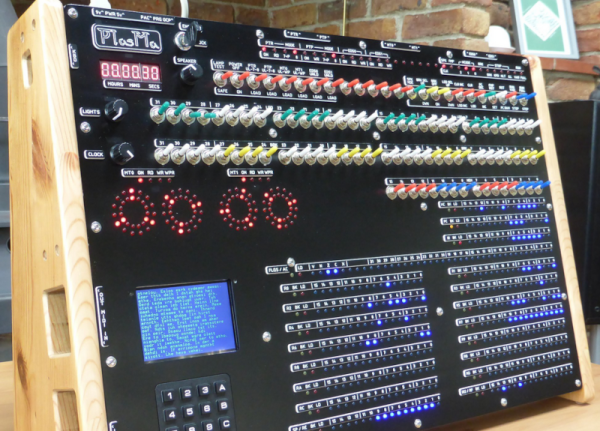
We miss the days when computers looked like computers. You know, blinking lights, rows of switches, and cryptic displays. [Phil Tipping] must miss those days too since he built PlasMa, a “mini-mainframe simulator.”

The device would look at home on the set of any old science fiction movie. Externally, it has 540 LEDs, 100 switches, and a number of other I/O devices, including a keypad and an LCD screen. Internally, it can support three different instruction sets. Everything is run by an ATmega2560, and it has simulated paper tape, magnetic tape, and disks (all via SD cards). The magnetic tapes also have LED simulated reels to show the tape position and other status information (the round displays just above the LCD display).

Continue reading “Your Home Mainframe”

Copper Coating 3D Prints

We would all like to 3D print in metal, but for now, the equipment to do that is out of reach for most of us. Instead of dealing with powder printers or metal-bearing polymers, [Robert] has a simple solution. Using a process known as mechanical plating or peen plating, he deposits a layer of copper on a PLA print. The results look good, as you can see in the video below.

This isn’t electroplating, although the result is similar. With electroplating, you have to make the 3D part conductive. You also have to deal with wet chemistry and fumes. This process uses a rock tumbler, copper powder, and small ball bearings.

Continue reading “Copper Coating 3D Prints”

Linux Fu: Preprocessing Beyond Code

If you glanced at the title and thought, “I don’t care — I don’t write C code,” then hang on a minute. While it is true that C has a preprocessor and you can notoriously do strange and — depending on your point of view — horrible or wonderful things with it, there are actually other options and you don’t have to use any of them with a C program. You can actually use the C preprocessor with almost any kind of text file. And it’s not the only preprocessor you can abuse this way. For example, the m4 preprocessor is wildly complex, vastly underused, and can handle C source code or anything else you care to send to it.

Definitions

I’ll define a preprocessor as a program that transforms its input file into an output file, reacting to commands that are probably embedded in the file itself. Most often, that output is then sent to some other program to do the “real” work. That covers cpp, the C preprocessor. It also covers things like sed. Honestly, you can easily create custom preprocessors using C, awk, Python, Perl, or any other programming language. There are many other standard programs that you could think of as preprocessors, for example, tr. However, one of the most powerful is made to preprocess complex input files called m4. For some reason — maybe because of its complexity — you don’t see much m4 in the wild.

Continue reading “Linux Fu: Preprocessing Beyond Code”

Modern Control Of A Logic Analyzer

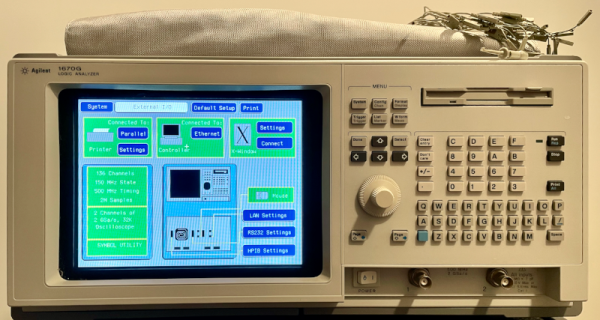
When you think of a logic analyzer today, you might think of a little USB probe that can measure a few signals and decoding for various serial buses. But actual logic analyzers were high-speed multichannel hardware with sophisticated ways to clock and trigger. [Tom] picked up an HP1670G on the surplus market and was impressed that it could sample 136 channels at 500 MHz. The circa-2000 machine has a front panel, but if you really wanted to use it, you wanted to use an X terminal. [Tom] shows us how that works with modern Linux software.

Continue reading “Modern Control Of A Logic Analyzer”

Beyond The Basics: Exploring More Exotic Scope Trigger Modes

Last time, we looked at some powerful trigger modes found on many modern scopes, including the Rigol DHO900 series we used as an example. Those triggers were mostly digital or, at least, threshold-based. This time, we’ll look at some more advanced analog triggers as well as a powerful digital trigger that can catch setup and hold violations. You can find the Raspberry Pi code to create the test waveforms online.

In addition to software, you’ll need to add some simple components to generate the analog waveform. In particular, pin 21 of the Pi connects to  2uF capacitor through a 10K resistor. The other side of the capacitor connects to ground. In addition, pin 22 connects directly to the capacitor, bypassing the 10K resistor. This allows us to discharge the capacitor quickly. The exact values are not especially important.

Runt Triggers

A runt pulse is one that doesn’t have the same voltage magnitude as surrounding pulses. Sometimes, this is due to a bus contention, for example. Imagine if you have some square waves that go from 0 to 5V. But, every so often, one pulse doesn’t make it to 5V. Instead, it stops at 3V.

Continue reading “Beyond The Basics: Exploring More Exotic Scope Trigger Modes”

Temperature Measurement By Wire

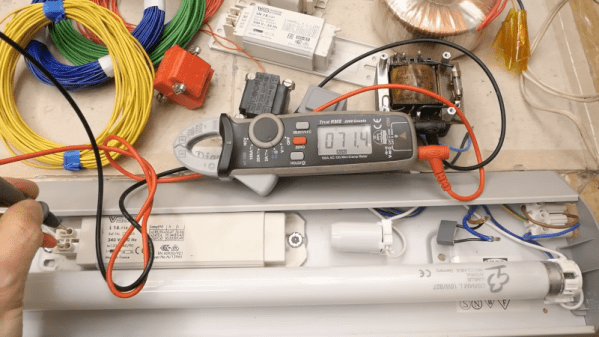
There’s an old joke about how to tell how tall a building is using a barometer. The funniest answer is to find the building owner and offer them a nice barometer in exchange for the information. We wonder if [DiodeGoneWild] has heard that one since his recent video details how to measure temperatures using an ohmmeter.

The idea is that wire changes its resistance based on temperature. So if you know the resistance of a lot of wire — maybe a coil — at room temperature and you can measure the resistance at temperature, it is entirely feasible to calculate the amount of temperature that would cause this rise in resistance.

Of course, there are many ways to measure resistance, too. It’s probably possible to measure parameters like operating current and estimate temperature for at least some circuits. The wire’s material also plays a part, and the online calculator lets you choose copper, aluminum, iron, or tungsten. You also need a lot of wire, a very accurate resistance measurement, or, preferably, both.

There are many ways to accurately measure resistance, of course. Then again, you can also get resistors specifically for the job.

Continue reading “Temperature Measurement By Wire”