New Electric Motor Tech Spins With No Magnets

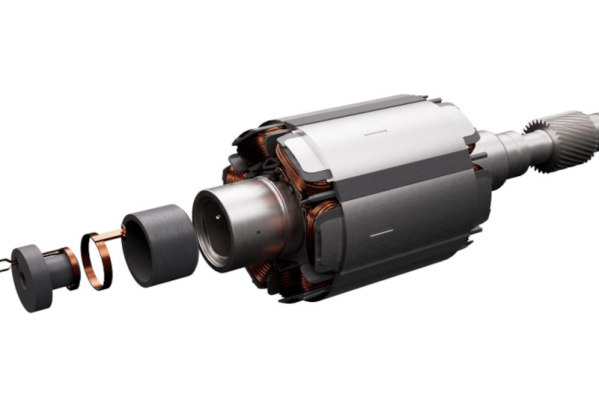
When you think of electric motors, you usually think of magnets. But magnets are heavy, and good magnets can pose problems when you need lots of them. A technology called SESM (separately excited synchronous motors) requires no magnets, but now ZF — a German company — claims to have a different scheme using inductive excitation. Motors that employ SESM tend to be larger and require a direct current to turn the rotor. This DC is often supplied by slip rings or an AC induction with a rectifier. The innovation here is that the inductive excitation is built completely into the shaft, which the company claims makes the motor both compact and powerful.

This kind of motor is usually destined for electric vehicles. The company claims the motor reduces losses by about 15% over conventional techniques. To maximize efficiency, conventional SESM uses slip rings or brushes to transmit power to the shaft. However, ZF claims their inductive improvements are even more efficient and can reduce axial size by around 90 mm.

Another advantage of the technology is that there is no need to provide a dry space for slip rings. That means fewer seals and the ability to cool the rotor with oil as you would with a motor containing permanent magnets. The company plans to offer a 400 V version of the motor and an 800 V that uses silicon carbide electronics.

If you build your own motors, have you tried anything like this? Usually, we don’t see motors this big, of course. We have, however, seen builds of reluctance motors that don’t use magnets.

Industrial Surge Protector Teardown

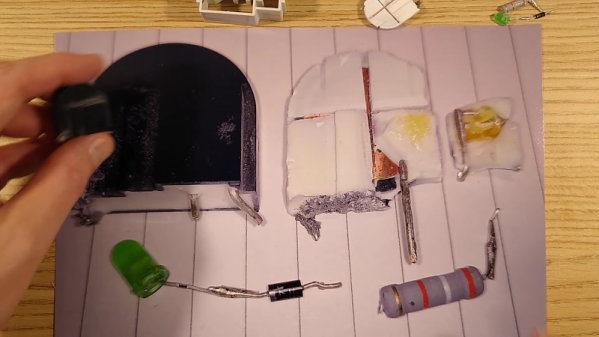
Surge protectors are a common item in the modern household, but the Meanwell unit that [Big Clive] tears apart was clearly intended for commercial use. In fact, he mentions it was made for outdoor signage. Removing the rear panel didn’t help much — the entire unit was potted in resin — but that didn’t stop [Clive]. Removing the resin revealed only a few components surrounded by a sand-like substance.

There’s no circuit board inside. Components are just wired together before potting. The significant player inside is a metal oxide varistor with a thermal fuse. [Clive] draws out a schematic, which is deceptively simple. The two LEDs are an older style of green LED, and he explains why the choice of LED is important in this application. In typical operation, the LEDs light. If a fuse blows, at least one of the LEDs will extinguish.

Not all useful circuits have to be complicated. This is an excellent example of how a simple but well-constructed design can succeed commercially.

Not all surge protectors are built this well. If you need a refresher on how varistors work, we can help with that.

Continue reading “Industrial Surge Protector Teardown”

Tape Is Very, Very Quiet

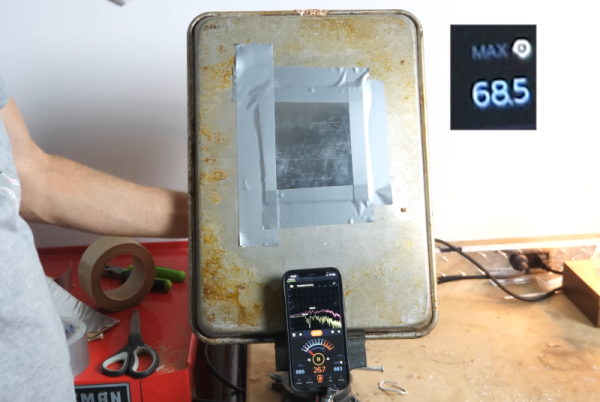
If someone stops by and asks you to help them make some noisy thing less noisy, you probably wouldn’t reach for a roll of tape. But [The Action Lab] shows some 3M tape made for exactly that purpose. For the right kind of noise, it can dampen noise caused by a surface vibrating. You can see how (and why) it works in the video below.

The tape works using a technique known as “constrained layer damping.” Obviously, the tape only works in certain applications. The video explains that it bonds a stiff surface to the vibrating surface using an elastic-like layer. The tape reduces vibrations from things like cymbals and a cookie tin. The noise reduction is both in amplitude and in the duration of the sound, making things noticeably quieter.

You sometimes see a similar material in cars to reduce vibration noise, but we aren’t sure if it uses the same technique. We’ve also seen different kinds of tape used to lower drums’ volume. Reduces the neighbor’s complaints about your practice jam sessions.

This tape reduces noise but can also reduce fatigue wear on metal and composite structures. The downside is it seems extraordinarily expensive. It also doesn’t help that most places want you to buy an entire case, which drives the price even higher. Depending on the size, you can expect to pay about $200 for each 36-yard roll of this tape. But it seems like the principle involved is simple enough that you could make your own, sort of like the video does with the aluminum plate.

Usually, when we talk about noise reduction around here, we mean the electronic kind. Or, sometimes, fungal.

Continue reading “Tape Is Very, Very Quiet”

Rare Arcade Game Teardown And Mods

[Video Game Esoterica] loves a 1990s video game called Operation Tiger. Apparently, there are only a few of these known to exist in 2023, and he managed to find one of them. Well, it is really just a module so he has to figure out how to give it enough input and output to be actually playable. You can see several videos of his work with the Taito game below.

The board has a lot of ICs and a Power PC to handle the 3D graphics. The graphics seem clunky today, but they were impressive for the time. According to the video, the CPU board was only used for this game. The ROM that holds the software is separate with a mix of mask-programmed memory and EPROMs.

The machine is meant to live in an arcade box. So wiring things like coin selectors, video, speakers, and controllers is a non-trivial exercise. The wiring paid off, though, as the board started up but with no buttons, it wasn’t able to start in the first video. The controls go through a 60-pin connector and he tackles that project in part two.

The next step is to actually update the game software, which is hard but possible. Of course, you can run many of these old games with MAME or, if you prefer, use it to score that primo engineering workstation you used to covet.

Continue reading “Rare Arcade Game Teardown And Mods”

Linux Fu: Build A Better Ls

Ask someone to name all the things they can find in a room. Only a few will mention air. Ask a Linux command line user about programs they use and they may well forget to mention ls. Like air, it is seemingly invisible since it is so everpresent. But is it the best it can be? Sure, you can use environment variables and aliases to make it work a little nicer, but, in fact, it is much the same ls we have used for decades. But there have always been moves to make better ls programs. One of them, exa, was recently deprecated in favor of one of its forks, eza.

One thing we liked about eza is that it is a single file. No strange installation. No multiple files to coordinate. Put it on your path, and you are done. So installation is easy, but why should you install it?

Continue reading “Linux Fu: Build A Better Ls”

Homebrew Linear Actuators Improved

[Harrison Low] published some 3D-printed linear actuators, which generated a lot of interest. He got a lot of advice from people on the Internet, and he took it to heart. The result: an improved version that you can see in the video below.

The original design used carbon fiber and Kevlar and was quite stiff. The actuators could move very fast, which was important to [Harrison]. However, they were also prone to wear and had issues with the force required to assemble them. He also wanted the design to be more modular to facilitate repair. The new design removes the bowden tubes, and the resulting actuator is both easier to assemble and easier to service.

Continue reading “Homebrew Linear Actuators Improved”

Will RadioShack Return?

We suspect that if you want to write a blockbuster movie or novel, the wrong approach is to go to a studio or publisher and say, “I have this totally new idea that is like nothing you’ve ever seen before…” Even Star Trek was pitched to the network as “Wagon Train to the stars.” People with big money tend to want to bet on things that have succeeded before, which is why so many movies are either remakes or Star Trek XXII: The Search for 4 PM Dinner Specials. Maybe that’s what the El Salvador-based Unicomer Group had in mind when they bought one of our favorite brands, RadioShack. They are reportedly planning a major comeback for the beleaguered brand both online and in the physical world.

In all fairness, the Shack may be better in our memories than in our realities. It was handy to stop off and pick up a coax connector, even if it cost three times the going rate for one. There was a time when RadioShack offered reasonable parts for projects, and it seems like near the end, they tried to hit that target again, but for many years, you could not find the typical parts for a modern project there anyway. However, Unicomer isn’t just a random group of investors.

Continue reading “Will RadioShack Return?”