Rising To The Occasion: A Brief History Of Crewed High Altitude Balloons

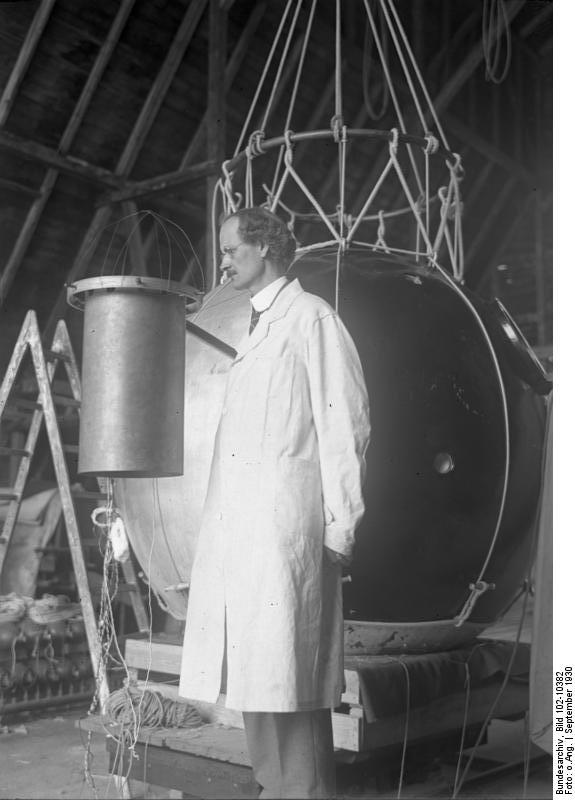
Piccard inspects an instrument on his balloon (Image: Bundesarchiv, Bild 102-10382 / CC-BY-SA 3.0)

We think of human flight as a relatively modern affair, with a few claims to the first airplane all around the turn of the last century. But people flew much earlier than that by using hot air balloons as well as gas-filled ones. While the Montgolfier brothers get most of the credit for hot air ballooning in 1783, there are some reports that a Brazilian priest may have lifted himself with a balloon as early as 1709.

Regardless, we’ve had balloons a good century earlier than winged flight, if not longer. While the device is deceptively simple, it is possible to get a balloon to very high altitudes without a lot of specialized technology. Airplanes at high altitudes need a way to get enough oxygen to fuel their engines, or they have to rely on rockets. Either way, there are plenty of design and operational challenges.

Balloons, of course, can simply rise to the occasion. Auguste Piccard and an assistant took a gas-filled balloon to 15,781 meters in 1931. Their gondola was pressurized, and they were the first humans to see the curvature of the Earth and the dark sky above. That record wouldn’t stand for long, though.

CCCP-1

The Soviet Union was keenly interested in Piccard’s flight, and the Soviet Air Force set about to build a research vessel, CCCP-1 (in English, USSR-1), that flew in 1933. The envelope was a large amount of thin fabric impregnated with latex and filled with hydrogen. The air-tight gondola presented several challenges in design. Most of the science experiments were outside, of course, and in 1933, you didn’t have an Arduino and RC servos to control things.

Continue reading “Rising To The Occasion: A Brief History Of Crewed High Altitude Balloons”

Parametric Design With Tinkercad

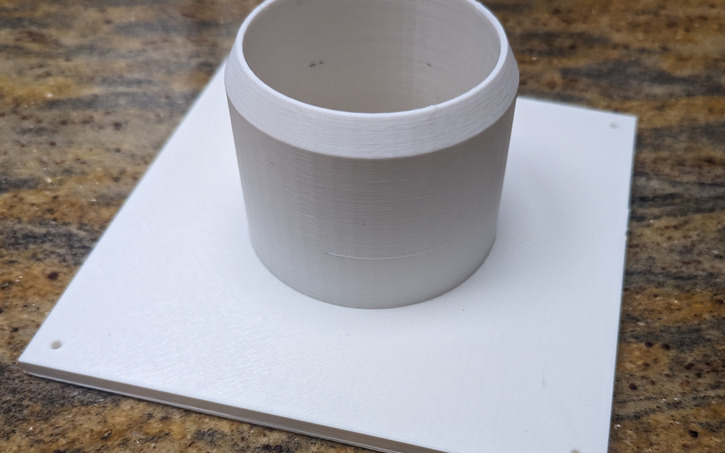
Tinkercad is like the hamburger helper of 3D design. You hate to admit you use it, and you know you should put in more effort, but — darn it — it’s easy, and it tastes pretty good. While I use a number of CAD programs for serious work, sometimes, when I just want a little widget like a flange for my laser cutter’s exhaust, it is just easier to do it in a few minutes with Tinkercad. However, I heard someone complaining the other day that it wasn’t of any use anymore because they took away custom shape generators. That statement is only partially true. Codeblocks allow you to easily create custom parametric items for use in Tinkercad.

A Tinkercad-designed flange

There was a time when you could write Javascript to create custom shapes, and it is true that they removed that feature. However, they replaced it with Codeblocks which is much easier to use for their target audience — young students — and still very powerful.

If you’ve used parametric design in a professional package or even used something like OpenSCAD, you probably don’t need to be sold on the benefit. This is, of course, a simple form of it, but the idea is to define things as mathematical relationships. As an example, suppose you have a front panel with two rows of four holes for switches evenly spaced and centered. That would be easy to draw. But if you later decide the top row needs five holes and the bottom only needs three, it will be a fair amount of work. But if you have the math defining it right, you change a few variables, and the computer does the rest. Continue reading “Parametric Design With Tinkercad”

$60 Robot Arm Is Compact

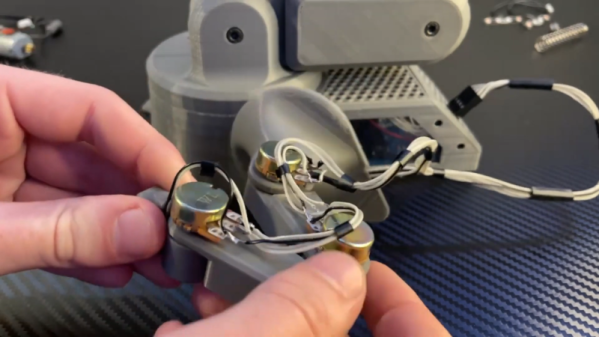
Thanks to 3D printing and inexpensive controllers, a robot arm doesn’t need to break the bank anymore. Case in point? [Build Some Stuff] did a good-looking compact arm with servos for under $60. The arm uses an interesting control mechanism, too.

Instead of the traditional joystick, the arm has a miniature arm with potentiometers at each joint instead of motors. By moving the model arm to different positions, the main arm will mimic your motions. It is similar to old control systems using a synchro (sometimes called a selsyn), but uses potentiometers and servo motors.

Continue reading “$60 Robot Arm Is Compact”

OSI Superboard II Replicated

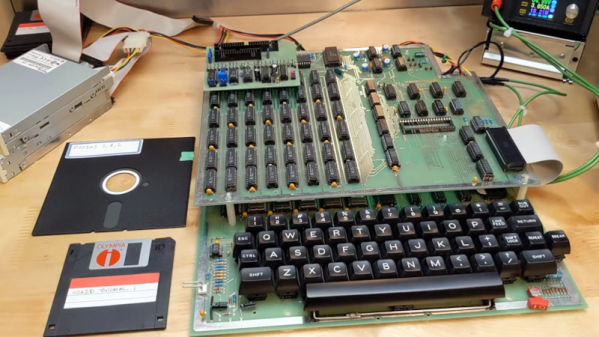
While our modern computer can easily emulate a lot of different old machines, there is something about having replica hardware that is even better. Not as nice as having the real thing, in some ways, although you don’t have to worry about wear and tear on a replica, either. [Jeff Tranter] has built a kit replica of an Ohio Scientific Superboard II, and it looks great, as you can see in the video below.

This was an inexpensive all-in-one 6502 computer with a keyboard and provision for TV or monitor output. If you had a 5V power supply, a cassette deck, and a TV you were in business for less money than most of the comparable alternatives. In fact, [Jeff] has the canceled check where his parents paid $486 Canadian for one in 1981. That was his introduction to computing, and we’d say that was a reasonable investment on the part of his parents.

Continue reading “OSI Superboard II Replicated”

The Shuttle Engine Needed 3D Printing, But…

If we asked you to design a circuit to blink a flashing turn signal, you would probably reach for a cheap micro or a 555. But old cars used bimetallic strips in a thermomechanical design. Why? Because, initially, 555s and microcontrollers weren’t available. [Breaking Taps] has the story of NASA engineers who needed some special cooling chambers in a rocket design for the Space Shuttle. Today you’d 3D print them, but in the 70s, that wasn’t an option. So they used wax. You can see a video about the process, including a build of a model rocket engine, in the video below.

The issue is the creation of tiny cooling channels in the combustion chamber. You can use additional thin pipes brazed onto the engine. However, there are several disadvantages to doing this way, but early rocket engines did it anyway. Having the cooling path integrated into the system would be ideal, but without 3D printing, it seems difficult to do. But not impossible.

Continue reading “The Shuttle Engine Needed 3D Printing, But…”

Air Hockey Solitaire

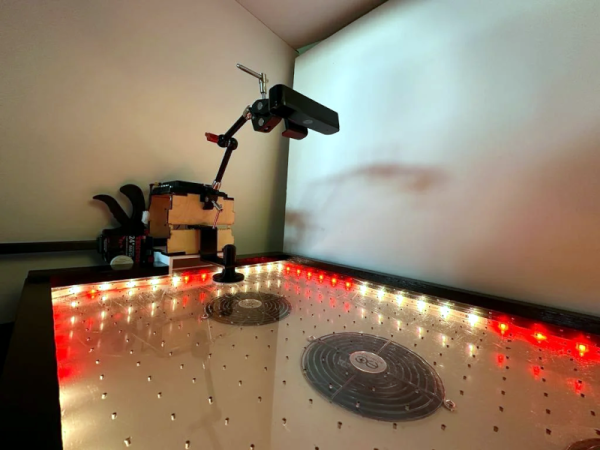
While air hockey is a fine amusement, it isn’t much fun if you can’t find someone to play against. Unless that is, you build a mini table with a robotic defender. [Vaib], [Nathan], and [Navish] can show you how. There is a video you can see below that shows two players using the table without the robot.

The project takes a bit of woodworking, as you might expect. You also have to drill 576 holes for the air to lift the puck. Some of the components are 3D printed in PETG, too. The automated defense uses a camera and relies on the fact that the puck is the only red thing on the table. A servo moves to intercept the incoming puck and return the shot. We were disappointed the video didn’t show the automated play.

We wondered if they had considered making a pair of the detachable robots and letting them play with each other. If you prefer football, the robot could probably adapt. We’ve seen other robot air hockey contenders, so maybe a better idea would be to build different robots and let them compete for a gold medal.

Continue reading “Air Hockey Solitaire”

The Cyber Resilience Act Threatens Open Source

Society and governments are struggling to adapt to a world full of cybersecurity threats. Case in point: the EU CRA — Cyber Resilience Act — is a proposal by the European Commission to enact legislation with a noble goal: protect consumers from cybercrime by having security baked in during design. Even if you don’t live in the EU, today’s global market ensures that if the European Parliament adopts this legislation, it will affect the products you buy and, possibly, the products you create. In a recent podcast, our own [Jonathan Bennett] and [Doc Searles] interview [Mike Milinkovich] from the Eclipse Foundation about the proposal and what they fear would be almost a death blow to open source software development. You can watch the podcast below.

If you want some background, you can read the EU’s now closed request for comments and the blog post outlining the problems from opensource.org. At the heart of the issue is the need for organizations to self-certify their compliance with the act. Since open source is often maintained by a small loose-knit group of contributors, it is difficult to see how this will work.

Continue reading “The Cyber Resilience Act Threatens Open Source”