My Glasses Hear Everything I’m Not Saying!

There was a time when you saw someone walking down the street talking to no one, they were probably crazy. Now you have to look for a Bluetooth headset. But soon they may just be quietly talking to their glasses. Cornell University researchers have EchoSpeech which use sonar-like sensors in a pair of glasses to watch your lips and mouth move. From that data, they can figure out what you are saying, even if you don’t really say it out loud. You can see a video of the glasses below.

There are a few advantages to a method like this. For one thing, you can speak commands even in places where you can’t talk out loud to a microphone. There have been HAL 9000-like attempts to read lips with cameras, but this is power-hungry and video tends to be data intensive.

Continue reading “My Glasses Hear Everything I’m Not Saying!”

Dyson Hair Dryer Becomes Jet Engine

While Dyson makes some good products, they aren’t known for being economical. Case in point: [Integza] spent $500 on a hair dryer. While he does have a fine head of hair, we suspected he wasn’t after it for its intended purpose, and we were right. It turns out he wanted to make it into a jet engine! Why? Oh, come on. The fact that you read Hackaday means you don’t need that question answered. Watch the video below to see how it all turned out.

What got [Integza]’s attention was the power of the very small motor. So he immediately, of course, opened it up. The build quality is very impressive, although for $500, shouldn’t it be? While we are sure the Dyson dryer is more robust than our $9 Revlon special, it seems doubtful that it would handle the high temperatures of a jet exhaust. In fact, he’s had plastic meltdown while trying to build a jet before. So this time, he had a different plan.

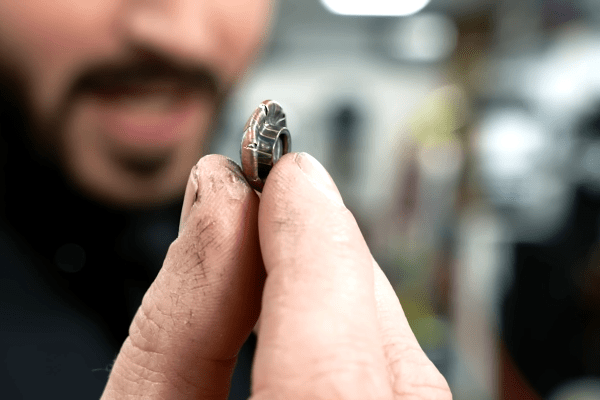
That plan involved designing a replacement shell for the dryer and having it 3D printed in metal, which may have cost almost as much or more than the dryer. It came out great, though — and some fuel lines and a spark plug later, he was ready to fire it up.

Did it work? You bet. Test equipment was melted accidentally, and eventually, the engine looked like it flamed out. But it generated some very hot exhaust. We’d like to say that no tomatoes were harmed during the production of the video, but we can’t because of our well-developed sense of ethics. Poor tomatoes! We might have used a Mr. Bill doll, but that probably infringes on someone’s copyright.

If you don’t want so much melting, maybe try water cooling. If you could make this reliable, the modification to your car becomes obvious.

Continue reading “Dyson Hair Dryer Becomes Jet Engine”

The Real John Wick-Style Bullet Proof Suit

If you’ve seen the John Wick movies, you’ve probably had to suspend your disbelief about many things, but the bulletproof suits are perhaps the hardest thing to swallow. They look like stylish suits but are impervious to just about anything at any range. What’s more is when you are hit, they seem to absorb all impact with no effect on the wearer at all.

You can keep running, firing, or karate kicking while the suit takes all of the bullets. You can even pull your jacket up over your face if you want to protect that million-dollar smile. Physics, of course, tells us that a suit like this is pretty much impossible. Except that they actually exist. Granted, the real-life suits don’t have the magic physics-defying powers of Mr. Wick’s suit, but if you have the cash, you can get a smart-looking suit that protects you from getting killed by a bullet.

Real Life, Part I

In the movies, the suits supposedly have Kevlar in them just like a real piece of ballistic body armor. The problem is, Kevlar is bulky. However, most of the real body armor you see — like a vest on a SWAT team operative — is made from Kevlar or similar ballistic fibers like Twaron, Goldflex, or Dyneema. They also have plates made of metal or ceramic. Continue reading “The Real John Wick-Style Bullet Proof Suit”

Debouncing For Fun And… Mostly, Just For Fun

In our minds and our computer screens, we live in an ideal world. Wires don’t have any resistance, capacitors don’t leak, and switches instantly make connections and break them. The truth is, though, in the real world, none of those things are true. If you have a switch connected to a lightbulb, the little glitches when you switch are going to be hard to notice. Hook that same switch up to a processor that is sampling it constantly, and you will have problems. This is the classic bane of designing microcontroller circuits and is called switch bounce. [Dr. Volt] covers seven different ways of dealing with it in a video that you can see below.

While you tend to think of the problem when you are dealing with pushbuttons or other kinds of switches for humans, the truth is the same thing occurs anywhere you have a switch contact, like in a sensor, a mechanical rotary encoder, or even relay contacts. You can deal with the problem in hardware, software, or both.

Continue reading “Debouncing For Fun And… Mostly, Just For Fun”

Homemade Scope Does Supercapacitor Experiments

We’ve always been a little sad that supercapacitors aren’t marked with a big red S on a yellow background. Nevertheless, [DiodeGoneWild] picked up some large-value supercapacitors and used his interesting homemade oscilloscope to examine how they worked. You can watch what he is up to in his workshop in the video below.

Supercapacitors use special techniques to achieve very high capacitance values. For example, the first unit in the video is a 500 F capacitor. That’s not a typo — not microfarads or even millifarads — a full 500 Farads. With reasonable resistance, it can take a long time to charge 500F, so it is easier to see the behavior, especially with the homemade scope, which probably won’t pick up very fast signals.

For example, A 350 mA charging current takes about an hour to bring the capacitor up to 2.6 V, just under its maximum rating of 2.7 V. Supercapacitors usually have low voltage tolerance. Their high capacity makes them ideal for low-current backup applications where you might not want a rechargeable battery because of weight, heat, or problems with long-term capacity loss.

The real star of the video, though, is the cast of homemade test equipment, including the oscilloscope, a power supply, and a battery analyzer. To be fair, he also has some store-bought test gear, too, and the results seem to match well.

Supercapacitors are one of those things that you don’t need until you do. If you haven’t had a chance to play with them, check out the video or at least watch it to enjoy the homebrew gear. We usually look to [Andreas Spiess] for ESP32 advice, but he knows about supercaps, too. If you really like making as much as you can, you can make your own supercapacitors.

Continue reading “Homemade Scope Does Supercapacitor Experiments”

Russia’s New Mystery Shortwave Station

The Buzzer, also known as UVB-76 or UZB-76, has been a constant companion to anyone with a shortwave radio tuned to 4625 kHz. However, [Ringway Manchester] notes that there is now a second buzzer operating near in frequency to the original. Of course, like all mysterious stations, people try to track their origin. [Ringway] shows some older sites for the Buzzer and the current speculation on the current transmitter locations.

Of course, the real question is why? The buzzing isn’t quite nonstop. There are occasional voice messages. There are also jamming attempts, including one, apparently, by Pac Man.

Some people think the new buzzer is an image, but it doesn’t seem to be the same signal. The theory is that the buzzing is just to keep the frequency clear in case it is needed. However, we wonder if it isn’t something else. Compressed data would sound like noise.  Other theories are that the buzzing studies the ionosphere or that it is part of a doomsday system that would launch nuclear missiles. Given that the signal has broken down numerous times, this doesn’t seem likely.

What’s even stranger is that occasional background voices are audible on the signal. That implies that buzzing noise isn’t generated directly into the transmitter but is a device in front of a microphone.

We’ve speculated on the buzzer and the jamming efforts around it before. Not exactly a numbers station, but the same sort of appeal.

Continue reading “Russia’s New Mystery Shortwave Station”

Reactivating A Harris RF-130 URT-23 Transmitter

If you enjoy old military hardware, you probably know that Harris made quite a few heavy-duty pieces of radio gear. [K6YIC] picked up a nice example: the Harris RF-130 URT-23. These were frequently used in the Navy and some other service branches to communicate in a variety of modes on HF. The entire set included an exciter, an amplifier, an antenna tuner, and a power supply and, in its usual configuration, can output up to a kilowatt. The transmitter needs some work, and he’s done three videos on the transmitter already. He’s planning on several more, but there’s already a lot to see if you enjoy this older gear. You can see the first three below and you’ll probably want to watch them all, but if you want to jump right to the tear down, you can start with the second video.

You can find the Navy manual for the unit online, dated back to 1975. It’s hard to imagine how much things have changed in 50 years. These radios use light bulbs and weigh almost 500 pounds. [Daniel] had to get his shop wired for 220 V just to run the beast.

It is amusing that some of this old tube equipment had a counter to tell you how many hours the tubes inside had been operating so you could replace them before they were expected to fail. To keep things cool, there’s a very noisy 11,000 RPM fan. The two ceramic final amplifier tubes weigh over 1.5 pounds each!

The third video shows the initial power up. Like computers, if you remember when equipment was like this, today’s lightweight machines seem like toys. Of course, everything works better these days, so we won’t complain. But there’s something about having a big substantial piece of gear with all the requisite knobs, switches, meters, and everything else.

We can’t wait to see the rest of the restoration and to hear this noble radio on the air again. You can tell that [Daniel] loves this kind of gear and you can pick up a lot of tips and lingo watching the videos.

Continue reading “Reactivating A Harris RF-130 URT-23 Transmitter”