Ask Hackaday: What’s Going On With Mazdas In Seattle?

What hacker doesn’t love a puzzle? We have a doozy for you. According to KUOW — the NPR affiliate in Seattle — they have been getting an unusual complaint. Apparently, if you drive a Mazda made in 2016 and you tune to KUOW, your radio gets stuck on their frequency, 94.9 MHz, and you can’t change it.

According to a post from the radio station, it doesn’t just affect the FM radio. A listener named Smith reported:

“I tried rebooting it because I’ve done that in the past and nothing happened,” Smith said, “I realized I could hear NPR, but I can’t change the station, can’t use the navigation, can’t use the Bluetooth.”

Continue reading “Ask Hackaday: What’s Going On With Mazdas In Seattle?”

How Can 335 Horses Weigh 63 Pounds?

Koenigsegg, the Swedish car company, has a history of unusual engineering. The latest innovation is an electric motor developed for its Gemera hybrid vehicle. The relatively tiny motor weighs 63 pounds and develops 335 horsepower and 443 lb-ft of torque. Dubbed the Quark, the motor uses both radial and axial flux designs to achieve these impressive numbers.

There is a catch, of course. Like most EV motors, those numbers are not sustainable. The company claims the motor can output peak power for 20 seconds and then drops to 134 horsepower/184 lb-ft of torque. The Gemera can supplement, of course, with its internal combustion engine — a 3 cylinder design.

Continue reading “How Can 335 Horses Weigh 63 Pounds?”

IBM Eagle Has A Lot Of Qubits

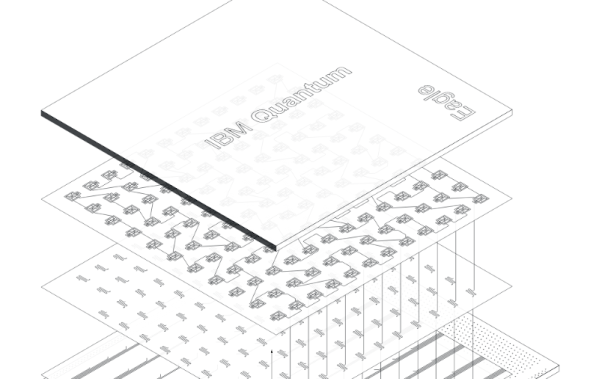
How many qubits do you need in a quantum computer? Plenty, if you want to anything useful. However, today, we have to settle for a lot fewer than we would like. But IBM’s new Eagle has the most of its type of quantum computer: 127-qubits. Naturally, they plan to do even more work, and you can see a preview of “System Two” in the video below.

The 127 qubit number is both impressively large and depressingly small. Each qubit increases the amount of work a conventional computer has to do to simulate the machine by a factor of two. The hope is to one day produce quantum computers that would be impractical to simulate using conventional computers. That’s known as quantum supremacy and while several teams have claimed it, actually achieving it is a subject of debate.

Like any computer, more bits — or qubits — are better than fewer bits, generally speaking. However, it is especially important for modern quantum systems since most practical schemes require redundancy and error correction to be reliable in modern implementations of quantum computer hardware. What’s in the future? IBM claims they will build the Condor processor with over 1,000 qubits using the same 3D packaging technology seen in Eagle. Condor is slated for 2023 and there will be an intermediate chip due in 2022 with 433 qubits.

Scaling anything to a large number usually requires more than just duplicating smaller things. In the case of Eagle and at least one of its predecessors, part of the scaling was to use readout units that can read different qubits. Older processors with just a few qubits would have dedicated readout hardware for each qubit, but that’s untenable once you get hundreds or thousands of qubits.

Qubits aren’t the only measure of a computer’s power, just like a conventional computer with more bits might be less capable than one with fewer bits. You also have to consider the quality of the qubits and how they are connected.

Who’s going to win the race to quantum supremacy? Or has it already been won? We have a feeling if it hasn’t already been done, it won’t be very far in the future. If you think about the state of computers in, say, 1960 and compare it to today, about 60 years later, you have to wonder if that amount of progress will occur in this area, too.

Most of the announcements you hear about quantum computing come from Google, IBM, or Microsoft. But there’s also Honeywell and a few other players. If you want to get ready for the quantum onslaught, maybe start with this tutorial that will run on a simulator, mostly.

Continue reading “IBM Eagle Has A Lot Of Qubits”

As Light As Plastic; As Strong As Steel

Chemical engineers at MIT have pulled off something that was once thought impossible. By polymerizing material in two different directions at once, they have created a polymer that is very strong. You can read a pre-print version of the paper over on Arxiv.

Polymers owe many of their useful properties to the fact that they make long chains. Molecules known as monomers join together in strings held together by covalent bonds. Polymer chains may be cross-linked which changes its properties, but it has long been thought that material that had chains going through the X and Y axis would have desirable properties, but making these reliably is a challenge.

Part of the problem is that it is hard to line up molecules, even large monomers. If one monomer in the chain rotates a bit, it will create a defect in the 2D structure and that defect will grow rapidly as you add more monomers. The new technique is relatively easy to do and is irreversible which is good because reversible chains tend to have undesirable characteristics like low chemical stability. Synthesis does require a few chemicals like melamine, calcium chloride, pyridine, and trimesic acid. Along with N-Methyl-2-pyrrolidone, the mixture eventually forms a gel. The team took pieces of gel and soaked it in ethanol. With some filtering, ultrasonics, centrifuging, and washing with water and acetone, the material was ready for vacuum drying and was made into a powder.

The powder is dissolved in acid and placed on a spinning silicon wafer to form a polymerized nanofilm. Other 2D films have been produced, of course, such as graphene, but polymer films may have a number of applications. In particular, in contrast to conventional polymers, sheets of this material are impermeable to gas and liquid, which could make it very useful as a coating.

According to the MIT press release, the film’s elastic modulus is about four and six times greater than that of bulletproof glass. The amount of force required to break the material is about twice that of steel. It doesn’t sound like this material will be oozing out of our 3D printers anytime soon. But maybe one day you’ll be able to get 2D super-strong resin.

For all their faults, conventional polymers changed the world as we know it. Some polymers occur naturally, and some use natural ingredients, too.

Twist Promises Easier Quantum Programming

We keep trying to learn more about quantum computers. But the truth is, the way we program quantum computers — or their simulators — today will probably not have much in common with how we program them in the future. Think about it. Programming your PC is nothing like programming the ENIAC. So we expect we’ll see more and more abstractions over the “bare metal” quantum computer. The latest of these is Twist, from MIT.

According to the paper (and the video, below), Twist expresses entangled data and processes in a way that traditional programmers can understand. The key concept is known as “purity” of expressions which helps the compiler determine if data is actually entangled with another piece of data or if any potential entanglement is extraneous. A pure expression only depends on qubits it owns, while a mixed expression may use qubits owned by other expressions.

Continue reading “Twist Promises Easier Quantum Programming”

Conveyor Belt Printer Mod Is Nearly All Printed

[Call Me Swal] wanted to experiment with large 3D prints. So he took a Hornet 3D printer and  designed a lot of 3D parts to convert it into an “infinite” conveyor belt printer. It looks like — as you can see in the video below — that all the parts are 3D printed but you will still need to buy material for the actual belt.

Of course, you may not have a Hornet, but the idea would be applicable to just about any similar printer. You’d have to, of course, adapt or redesign the parts.

Continue reading “Conveyor Belt Printer Mod Is Nearly All Printed”

3D Printing Goes Near Infrared

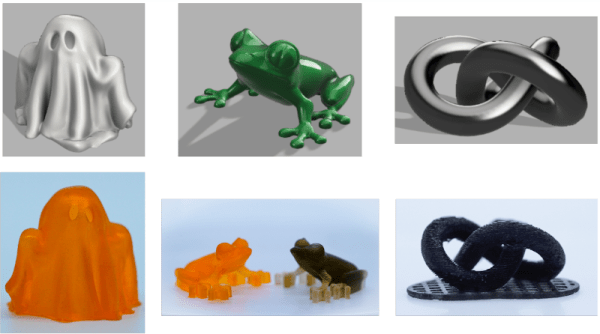
Researchers at the University of Texas have been experimenting with optical 3D printing using near infrared (NIR) light instead of the more traditional ultraviolet. They claim to have a proof of concept and, apparently, using NIR has many advantages. The actual paper is paywalled, but there are several good summaries, including one from [3D Printing Industry].

UV light degrades certain materials and easily scatters in some media. However, decreasing the wavelength of light used in 3D printing has its own problems, notably less resolution and slower curing speed. To combat this, the researchers used an NIR-absorbant cyanine dye that exhibits rapid photocuring. The team reports times of 60 seconds per layer and resolution as high as 300 micrometers. Nanoparticles in the resin allow tuning of the part’s appearance and properties.

Continue reading “3D Printing Goes Near Infrared”