Tiny 3D Printed Magnets Show Patterns

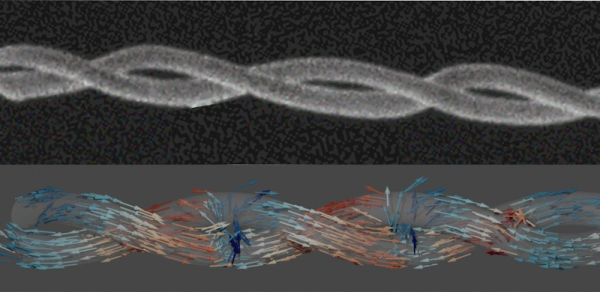
You normally associate a double helix with DNA, but an international team headquartered at Cambridge University used 3D printing to create magnetic double helixes that are about a 1,000 times smaller than a human hair. Why do such a thing? We aren’t sure why they started, but they were able to find nanoscale topological features in the magnetic field and they think it will change how magnetic devices work in the future — especially magnetic storage devices.

In particular, researchers feel this is a step towards practical “racetrack” memory that stores magnetic information in three dimensions instead of two and offer high density and RAM-like access times. You can read the full paper if you want the gory details.
Continue reading “Tiny 3D Printed Magnets Show Patterns” →

Lisp In 436 Bytes

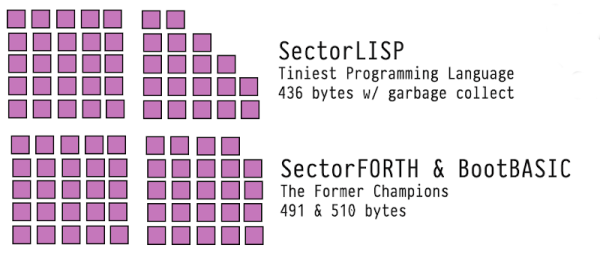
You would assume that any programming language available back in the 1960s would be small enough to easily implement on today’s computers. That’s not always true though, since old languages sometimes used multiple passes. But in some cases, you can implement what would have been a full language decades ago in a tiny footprint. A case in point is a pretty good implementation of Lisp — including garbage collection — in 436 bytes.

SectorLISP claims to be the tiniest real language, beaten only by toy languages that are not really very useful. If you want to, you can try it in your browser, but that version has better error messages and persistent bindings, so it hogs up a whole 509 bytes.

Continue reading “Lisp In 436 Bytes” →

OpenCV Knows Where Your Hand Is

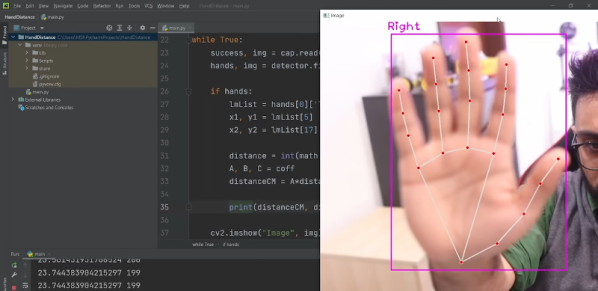
We have to say, [Murtaza]’s example game in his latest video isn’t very exciting. However, the OpenCV technique he uses to track a hand and determine its distance from a single camera is pretty interesting. The demo shows a random button on the screen and you have to use your hand to press the button which then moves so you can try again. The hand measurement seems accurate to a few centimeters which is good enough for many applications.

The Python code is actually quite straightforward. Essentially, the software tracks your hand and by estimating its relative size to determine how far away it is. Of course, your hand might also rotate, and [Murtaza] works through all the cases step-by-step. If we wanted to know a distance, we’d probably turn to ultrasonics or a time of flight sensor. The problem is, those sensors can’t tell your hand from anything else that happens to be in front of it. The use of a single camera to track and locate is pretty impressive.

If you haven’t used OpenCV before, the channel has a lot of tutorials and they are all worth watching. Computer vision is a great technique and can replace a lot of things in some applications. GPS, for example. Or, try this creepier tracking application next Halloween.

Continue reading “OpenCV Knows Where Your Hand Is” →

Experiments With A Nernst Lamp

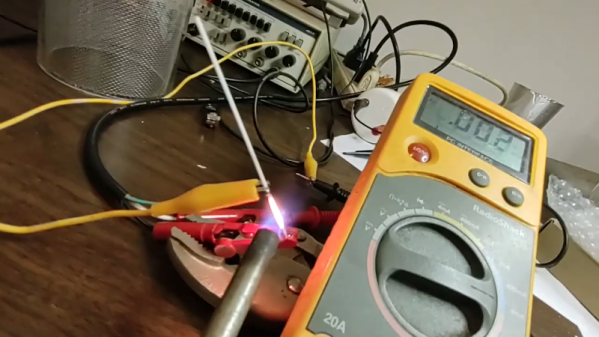
Every biography of Edison talks about how the secret to the incandescent lamp was to remove the air from the bulb. That’s true when you use conventional filaments, but a man named Nernst found that using a filament that was already oxidized would allow you to create a lamp that would operate fine in the normal atmosphere. [Jaynes Network] takes a look at these oddities which date back to the 1800s in a recent video that you can see below.

The lamps use a ceramic filament, but the downside is that the filament needs to be hot to allow the lamp to work. The experiment takes a zirconium oxide rod and attempts to light it up. The heat source is a propane torch.

Continue reading “Experiments With A Nernst Lamp” →

New Holographic Display Hacks The Light Field

[Petapixel] has an interesting post about a startup company’s new holographic display that claims to be “indistinguishable from reality.” The company behind it, Light Field Labs, claims their system requires no glasses and handles different angles.

You can see a bit in the [C|Net] video below, but — of course — being on YouTube, you can’t get a sense for how good the 3D effect is.

Continue reading “New Holographic Display Hacks The Light Field” →

Frame Antenna Works The Low Bands

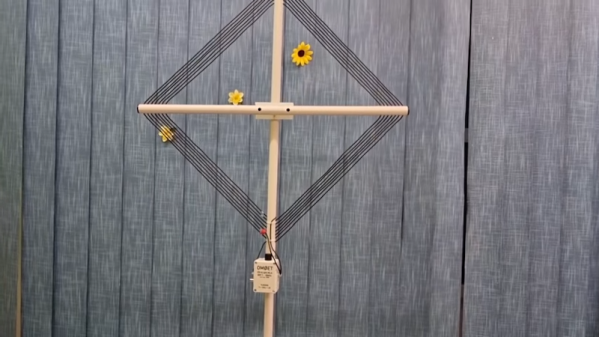
The lower the frequency of radio transmission, the more antenna that will be needed in general. [OM0ET] wanted to work the 80M to 20M ham bands and decided to turn to a frame antenna. You can see the project in the video below.

The antenna looks a lot like a magnetic loop antenna. The one in the video has seven loops forming a 520mm square. The loop is, of course, an inductor and by removing some insulation, the operator can clip a lead at different points to control the inductance. A variable capacitor resonates the antenna, so there is definitely tuning required.

Continue reading “Frame Antenna Works The Low Bands” →

Tech In Plain Sight: Primitive Engineering Materials

It isn’t an uncommon science fiction trope for our hero to be in a situation where there is no technology. Maybe she’s back in the past or on a faraway planet. The Professor from Gilligan’s Island comes to mind, too. I’d bet the average Hacakday reader could do pretty well in that kind of situation, but there’s one thing that’s often overlooked: materials. Sure, you can build a radio. But can you make wire? Or metal plates for a capacitor? Or a speaker? We tend to overlook how many abstractions we use when we build. Even turning trees into lumber isn’t a totally obvious process.

People are by their very nature always looking for ways to use the things around them. Even 300,000 years ago, people would find rocks and use them as tools. It wasn’t long before they found that some rocks could shape other rocks to form useful shapes like axes. But the age of engineered materials is much younger. Whether clay, metal, glass, or more obviously plastics, these materials are significantly more useful than rocks tied to sticks, but making them in the first place is an engineering story all on its own.

Continue reading “Tech In Plain Sight: Primitive Engineering Materials” →