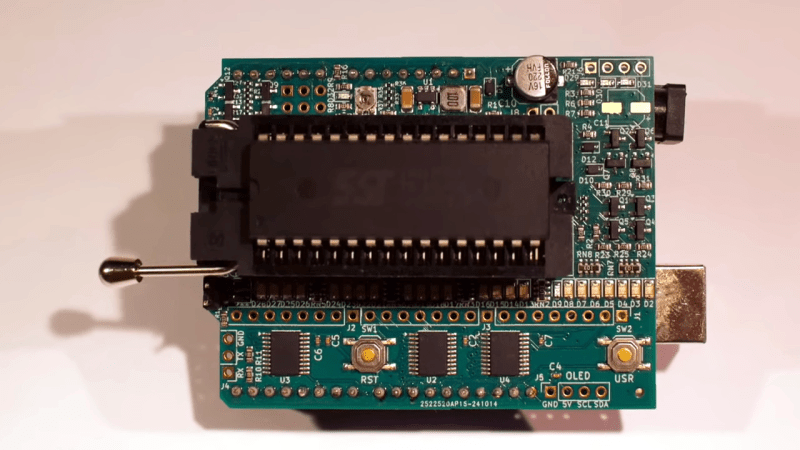
From the “why didn’t we think of that” department comes [dupontgu’s] pong mouse project. The mouse appears and acts like a normal computer mouse until you click the scroll wheel. When you do, the mouse rapidly moves the cursor on the connected computer to play pong. Obviously, though, the paddles and the ball all look like your cursor, whatever that happens to be. So, how do you tell the score? Well, when a score happens, the cursor shows between the two paddles. In the middle means the game is tied. Otherwise, the player closest to the score indicator is winning. Continue reading “Mouse Doesn’t Play Pong… It IS Pong!”
Author: Al Williams4349 Articles
The First Real Sputnik
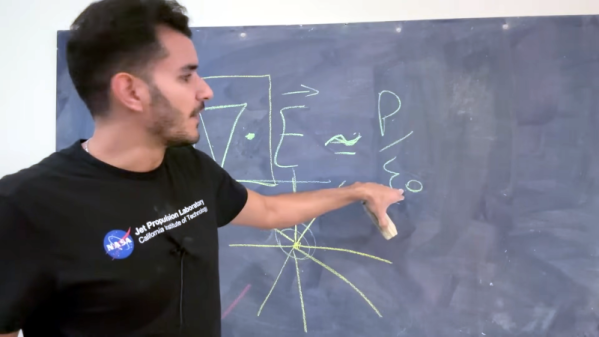
Americans certainly remember Sputnik. At a time when the world was larger and scarier, the Soviets had a metal basketball flying over the United States and the rest of the world. It made people nervous, but it was also a tremendous scientific achievement. However, it wasn’t the plan to use it as the first orbiter, as [Scott Manley] explains in a recent video that you can see below.
The original design would become Sputnik 3, which, as [Scott] puts it, was the first Soviet satellite that “didn’t suck.” The first one was essentially a stunt, and the second one had an animal payload and thermal problems that killed the canine occupant, [Laika].
Vintage Crystal Radio Draws The Waves
The classic crystal radio was an oatmeal box with some wire and a few parts. [Michael Simpson] has something very different. He found an assembled Philmore “selective” radio kit. The simple kit had a coil, a germanium diode, and a crystal earphone.
We were sad when [Michael] accidentally burned a part of the radio’s coil. But–well–in the end, it all worked out. We’ll just say that and let you watch for yourself. The radio is simplicity itself, built on a wooden substrate with a very basic coil and capacitor tuned circuit. Continue reading “Vintage Crystal Radio Draws The Waves”
Obscure Sci Fi Robots
Even if you don’t like to build replicas of movie robots, you can often draw inspiration from cinema. Everyone knows Robby the Robot, Gort, and R2D2. But [Atomic Snack Bar] treats us to some lesser-known robots from movies in the 1930s, 40s, and 50s. While we are pretty up on movies, we have to admit that the video, which you can see below, has a few we didn’t know about.
The robots are mostly humanoid. The comedy vampire flick from the 1950s could have inspired Robby, who appeared four years later. The exception that proves the rule is the Twonky which was a TV set turned robot turned mind controller.
Old Time Stereographs Get New Photos
In the late 1800s, the stereograph — sometimes incorrectly called a stereopticon — was a big craze. You’d view two side-by-side images through some lenses and see a three-dimensional image. This, of course, later would morph into View-Masters and, eventually, virtual reality headsets. But if you have an old stereograph, where do you get new images for it? If you are [Engineers Need Art], you write a program to convert MPO files (a common 3D image format) to printable stereograms. Interestingly, he used AI to assist in the project and has observations about where it helped and where it didn’t.
The post goes into a lot of detail about how the author experimented with 3D imaging for many years. However, it eventually discusses a MacOS application built with the help of an AI chatbot.
Serve Your Next Website With QuickBasic
You can only imagine that when they made Star Trek back in the 1960s, they would have laughed if anyone suggested they’d still be making the show nearly six decades later. If you told [John Kemeny] at Dartmouth back in 1964 that people would be serving websites in Basic in the year 2024, he’d probably be amazed after you explained what a website was. But that’s what [Jamonholmgren] is doing.
[Jamon] wrote his first Basic program when he was 12, which was a common thing to do. Recently, he decided to build and deploy a website using Basic, and so this project, qub (pronounced like cube), was born. The web server is modified from an existing source but adds features and many new features are planned.
Linux Handheld Packs Dual Batteries So It’s Never Out Of Juice
There was a time — not so long ago — when a handheld terminal would have been an expensive and exotic piece of kit. Now, all it takes is a Raspberry Pi and an off-the-shelf TFT display, as [ZitaoTech] shows us.

Admittedly, we are now seeing these all over the place, but this build looks well thought out. It looks suspiciously like a Blackberry, which isn’t a bad thing. It also has an interesting dual-battery system that lets you swap between two identical Nokia BL-5C batteries without missing a beat.
The device looks like a Blackberry because it uses the Q10 or Q20 Blackberry keyboard. There is a pass-through switch that lets you use the keyboard and pointer as a USB device on a different host computer.
Rounding out the design are three USB ports, an I2C port, and a TF card slot. Size-wise, the device is about 140 mm tall and 82 mm wide. The thickness is less than 16 mm. Even with the batteries, it weighs a lot less than 200 grams.
In the “Something-you-can-try” directory, there are images for Windows 3.1, mini VMAC, and — of course — DOOM. As you might expect, most of the project is 3D printing the intricate case.
We’ve seen similar projects, including one that has a case inspired by the ZX Spectrum. Then there is Beepy.