Square Roots 1800s Style — No, The Other 1800s

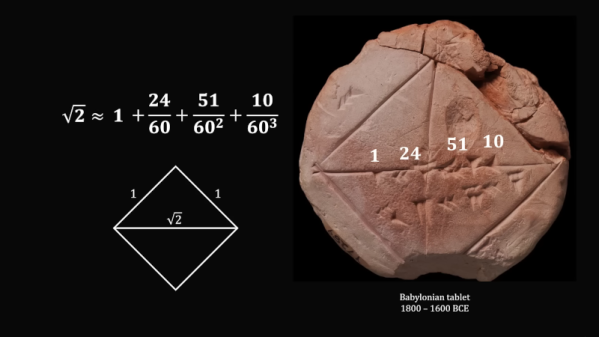
[MindYourDecisions] presents a Babylonian tablet dating back to around 1800 BC that shows that the hypotenuse of a unit square is the square root of two or 1.41421. How did they know that? We don’t know for sure how they computed it, but experts think it is the same as the ancient Greek method written down by Hero. It is a specialized form of the Newton method. You can follow along and learn how it works in the video below.

The method is simple. You guess the answer first, then you compute the difference and use that to adjust your estimate. You keep repeating the process until the error becomes small enough for your purposes.

Continue reading “Square Roots 1800s Style — No, The Other 1800s”
The Lancaster ASCII Keyboard Recreated

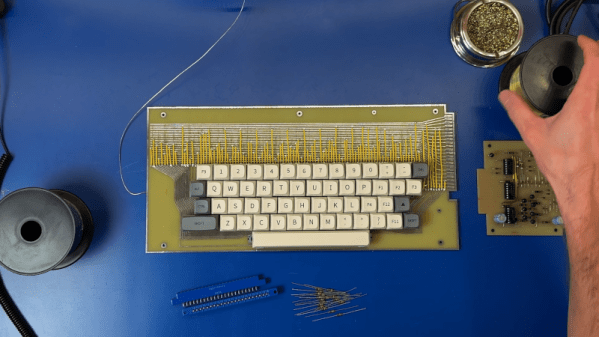
It is hard to imagine that there was a time when having a keyboard and screen readily available was a real problem for people who wanted to experiment with computers. In the 1970s, if you wanted a terminal, you might well have built a [Don Lancaster] “TV Typewriter” and the companion “low cost keyboard.” [Artem Kalinchuk] wanted to recreate this historic keyboard and, you know what? He did! Take a look at the video below.

The first task was to create a PCB from the old artwork from Radio Electronics magazine. [Artem] did the hard work but discovered that the original board expected a very specific kind of key. So, he created a variant that takes modern MX keyboard switches, which is nice. He does sell the PCBs, but you can also find the design files on GitHub.

Continue reading “The Lancaster ASCII Keyboard Recreated”

Programmable Zener Is Really An IC

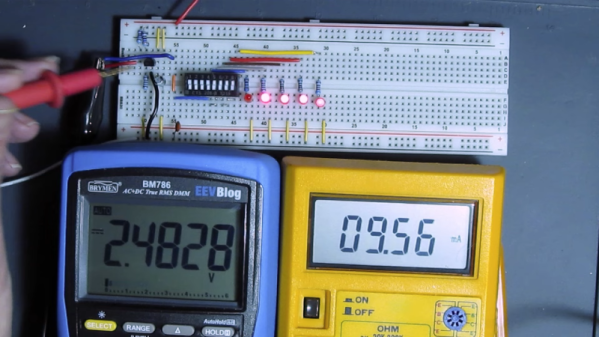
[Kevin] doesn’t stock zener diodes anymore. Why? Because for everything he used to use zeners, he now uses TL431 bandgap voltage references. These look like zener diodes but have an extra terminal. That extra terminal allows you to set the threshold to any value you want (within specifications, of course). Have a look at the video below for an introduction to these devices and a practical circuit on a breadboard.

Inside, there’s a voltage reference, an op-amp, and a transistor, so these are tiny 3-terminal ICs. The chip powers itself from the load, so there are no separate power supply pins.

Continue reading “Programmable Zener Is Really An IC”

RISC CPU Lives In Excel

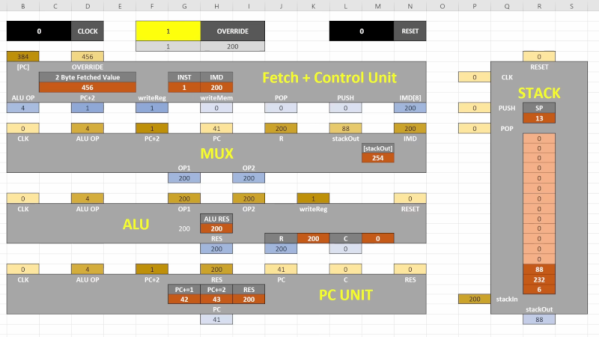
Last time we checked in on [Inkbox], he had made a 16-bit CPU in Excel. Impressive, but not really practical. Presumably, his latest project isn’t any more practical, but we suspect an 8-bit RISC CPU was easier to implement in Excel and probably runs faster, too. The new machine uses a stack architecture with a simplified instruction set of ten instructions. You can follow along with his Excel adventure in the video below.

If you think about it, you may decide that doing something like this in Excel is easy because you could just script it and use Excel as the user interface. That’s true, but that’s not how [Inkbox] does it. He won’t use scripts or IF statements in a cell. That makes things much harder.

Continue reading “RISC CPU Lives In Excel”

$40 Ham Antenna Works Six Bands

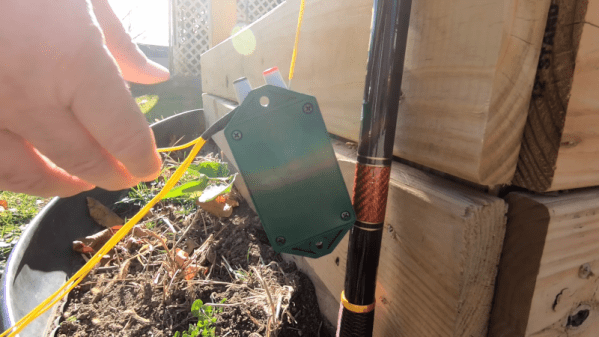
[My Ham Radio Journey] wanted to see if a “common person” (in his words) could build an effective vertical ham radio antenna. If you look at the video below, the answer is apparently yes.

He started with a 24-foot fishing rod and a roll of 22 gauge wire. The height of the antenna wire is just over 20 feet long and he has several ground radials, as you might expect for a vertical antenna.

Continue reading “$40 Ham Antenna Works Six Bands”

Forget Pixel Art: Try Subpixels

[Japhy Riddle] was tired of creating pixel art. He went to subpixel art. The idea is that since each color pixel is composed of three subpixels, your display is actually three times as dense as you think it is. As long as you don’t care about the colors, of course.

Is it practical? No, although it is related to the Bayer filter algorithm and font antialiasing. You can also use subpixel manipulation to hide messages in plain sight.

Continue reading “Forget Pixel Art: Try Subpixels”

Crowdsourcing Ionosphere Data With Phones

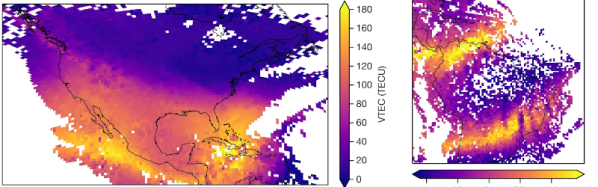
How do you collect a lot of data about the ionosphere? Well, you could use sounding rockets or specialized gear. Or maybe you can just conscript a huge number of cell phones. That was the approach taken by Google researchers in a recent paper in Nature.

The idea is that GPS and similar navigation satellites measure transit time of the satellite signal, but the ionosphere alters the propagation of those signals. In fact, this effect is one of the major sources of error in GPS navigation. Most receivers have an 8-parameter model of the ionosphere that reduces that error by about 50%.

However, by measuring the difference in time between signals of different frequencies, the phone can estimate the total electron current (TEC) of the ionosphere between the receiver and the satellite. This requires a dual-frequency receiver, of course.

Continue reading “Crowdsourcing Ionosphere Data With Phones”