Shapeshifter – An Open Source Drum Machine

With microcontrollers growing ever more powerful each new generation, things that were mere pipedreams before are now readily possible. The Shapeshifter drum machine is a perfect example.

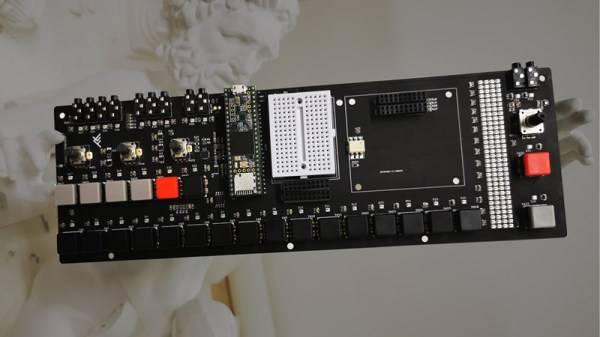
Shapeshifter’s design is open-source, with everything available on Github for the curious musical tinkerers out there. The device is built around a PCB with only through-hole components, making assembly easy for even the least experienced enthusiasts out there. A Teensy 3.6 is then slotted into the socket on the board, providing 180MHz of grunt to run the show. It’s an excellent choice, as the Teensy platform has a huge range of libraries which make it simple to work with audio.

Being open-source, not only is it a cinch to make your own, but there’s plenty of room to remix the design to your personal tastes. There’s even a breadboarding area and the capability to add an expansion card for even more possibilities. Some users have even gone so far as to add displays and filter mods to really open things up.

We love a good drum machine at Hackaday, from the Amstrad-based to pocket-sized wonders. If you’ve got a build of your own, be sure to drop it in the tips line.


Tearing Down IKEA’S Sonos Speaker

There’s little better way to learn about a piece of electronics than by tearing it down. Taking a peek under the hood can reveal all manner of things about a device’s design, manufacturing, and origins. [This Does Not Compute] does a great job of doing just that, digging into the guts of IKEA’s Symfonisk speaker.

Symfonisk is a WiFi-enabled speaker, working with the Sonos ecosystem. Tearing down the device reveals some similarities to IKEA’s earlier Eneby speaker, with both devices sharing similar speaker drivers, apparently sourced from GGEC. However, upon digging deeper, it’s revealed that the Symfonisk has more in common with a speaker from another manufacturer entirely.

The video does a great job of not only investigating the manufacturing origins of the device, but breaking down the way it all works. This shows how the speaker relies on an Atheros WiFi-only chipset, thus explaining the lack of Bluetooth functionality, as well as discussing things like the neat solutions for cable management. Interestingly, the speaker uses a two-channel DAC and Class-D amplifier, but only operates in mono. Instead, the two channels are instead used to separately drive the tweeter and woofer, allowing EQ to be done in software on the main CPU, negating the need for analog crossover electronics.

It’s a teardown that would serve as a great primer for anyone considering building a piece of consumer electronics, but particularly those involved in the hi-fi space. To see how it was done way back when, perhaps try this 8-track teardown instead. Video after the break.

Continue reading “Tearing Down IKEA’S Sonos Speaker” →

Portrait Painter Turns G-Code Into Artworks

Portrait painting is, by and large, a human endeavour. But, like any and all skills, there are machines ready and willing to take a crack at it. [Jose Salatino] has built just such a machine, and the results are impressive.

Samples of the artwork created by [Jose’s] portrait painter.
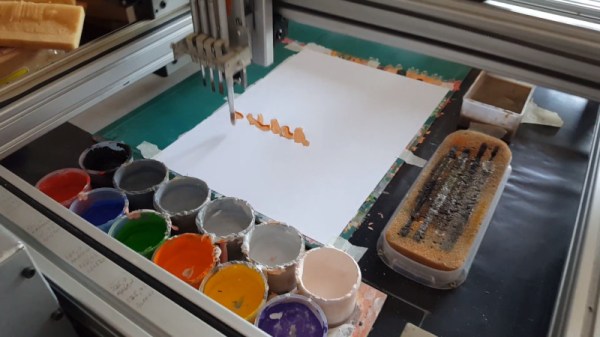
[Jose’s] portrait painter relies on a Cartesian CNC setup, with an X-Y gantry fitted with a retractable brush carrier. The carrier holds four brushes, allowing the device to paint with different sized strokes as per the artistic requirements. An algorithm is used to turn images into a series of brushstrokes, which are then turned into G-code to drive the system. Colors are mixed just like a human painter would, with the brush dipping into a series of paint pots. Using the hue-saturation-brightness (HSB) color system makes this easy.

While it’s much slower than your average printer, the goal here isn’t to create photorealistic images, but to create something with artistic appeal. The artworks painted by the ‘bot have a remarkable likeness to oil paintings by human artists, thanks to using similar techniques. We’re sure [Jose’s] experience as an oil painter helped out here, too.

We’ve seen other ‘bots produce custom artworks before, too. Video after the break.

Continue reading “Portrait Painter Turns G-Code Into Artworks” →

Minature Table Saw Gets The Teeny Jobs Done

Table saws are highly useful tools, but tend to take up a lot of space. They’re usually designed to handle the bigger jobs in a workshop. It doesn’t have to be that way, however, as [KJDOT] demonstrates with a miniature table saw.

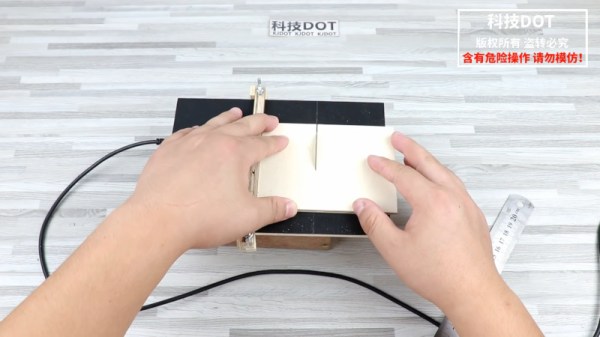
It’s a saw that relies on a simple build. The frame is made of plywood, and can be built with just a drill and a hand saw. A brushed motor is used to run the saw, using an off-the-shelf PWM controller and a 24V power supply. A handful of bearings and standard brackets are then used to put it all together, and there’s even a handy adjustable fence to boot. With a 60mm blade fitted, the saw is ready to go.

It’s a build that would be great for anyone regularly working with wood or plastics on the smaller scale. If you like building dollhouses, this could be the tool for you. You might also find the table nibbler to be an enticing proposition. Video after the break.

Continue reading “Minature Table Saw Gets The Teeny Jobs Done” →

What Will We Do With The Turbine Blades?

As the global climate emergency continues to loom over human civilization, feverish work is underway around the world to find technical and political solutions to the problem. Much has been gained in recent years, but as global emissions continue to increase, there remains much left to do to stave off the most catastrophic effects of climate change.

Renewable energy has led the charge, allowing humanity to continue to enjoy the wonders of electricity with a reduced environmental impact. The future looks promising, with renewable sources becoming cheaper than traditional fossil fuel energy plants in many cases, both in the US and abroad. At the same time, the rise of renewable technologies has brought new and varied challenges to the fore, which must be dealt with in kind. Take wind energy, for instance. Continue reading “What Will We Do With The Turbine Blades?” →

Pickaxe Controller Is Great For Minecraft, Just Aim Carefully

Minecraft started out as a lovable indie game, and became an unstoppable billion-dollar juggernaut in a remarkably quick fashion. Over time, it’s become a favorite among modders and those that seek to explore what’s possible with the game. [Eric] decided that the game could be more immersive, and built this awesome pickaxe controller.

The controller is built around an off-the-shelf Minecraft pickaxe toy; a popular piece of merchandise given the tool’s importance in the game. [Eric] added an Arduino, an accelerometer, and buttons. This lets the controller act as a mouse, allowing the user to control the camera by moving the pickaxe. The buttons unlock further functionality, with the red button allowing the user to mine by swinging the axe. Reportedly this is a lot of fun, albeit tiring in long sessions. Other features are still controlled by the keyboard, such as movement and accessing inventory screens. We’d love to try it out; carving out a tunnel block by block would be quite satisfying after all the exertion!

[Eric] is actually giving the controller away to a lucky subscriber, so head over to the Youtube video if you’d like a shot to own the nifty pickaxe. We’ve seen other advanced Minecraft controllers before, too. Video after the break.

Continue reading “Pickaxe Controller Is Great For Minecraft, Just Aim Carefully” →

3D Printed Tools For Quick Press Brake Jobs

Press brakes are a workshop staple when working with sheet metal. They’re ideal for executing accurate and repeatable bends over and over again. Typically, they’re fitted with steel tooling that can hold up to thousands of press cycles. However, such tooling is expensive, and time consuming to produce. [Anthony] recently had a job come through the shop that required a unique internal radius. Rather than rush out and buy tooling, he decided to 3D print his own instead!

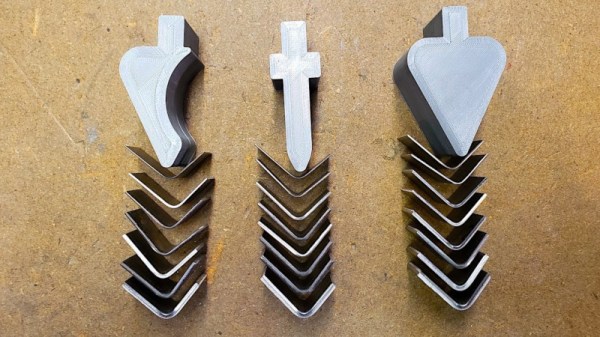
The press brake tools were printed on a standard Prusa i3, using regular PLA filament. There’s nothing particularly special in the process, with the prints using 12 perimeters and 20% infill. Despite being made of plastic, the tools held up surprisingly well. In testing, the parts were able to bend up to 3.4 mm steel, undergoing several cycles without major visible wear. [Anthony] also experimented with gooseneck parts, which, while less robust, make it easy to accommodate more complex sheet metal parts.

3D printing is a great way to produce custom press tooling, and can be done far more cheaply and quickly than producing traditional steel tooling. While it’s unlikely to be useful for long production runs, for short runs that need custom geometry, it’s a handy technique. We’ve even seen 3D printed punch-and-die sets, too. Video after the break.

Continue reading “3D Printed Tools For Quick Press Brake Jobs” →