This Week In Security: Another Record Patch Tuesday, LAME Is More Secure, Secure Boot Is Less Secure, And Milk Malware

Following the reports last week using the Windows Global Device ID (GDID) in tracking a malware operators behavior, here is a comprehensive write-up about what goes into the GDID and how it is used. It’s worth noting that the GDID itself was not used to catch the malware operator, however once a suspect was identified, the GDID was used to correlate behavior across various Microsoft products on the Internet.

The GDID is generated and assigned during a Windows install, but a re-install of Windows will generate a new GDID. Developer [SmtimesIWndr] tracks the generation and tracking of the GDID through the various Windows libraries and services, identifying where it appears to be created and how it is passed to other services like Azure.

Worth noting is your GDID is a unique, personally identifiable piece of information; if you go exploring and extract it from your Windows install, be sure to keep it private!

LAME mp3 updates

Those of us who were around for the dawn of MP3 files may remember the LAME encoder and library. After almost 10 years, there is a new LAME release.

Notably, this includes two security fixes, one for a stack buffer overflow based on malicious input to the Blade encoder, and an integer underflow in the AIFF header parser. Both of the fixed bugs feel very old-school, which seems appropriate given the age of the library and most of the related code.

Buffer overflows impacting the stack are some of the simplest and most direct forms of vulnerabilities, where it is possible to write past the end of a buffer and control how the function returns and instead execute arbitrary code. Integer under-flows, similarly, impact memory management; usually caused by allowing a variable that stores the size of a buffer to go negative. Since sizes are typically unsigned positive numbers, a negative is interpreted as an enormous positive number, writing past the proper buffer length.

Despite the new findings, the LAME codebase has been extremely resilient over the years, and considering the number of programs that likely still use LAME under the covers to process audio, seeing the project wake up with security fixes is great news.

Recovering Passwords from BIOS

Researchers have found a vulnerability in Dell BIOS code that allows extraction of the administrator password from the BIOS flash chips, either with physical access via a flash programmer, or via administrator or root level access to the operating system and reading the contents of the flash chip.

Dell used a 20 byte key to encrypt a 32 byte password field: for any admin password of 12 characters or fewer, the password is stored in completely plaintext. For longer passwords, characters beyond the first 12 are encrypted – but the random bytes are computed from the first character of the password mixed with fixed device data, yielding only 256 possible encryption seeds for the remaining bytes.

Using the BIOS admin password for evil requires local access, so the attack surface is small, however as the researchers note it controls the boot order and may allow an attacker with physical access to then boot an unsigned OS or bypass full-disk encryption, so it’s serious.

Continue reading “This Week In Security: Another Record Patch Tuesday, LAME Is More Secure, Secure Boot Is Less Secure, And Milk Malware”

This Week In Security: ID Breaches, Code Smell, And Poetic Flows

Discord had a data breach back on September 20th, via an outsourced support contractor. It seems it was a Zendesk instance that was accessed for 58 hours through a compromised contractor user account. There have been numbers thrown around from groups claiming to be behind the breach, like 1.6 Terabytes of data downloaded, 5.5 million user affected, and 2.1 million photos of IDs.

Discord has pushed back on those numbers, stating that it’s about 70,000 IDs that were leaked, with no comments on the other claims. To their credit, Discord has steadfastly refused to pay any ransom. There’s an interesting question here: why were Discord users’ government issued IDs on record with their accounts?

The answer is fairly simple: legal compliance. Governments around the world are beginning to require age verification from users. This often takes the form of a scan of valid ID, or even taking a picture of the user while holding the ID. There are many arguments about whether this is a good or bad development for the web, but it looks like ID age verification is going to be around for a while, and it’ll make data breaches more serious.

In similar news, Salesforce has announced that they won’t be paying any ransoms to the group behind the compromise of 39 different Salesforce customers. This campaign was performed by calling companies that use the Salesforce platform, and convincing the target to install a malicious app inside their Saleforce instance. Continue reading “This Week In Security: ID Breaches, Code Smell, And Poetic Flows”

Regular Expressions Finally Come To Microsoft Excel

There are two types of people in the world: those who have no idea what a regular expression is, and those who not only know what they are but can compose them on the fly and tend to use them in situations where they’re clearly not called for. And it’s that latter camp, of which we consider ourself a proud member, that is rejoicing with the announcement that Microsoft is adding regular expression support to Excel.

Or perhaps not rejoicing so much as wondering what took so long. Yes, regular expressions have been part of VBA for a while now, but the new functions allow you to use regexes right in the spreadsheet grid. There are plenty of caveats, of course. The big one is that this is still in beta at this time, so you have to do some gymnastics to enable it, if you’re even allowed to in the first place. Second, support appears limited to three functions at the moment: REGEXTEST, which provides a logical test of pattern matching; REGEXEXTRACT, which returns a substring that matches a pattern; and REGEXREPLACE, which substitutes a string for a pattern. The video below walks through how to use these functions within spreadsheets.

What’s also unclear now is what flavor of regular expressions is supported. There are a bewildering number of entities in the regex bestiary — character classes, positional indicators, quantifiers, subexpressions, lazy and greedy matches, and a range of grouping constructs that perplex even regex pros. One hopes these new functions will support one of the existing regex standards, but Microsoft is famous for “extending and enhancing.” Then again, regex support has been in the .NET Framework for years and is pretty close to the Perl standard, so our guess is that it’ll be close to that.

If you fall into the “What’s a regex?” camp but want to change that, why not get your grep on?

Continue reading “Regular Expressions Finally Come To Microsoft Excel”

Reverse-Engineering The Web-@nywhere Watch For 2001-Era Smartwatch Action

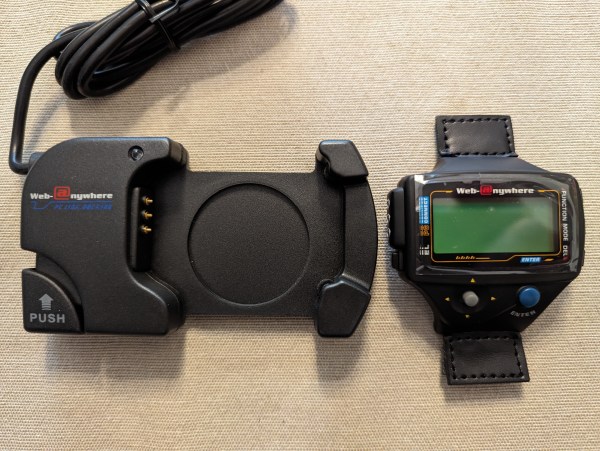
Although smartwatches seem to be just a recent fad, people have been strapping wristwatches to their wrists with all kinds of functionality. Whether a miniscule calculator, a remote control, an organizer or as in the case of the Web-@nywhere Watch a web browser. In the last case only sort of, naturally, as it was released in 2001 and this little early 2000s marvel cost only $85 (or $150 in 2024 USD), so what could it really be capable of? This is the million dollar question that [Cameron Kaiser] sought to find out as he found a new-in-box unit for sale.
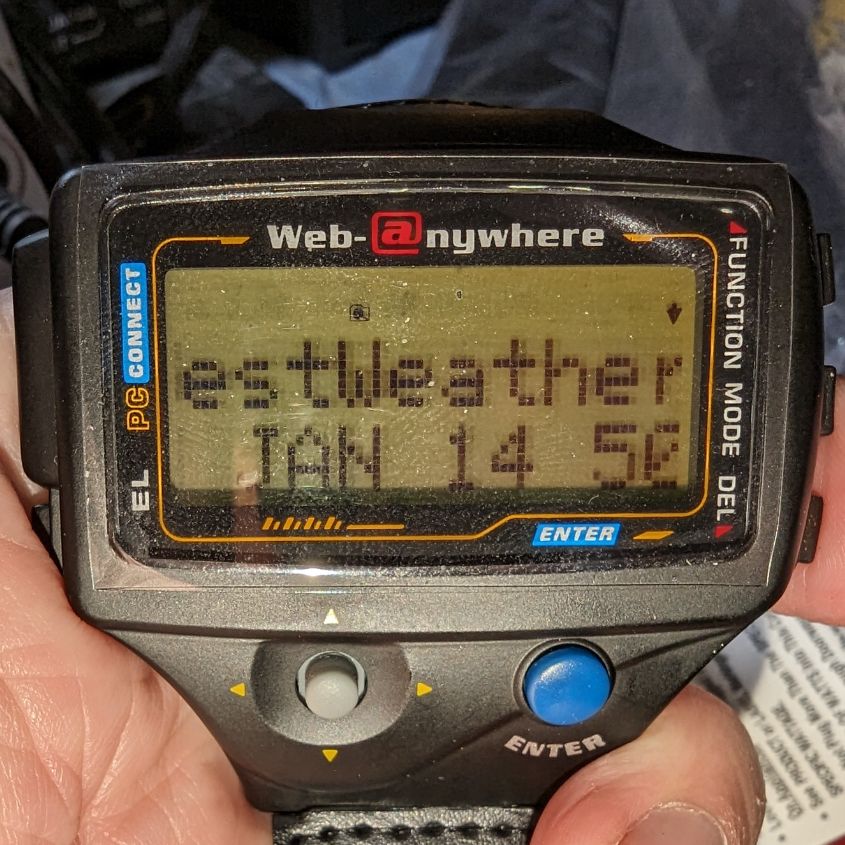
The Web-@nywhere watch in action. (Credit: Cameron Kaiser)

Beforehand he knew already that the unit required interaction with a PC-based application to sync the 93 kB of on-watch data, with the required software and remote servers now being very much outdated and/or gone. This required some reverse-engineering to once more bring this watch widget back to life. Along the way it became also quite clear that this watch was designed as a cheap rip-off of the much better 1998 Seiko Ruputer – which later got sold also as the onHand PC – using the same joystick-driven interface.

After some poking around with the Windows-based software that came with the watch [Cameron] quickly realized that while it could establish a serial link with the watch in its cradle, it fully relied on a now defunct FTP server formerly run by the manufacturer, Kinger, along with any games and content on it. Since FTP servers were never archived like HTTP sites, this content is likely gone forever.

Fortunately, the protocol between the PC and the watch is a standard serial link (with parity), so [Cameron] was able to sniff the serial traffic and figure out the protocol, the results of which he has made available on GitHub in the form of a Perl script for transforming text and a C-based application to do the uploading. Now once again Web-@nywhere users can proudly roam the streets with 2024-era website content on their wrists.


FLOSS Weekly Episode 765: That Ship Sailed… And Sank

This week Jonathan Bennett and Aaron Newcomb talk with Randal Schwartz, the longest running host of FLOSS Weekly, Perl’s biggest cheerleader, and now Dart and Flutter expert. What’s new with Randal since his last FLOSS Weekly episode in May 2020? Why should you look at Dart and Flutter? And how do you avoid becoming a security martyr?

Randal has been busy since handing over the reigns of FLOSS Weekly, adding to his Perl credentials a solid claim to being a Dart Flutter expert. The Dart language has some real appeal, taking the best features from JIT languages like JavaScript, and also offering binary compilation like a real systems language should. Then the Flutter framework lets you write your code once, and literally run it on any screen. Sure, there have been some growing pains along the way, and listen to the episode to hear Randal describe the “45-degree turns” the language/framework duo has taken through the years.

Then as almost a bonus at the end of the episode, Randal quickly covered his now-expunged conviction for “doing his job with too much enthusiasm”, and covered some basic pointers to keep other security researchers out of trouble. This week is a nostalgia trip for long-time listeners, as well as a real treat for everyone else.

Continue reading “FLOSS Weekly Episode 765: That Ship Sailed… And Sank”

This Week In Security: Triangulation, ProxyCommand, And Barracuda

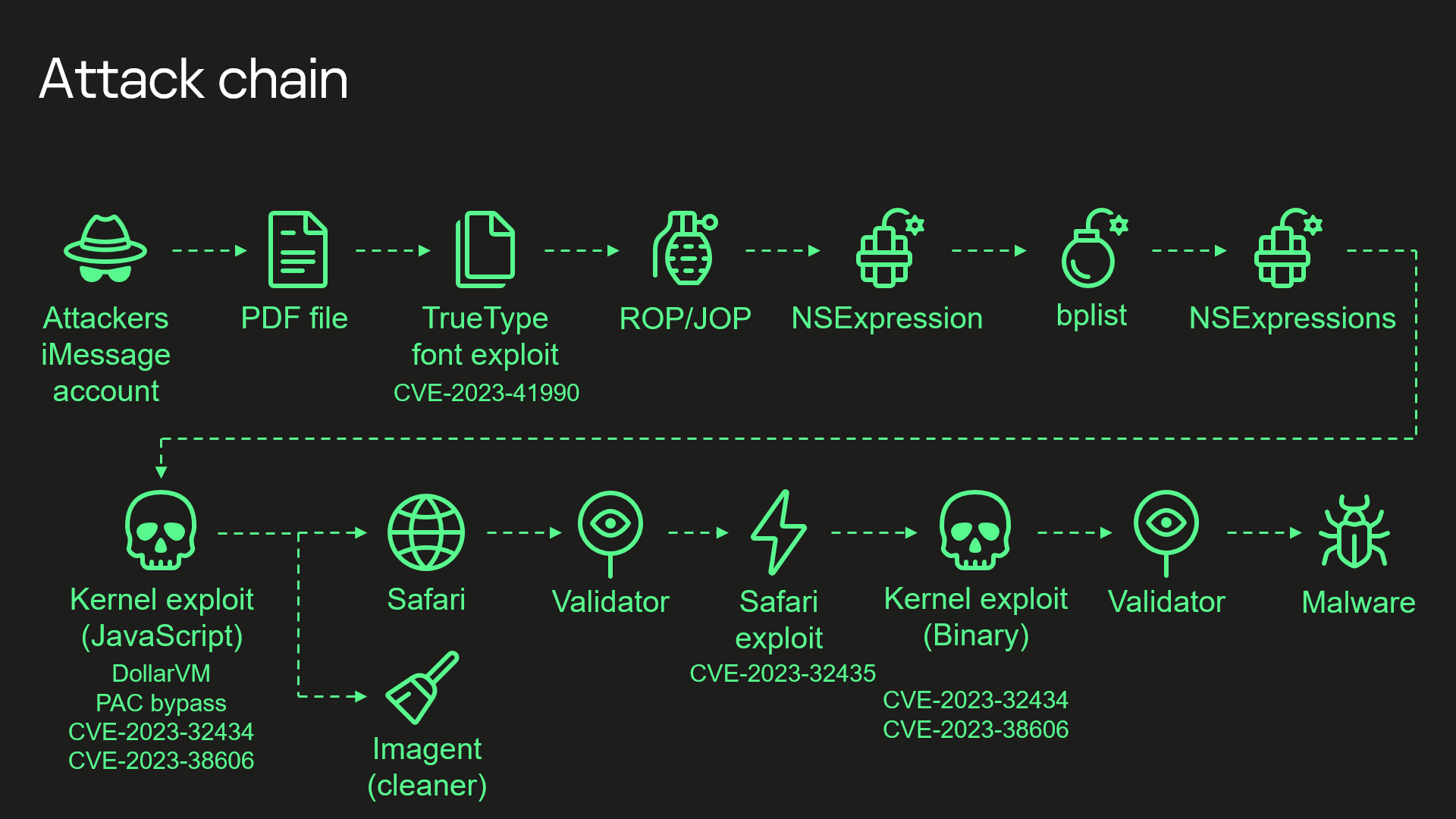
It’s not every day we get to take a good look inside a high-level exploit chain developed by an unnamed APT from the western world. But thanks to some particularly dedicated researchers at Kaspersky, which just happens to be headquartered in Moscow, that’s exactly what we have today. The name Operation Triangulation was picked, based off part of the device fingerprinting code that rendered a yellow triangle on an HTML canvas.

The entire talk is available, given this week at the 37th Chaos Communication Congress, 37c3. The exploit starts with an iMessage attachment, delivered silently, that exploits an undocumented TrueType font instruction. Looking at the source code implies that it was a copy-paste error where a programmer didn’t quite get the logic right for a pointer calculation. That vulnerability gives a memory write primitive that pivots into code execution. What’s particularly interesting is that Apple silently fixed this bug January 2023, and didn’t make any public statements. Presumably there were an uptick of crash logs that pointed to this problem, but didn’t conclusively show attempted exploitation.

The exploits then moves to using NSExpression as a next stage. NSExpression is an ugly way to write code, but it does allow the exploit chain to get to the next stage, running JavaScript as an application, without Just In Time compilation. The JS payload is quite a beast, weighing in at 11,000 lines of obfuscated code. It manages to call native APIs directly from JS, which then sets up a kernel exploit. This is multiple integer overflow flaws that result in essentially arbitrary system memory reads and writes. Continue reading “This Week In Security: Triangulation, ProxyCommand, And Barracuda”

This Week In Security: Barracuda, Zyxel, And The Backdoor

Barracuda’s Email Security Gateway (ESG) has had a vulnerability in it for years. Tracked as CVE-2023-2868, this one was introduced back in version 5.1.3.001, and only got patched during the 9.2 development cycle. Specific build information on patched firmware has not been made available, but a firmware build containing the patch was deployed on May 20.

The flaw was a command injection bug triggered by .tar files attached to incoming emails. The appliance scans attachments automatically, and the file names could trigger the qx operator in a Perl script. It’s a nasty one, ranking a 9.4 on the CVSS scale. But the really bad news is that Barracuda found the vulnerability in the wild, and they have found evidence of exploitation as far back as October 2022.

There have been three malware modules identified on the compromised appliances. SALTWATER is a backdoor trojan, with the ability to transfer files, execute commands, and host network tunnels. SEASPY is a stealthier module, that looks like a legitimate service, and uses PCAP to monitor traffic and receive commands. And SEASIDE is a Lua module for the Barracuda SMTP monitor, and it exists to host a reverse shell on command. Indicators of Compromise (IOCs) have been published, and Barracuda recommends the unplug-and-remove approach to cleaning up an infection. The saving grace is that this campaign seems to have been targeted, and wasn’t launched against every ESG on the Internet, so maybe you’re OK.

Moxa, Too

And speaking of security software that has problems, the Moxa MXsecurity appliance has a pair of problems that could be leveraged together to lead to a complete device takeover. The most serious problem is a hard coded credential, that allows authentication bypass for the web-API. Then the second issue is a command-line escape, where an attacker with access to the device’s Command Line Interface (CLI) can break out and run arbitrary commands. Continue reading “This Week In Security: Barracuda, Zyxel, And The Backdoor”